Open Source Alternatives
  • Alternatives
  • Categories
    Categories by size882 projects
    • Developer Tools461
    • AI & Machine Learning404
    • Web Development196
    • Business & Productivity191
    • Communication & Collaboration126
    • Security & Monitoring126
    • IT Management123
    • Product & Project Management106
    • Cloud & Hosting105
    • Data & Analytics104
    Browse all 21 categoriesLLMOps & AI Tooling, Design & Creative and 9 more
  • Blog
  • Advertise
SearchNotion, Slack, password manager.../
Submit
Open Source Alternatives
  • Alternatives
    • Developer Tools461
    • AI & Machine Learning404
    • Web Development196
    • Business & Productivity191
    • Communication & Collaboration126
    • Security & Monitoring126
    • Browse all 21 categories
  • Blog
  • Advertise
Submit your project

New open source projects by email

The projects we add and every new guide. Free, unsubscribe any time.

Open Source Alternatives LogoOpen Source Alternatives

Handpicked Open Source Alternatives to Paid Softwares

Product

  • Categories
  • Tag
  • Advertise

Resources

  • Blog
  • Collection
  • Submit

Company

  • Privacy Policy
  • Terms of Service
  • Refund Policy
  • Sitemap

Alternatives

  • Claude Code
  • Jira
  • Notion
  • Slack
  • Linear
  • Wispr Flow
  • All alternatives
© 2026 Open Source Alternatives. All rights reserved.
Open SourceAlternatives
Home/Categories/Security & Monitoring/pentagi
icon of pentagi

pentagi

Open source alternative to NodeZero by Horizon3.ai

  • 31.3K stars
  • MIT
  • Active this week
  • Last commit 5 days ago

Last verified Oct 19, 2026

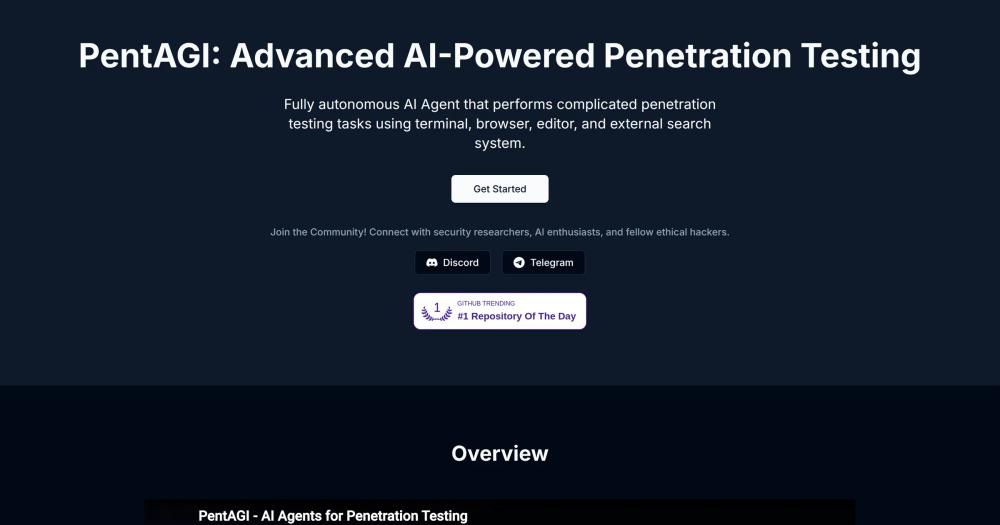
Automate penetration testing with a multi-agent AI system that handles reconnaissance, planning, and exploitation using 20-plus built-in tools in Docker.

Visit websiteGitHub31.3K stars
image of pentagi
TL;DR

pentagi is an autonomous multi-agent system for penetration testing that coordinates research, planning, and execution through specialized AI agents. It replaces manual toolchain assembly and partially-automated commercial scanners, using 20-plus built-in security tools including nmap, metasploit, and sqlmap, all run inside isolated Docker containers. MIT licensed and self-hosted via Docker Compose, it connects to OpenAI, Anthropic, Ollama, and a dozen other LLM providers. Best for security engineers and red teams who want autonomous coverage of reconnaissance and exploitation phases.

Read the full breakdownHide the full breakdownWho it is for, how it works, trade-offs, the quick start and the FAQ
who it's for

Who pentagi is for#

Security engineers running recurring internal assessments

PentAGI handles the reconnaissance and initial exploitation phases of an internal pentest autonomously, logging every command and result to PostgreSQL. Engineers review AI-generated findings and redirect effort to the results that require human judgment, compressing the time from kick-off to first report.

Skip if:

Teams needing certified penetration test reports for compliance. AI-generated findings from PentAGI are a starting point for investigation, not a substitute for a documented, auditable test by a certified tester.

Red teams evaluating AI-augmented offensive tooling

The multi-agent architecture and multi-provider LLM support make PentAGI a testbed for evaluating where autonomous AI agents add value in offensive workflows. Researchers can swap LLM backends, observe agent decision chains through Langfuse, and extend the tool via its REST and GraphQL APIs.

Skip if:

Teams that need deterministic, auditable attack sequences. The AI agent's path through a test is nondeterministic; two runs against the same target may take different routes.

Researchers studying AI behavior in security tasks

PentAGI's Langfuse integration logs every LLM interaction with token counts, prompt content, and agent decisions. This telemetry is useful for researchers comparing how different LLMs approach security tasks or building datasets of AI-driven penetration test traces.

Skip if:

Researchers who need reproducible, scripted tool invocations for benchmarking. The autonomous decision layer introduces variability that scripted evaluations typically need to control.

DevSecOps teams integrating pentesting into CI/CD

The REST and GraphQL APIs allow automated engagement triggers from CI/CD pipelines or security orchestration tools. Teams can start a scoped assessment against a staging environment on each deployment, with results stored in PostgreSQL for trend analysis over time.

Skip if:

Teams whose staging environments are not isolated from production. Running autonomous penetration testing tools against shared infrastructure without network isolation risks unintended lateral movement.

the problem

The problem it solves#

Penetration testing requires coordinating dozens of tools, timing attack sequences correctly, and interpreting results that change depending on target behavior. A skilled tester might spend most of an engagement on reconnaissance and environment mapping, tasks that are repetitive and well-suited to automation but have historically required a human to orchestrate.

Commercial security testing tools address parts of this: Metasploit Pro automates exploitation modules, Burp Suite Professional handles web application scanning. But they still require an operator to direct each phase, choose each tool, and interpret each result. Autonomous coverage, where the system decides what to run next based on what it found, remains the gap these tools leave open.

how pentagi solves it

How it solves it#

Multi-Agent Coordination System

Delegates penetration test phases to specialized agents: a researcher agent gathers intelligence, a developer agent plans the attack sequence, and an executor agent runs the commands. The orchestrator coordinates all three, querying a vector store for similar past engagements before each phase begins.

20-Plus Built-In Security Tools

Includes nmap, metasploit, and sqlmap pre-installed in sandboxed Docker containers, with automatic image selection based on task requirements. The tools run in complete isolation from the host system, so test operations cannot affect the infrastructure running PentAGI itself.

Multi-Provider LLM Support

Connects to OpenAI, Anthropic, Google Gemini, AWS Bedrock, Ollama, DeepSeek, GLM, Kimi, Qwen, MiniMax, and custom OpenAI-compatible endpoints. Ollama support means teams running privacy-sensitive assessments can keep all inference local with no data leaving their infrastructure.

PostgreSQL Vector Store with Long-Term Memory

Stores every command and output in PostgreSQL with the pgvector extension, enabling semantic search over past engagement results. The memory system retrieves similar historical findings during current engagements, so agents build on prior work rather than starting from scratch each time.

REST and GraphQL APIs

Exposes a full REST API and a GraphQL API for programmatic control and integration with existing security pipelines. Bearer token authentication governs API access, allowing teams to trigger assessments from CI/CD pipelines or external orchestration tools.

Full Observability Stack

Optionally integrates Grafana dashboards, VictoriaMetrics time-series storage, Jaeger distributed tracing, and Loki log aggregation via OpenTelemetry. Langfuse LLM analytics tracks AI model behavior and token usage across engagements.

strengths · trade-offs

Strengths and trade-offs#

Strengths

  • MIT License with Full Self-HostingPentAGI is MIT licensed, so you can run it on your own infrastructure without licensing fees and modify it for commercial use without restriction. Unlike Metasploit Pro or Burp Suite Professional, which charge per-seat or per-engagement fees, the only cost for a self-hosted PentAGI instance is the underlying server.
  • 10-Plus LLM Provider FlexibilitySupports more LLM backends than most comparable tools: OpenAI, Anthropic, Google Gemini, AWS Bedrock, Ollama, DeepSeek, and several others. The ability to swap providers means teams are not locked into one AI vendor and can switch to a local model if API costs grow or data must stay on-premises.
  • Strong Community TractionThe repository accumulated over 23,000 stars and 3,000 forks since its creation in January 2025, with active development and 59 open issues as of September 2026. This pace indicates a healthy contributor base and an active roadmap.
  • Sandboxed Execution Protects the HostAll security tool execution happens inside isolated Docker containers, preventing test operations from affecting the host machine or the network running PentAGI. This matters in lab environments where the testing infrastructure and target systems share a physical network.

Trade-offs

  • -Not a Breach-and-Attack Simulation ToolPentAGI is an autonomous penetration testing assistant, not a CALDERA-style adversary emulation product. It does not run predefined attack campaigns or simulate specific threat actors. Teams evaluating BAS platforms for continuous control validation will need a different tool.
  • -Resource Requirements for the Full StackRunning the complete monitoring stack (Grafana, VictoriaMetrics, Jaeger, Loki, Langfuse, Neo4j) alongside the core services requires a host with meaningful RAM and storage. A minimal Docker Compose deployment is lighter, but the full observability configuration is not a single-container install.
  • -JSON Report Export Not Yet SupportedFlow reports can be viewed in the web UI, copied to clipboard, downloaded as Markdown, or exported as PDF. JSON export is not a documented output format in the current release, which limits automated ingestion of report data into external security management platforms.
versus alternatives

pentagi vs alternatives#

PentAGI vs Metasploit Pro

Both PentAGI and Metasploit Pro build on the open-source Metasploit framework, but serve different operating models. Metasploit Pro is a managed interface for experienced operators who want to run Metasploit modules efficiently; PentAGI is an autonomous agent system that decides what to run based on what it discovers.

FeaturePentAGIMetasploit Pro
LicenseMITProprietary
Self-hostingYesYes (licensed)
Autonomous operationYesNo
LLM integrationYes (10+ providers)No
PricingFree (self-hosted)Commercial subscription

PentAGI is the better choice when the goal is reducing the human time needed per engagement, especially for teams running repeated internal assessments. Metasploit Pro is the better choice when you need the full depth of the Metasploit exploit library with a GUI-driven workflow and commercial support from Rapid7.

PentAGI vs Burp Suite Professional

Burp Suite Professional is the standard tool for web application penetration testing; it intercepts HTTP traffic, scans for vulnerabilities, and provides a suite of web-focused attack tools. PentAGI targets a broader scope, covering network reconnaissance, infrastructure testing, and multi-tool coordination across targets.

FeaturePentAGIBurp Suite Professional
LicenseMITProprietary
Self-hostingYesYes (licensed)
Web app focusGeneral via built-in toolsSpecialized
Autonomous operationYesNo
PricingFree (self-hosted)Paid license per user

Burp Suite Professional remains the better choice for deep web application assessments where HTTP-level inspection and browser integration are the primary requirement. PentAGI is the better choice for broader infrastructure assessments where multiple tools need to be coordinated across a target environment, and where reducing manual operator time is the primary constraint.

install · quick start

Quick start#

bash
Self-hosting uses Docker Compose with a PostgreSQL vector store and optional monitoring services.
```bash
git clone https://github.com/vxcontrol/pentagi
cd pentagi
docker compose up -d
```
tech stack · detected from GitHub

What it's built on#

Languages
GoTypeScript
Frameworks
React
Tooling
GraphQL
frequently asked

FAQ#

What LLM providers does PentAGI support?

PentAGI supports OpenAI, Anthropic, Google Gemini, AWS Bedrock, Ollama, DeepSeek, GLM, Kimi, Qwen, MiniMax, and any custom OpenAI-compatible endpoint. Ollama lets you run local models with no external API calls. The provider is configured via environment variables in the Docker Compose setup.

Is PentAGI legal to use for penetration testing?

PentAGI is a tool for authorized security testing on systems you own or have explicit written permission to test. Like nmap or metasploit, using it against systems without authorization is illegal in most jurisdictions. The project is designed for ethical hackers, security researchers, and IT professionals conducting authorized assessments.

How does PentAGI differ from running Metasploit or Nmap manually?

PentAGI wraps those tools in an autonomous multi-agent system that decides what to run next based on what it found. Rather than a human operator selecting modules and interpreting output, the AI agents handle reconnaissance, planning, and execution, storing results for future reference. The result is closer to directing a junior analyst than running a CLI tool directly.

Does PentAGI require a GPU or specific hardware?

No GPU is required when using cloud-hosted LLM providers such as OpenAI or Anthropic. For local Ollama deployments, GPU availability improves inference speed but is not mandatory. The core stack runs on a standard Linux server with Docker and Docker Compose installed.

Can PentAGI generate penetration test reports?

Yes. Flow reports are available through the web UI, with options to copy to clipboard, download as Markdown, or export as PDF. JSON export is not yet supported. Reports include a log of every action taken, tool output, and findings generated by the AI agents.

also worth a look

Similar open-source tools#

Claude-Red

Alternative toNodeZero by Horizon3.ai

78 offensive security skills for Claude, drop-in and MIT licensed

  • 7,609 GitHub stars
  • MITLicence MIT

Bifrost

Alternative toPortkey

Open-source AI gateway with 23+ providers, failover, and MCP support.

  • 8,975 GitHub stars
  • Apache-2.0Licence Apache-2.0

jentic-one

Alternative toComposio

Self-hosted API broker that routes agent calls without exposing keys

  • 186 GitHub stars
  • Apache-2.0Licence Apache-2.0

GitLab

Alternative toGitHub

Self-hosted Git server with CI/CD, security scans, and planning

  • 24,535 GitHub stars
  • MITLicence MIT

REA (Reverse Engineer Anything)

Featured

Alternative toRevEng.AI

AI-powered reverse engineering for binaries, apps, and assemblies.

  • 345,900 GitHub stars
  • MITLicence MIT

Radar

Alternative toLens

Open-source Kubernetes UI with topology, GitOps, and AI agent MCP.

  • 3,866 GitHub stars
  • Apache-2.0Licence Apache-2.0
by category

Open source tools in these categories#

126

Security & Monitoring

REA (Reverse Engineer Anything), RustDesk, Uptime Kuma
404

AI & Machine Learning

freeCodeCamp, OpenClaw, REA (Reverse Engineer Anything)
86

DevOps & CI/CD

Nvm, Uptime Kuma, Netdata

Featured

Omnara

Alternative toCClaude Managed Agents

Open-source agent deployment API. Self-host or use Omnara Cloud.

  • 2,957 GitHub stars
  • Apache-2.0Licence Apache-2.0
  • #AI Agents

Inbox Zero

Alternative toSuperhuman

AI email assistant that drafts replies and clears your inbox

  • 12,712 GitHub stars
  • AGPL-3.0Licence AGPL-3.0
  • #Email

rakazo

Alternative toGrok Bot

AI teammates you own: your keys, your model, your machine.

  • 4,904 GitHub stars
  • Apache-2.0Licence Apache-2.0
  • #AI Agents
Feature your project

New open source projects by email

The projects we add and every new guide. Free, unsubscribe any time.

Find open source alternatives to paid software

/
  • Claude Code to OpenCode
  • Jira to Windshift
  • Notion to AppFlowy
  • Slack to Mattermost
  • Linear to GitLab
  • Wispr Flow to Handy
  • CapCut to Concat
  • Grok Bot to rakazo
  • Superhuman to Inbox Zero
  • Airtable to AITable
  • Muse to OpenClaw
  • GitHub Copilot to Cline
  • Datadog to Netdata
  • Microsoft Teams to Rocket.Chat
  • Pinecone to Qdrant
  • Zapier to n8n
  • Devin AI to OpenHands
  • Firebase to Supabase
  • 1Password to KeePassXC
  • Confluence to Docmost
  • Contentful to Strapi
  • Adobe Premiere Pro to Shotcut
  • ChatGPT to AnythingLLM
  • LangSmith to Langfuse