Open Source Alternatives
  • Alternatives
  • Categories
    Categories by size882 projects
    • Developer Tools461
    • AI & Machine Learning404
    • Web Development196
    • Business & Productivity191
    • Communication & Collaboration126
    • Security & Monitoring126
    • IT Management123
    • Product & Project Management106
    • Cloud & Hosting105
    • Data & Analytics104
    Browse all 21 categoriesLLMOps & AI Tooling, Design & Creative and 9 more
  • Blog
  • Advertise
SearchNotion, Slack, password manager.../
Submit
Open Source Alternatives
  • Alternatives
    • Developer Tools461
    • AI & Machine Learning404
    • Web Development196
    • Business & Productivity191
    • Communication & Collaboration126
    • Security & Monitoring126
    • Browse all 21 categories
  • Blog
  • Advertise
Submit your project

New open source projects by email

The projects we add and every new guide. Free, unsubscribe any time.

Open Source Alternatives LogoOpen Source Alternatives

Handpicked Open Source Alternatives to Paid Softwares

Product

  • Categories
  • Tag
  • Advertise

Resources

  • Blog
  • Collection
  • Submit

Company

  • Privacy Policy
  • Terms of Service
  • Refund Policy
  • Sitemap

Alternatives

  • Claude Code
  • Jira
  • Notion
  • Slack
  • Linear
  • Wispr Flow
  • All alternatives
© 2026 Open Source Alternatives. All rights reserved.
Open SourceAlternatives
Home/Categories/AI & Machine Learning/Bifrost
icon of Bifrost

Bifrost

Open source alternative to Portkey

  • 9K stars
  • Apache-2.0
  • Active this week
  • Last commit 1 day ago

Last verified Oct 21, 2026

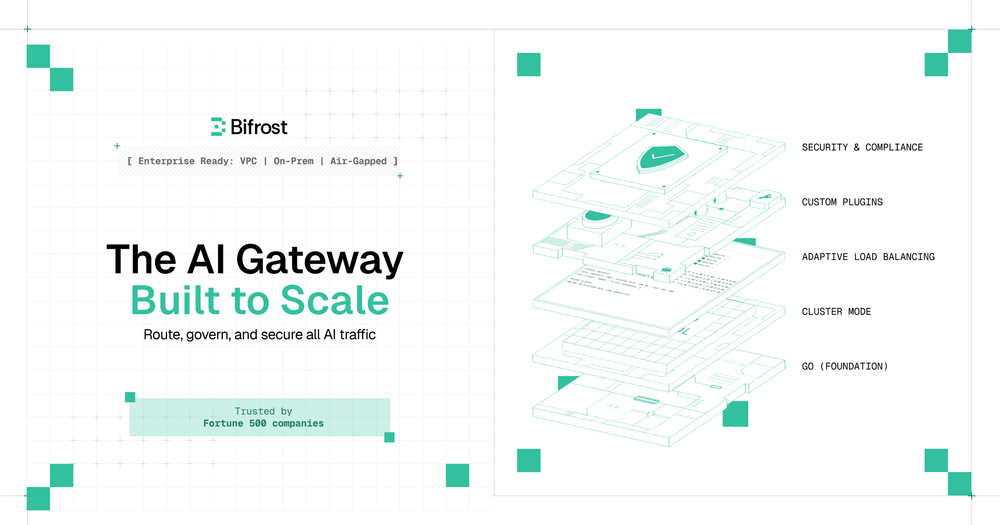
Connect any AI SDK to 23+ LLM providers through a unified gateway, with automatic failover, semantic caching, MCP support, and 11µs overhead at 5,000 RPS.

Visit websiteGitHub9K starsDeploy on Hostinger
image of Bifrost
TL;DR

Bifrost is an open-source AI gateway written in Go that routes requests across 23+ LLM providers through one OpenAI-compatible API. It replaces paid AI gateway services like Portkey with a self-hosted deployment that adds 11µs of overhead per request at 5,000 RPS, with built-in failover, semantic caching, and MCP gateway support. Licensed Apache-2.0, it starts with one Docker command or npx. Best for AI engineering teams that need multi-provider reliability and governance without routing traffic through a third-party service.

Read the full breakdownHide the full breakdownWho it is for, how it works, trade-offs, the quick start and the FAQ
who it's for

Who Bifrost is for#

Platform teams managing LLM access across product teams

Bifrost gives platform teams a single control plane for all LLM traffic, with virtual keys per team, per-team budgets, and a unified dashboard. Instead of each team managing their own API keys and billing, costs are tracked and governed centrally.

Skip if:

If your organization uses a single team's LLM account with no cross-team billing or governance requirements, the control-plane layer is overhead. A direct SDK call is simpler.

AI engineers building high-availability agent pipelines

Automatic failover means an agent workflow does not fail when a single provider goes down or hits a rate limit. Load balancing across multiple API keys raises the effective throughput ceiling without rewriting the agent's LLM calls.

Skip if:

If you're running a single-provider proof of concept or a low-volume project where downtime is acceptable, the gateway is unnecessary infrastructure.

Teams evaluating or migrating away from LiteLLM

Bifrost is a drop-in OpenAI-compatible alternative to LiteLLM's proxy mode. The benchmark data (54x lower P99 latency, 68% less memory at 500 RPS) is directly relevant to teams running LiteLLM at volume and hitting performance or memory issues.

Skip if:

If your existing LiteLLM deployment is stable and you have no performance complaints, migration adds risk with limited benefit.

Developers building production apps that use MCP tools

The built-in MCP gateway centralizes tool connections for AI agents. Instead of each agent maintaining its own MCP client configuration, tools are registered once in Bifrost and available to all models passing through the gateway.

Skip if:

If you're building a single-agent app with a few tools and no multi-agent coordination, configuring Bifrost adds infrastructure with little payoff compared to a direct MCP client.

the problem

The problem it solves#

Building production AI systems on a single LLM provider is fragile. Provider outages, rate limits, and sudden pricing changes leave teams with no fallback, and adding provider redundancy manually means writing bespoke routing logic per provider API. That code becomes a maintenance burden as providers update their SDKs.

Governance adds a second layer of work. When multiple teams or agents share API keys, costs accumulate invisibly until the bill arrives. Setting per-team budgets and audit logs requires custom instrumentation that most teams build slowly and inconsistently, if at all. Adding Model Context Protocol tool access across a fleet of agents adds a third coordination problem with no standard answer in the provider SDKs.

how Bifrost solves it

How it solves it#

Multi-Provider Routing

Routes requests across 23+ providers (OpenAI, Anthropic, AWS Bedrock, Google Vertex, Azure, and more) through a single OpenAI-compatible endpoint. Switching models or providers requires changing only the model string in the request body, not any SDK configuration.

Automatic Failover and Load Balancing

Automatically reroutes to a backup provider when one goes down, with intelligent load distribution across multiple API keys for the same provider. In benchmarks, the gateway sustained 5,000 RPS with a 100% success rate on a t3.xlarge instance.

Semantic Caching

Caches LLM responses based on semantic similarity rather than exact string matches. Functionally equivalent questions return the cached answer, cutting redundant provider calls and reducing costs across a team's shared AI requests without changes to application code.

MCP Gateway

Acts as a centralized Model Context Protocol gateway, giving AI models access to external tools (filesystems, web search, databases) with centralized policy enforcement. All MCP tool connections route through one managed layer rather than being configured per agent.

Virtual Keys and Budget Management

Issues separate virtual API keys per team, project, or use case, each with independent spending limits and access controls. Usage costs are tracked at key granularity, making it possible to attribute costs to specific teams or stop a runaway model before it hits the monthly limit.

Built-in Observability

Includes native OpenTelemetry support and a built-in dashboard for monitoring request volumes, latency, and error rates without additional setup. Prometheus metrics are available for teams already running a monitoring stack.

strengths · trade-offs

Strengths and trade-offs#

Strengths

  • Go-native performance with verified benchmarksThe Go implementation adds 11µs of overhead per request at 5,000 RPS on a t3.xlarge, with a 100% success rate. Benchmarks against LiteLLM at 500 RPS show 54x lower P99 latency and 68% lower memory usage, making Bifrost viable for latency-sensitive workloads.
  • Drop-in replacement requiring one URL changeReplacing an existing OpenAI, Anthropic, or Google GenAI SDK requires changing one line, the base_url value. No SDK rewrites, no new client libraries. Works with LangChain, LangGraph, Vercel AI SDK, LiteLLM, and most major AI frameworks.
  • Apache-2.0 license with in-VPC deploymentThe Apache-2.0 license permits commercial use, modification, and redistribution with no restrictions. The in-VPC deployment model means no API traffic routes through Bifrost or Maxim servers, which meets data residency requirements for financial, healthcare, and government workloads.
  • Active project with a clear enterprise pathCreated in March 2025, the repo reached 8,800+ stars in its first year. An enterprise tier adds clustering, adaptive load balancing, and guardrails for teams that outgrow the open-source feature set, with the Apache-2.0 core remaining free.

Trade-offs

  • -High open issue count for a young projectThe GitHub tracker shows 1,225 open issues for a project launched in March 2025. While this partly reflects rapid adoption, teams evaluating Bifrost for production use should review the open issue list for blockers in their specific provider combination or deployment target before committing.
  • -Enterprise features require a Maxim commercial licenseThe OSS tier covers multi-provider routing, load balancing, failover, semantic caching, virtual keys, basic budget management, and OpenTelemetry observability. Clustering, adaptive load balancing, guardrails, and advanced MCP gateway features require a commercial license from Maxim.
  • -Shorter production track record than established gatewaysBifrost launched in March 2025. While performance benchmarks are strong and the project is actively maintained, its production track record is shorter than established alternatives. Teams running mission-critical workloads should evaluate stability through a pilot deployment first.
versus alternatives

Bifrost vs alternatives#

Bifrost vs Portkey

Both Bifrost and Portkey sit between your application and LLM providers, handling routing, key management, and observability. The core decision is whether to run that layer yourself or pay Portkey to operate it.

FeatureBifrostPortkey
LicenseApache-2.0Proprietary
Self-hostingYesLimited (enterprise only)
PricingFree (OSS core)Usage-based
Providers23+ (OSS)250+ (managed)
Data residencyFull in-VPC controlRoutes through Portkey
MCP gatewayYesAvailable
Performance overhead11µs at 5,000 RPSNot published

Bifrost is the stronger choice when data residency is a requirement. A full in-VPC deployment routes no traffic through external servers, which matters for healthcare, financial, and government workloads operating under data sovereignty rules. Apache-2.0 licensing also eliminates per-request costs: you pay only for the infrastructure you already run.

Portkey is the better choice when you want zero infrastructure to manage. Its managed service connects to 250+ providers out of the box, includes a polished UI for prompt management and distributed tracing, and requires no operational capacity for a Go service. If your team has no bandwidth for self-hosted infrastructure or needs Portkey's integrations without configuration work, the managed tier is the faster path.

Performance at scale favors Bifrost. Published benchmarks show 11µs of overhead per request at 5,000 RPS with no failed requests; Portkey does not publish equivalent latency numbers for its managed service. For latency-sensitive production workloads, the self-hosted Bifrost deployment gives deterministic performance a third-party managed service cannot guarantee.

install · quick start

Quick start#

bash
Deploy Bifrost as a local server using Docker or NPX.
```bash
npx -y @maximhq/bifrost

docker run -p 8080:8080 maximhq/bifrost

docker run -p 8080:8080 -v $(pwd)/data:/app/data maximhq/bifrost
```
tech stack · detected from GitHub

What it's built on#

Languages
GoJavaScriptPythonTypeScript
Frameworks
React
frequently asked

FAQ#

Is Bifrost free to use?

Yes. The open-source version is Apache-2.0 licensed and free to self-host. Enterprise features (clustering, adaptive load balancing, guardrails, and advanced MCP gateway options) require a commercial license from Maxim; contact them for pricing.

Can Bifrost replace LiteLLM?

Bifrost covers the same core use case as LiteLLM's proxy: a self-hosted gateway that provides a unified OpenAI-compatible API across multiple LLM providers. Benchmark comparisons at 500 RPS show 54x lower P99 latency and 68% less memory usage. Migration requires changing one base_url line in your existing SDK.

Does my data leave my infrastructure when using Bifrost?

Not in a self-hosted deployment. Bifrost can be deployed entirely within your own VPC; no request data passes through Maxim or Bifrost servers. The built-in telemetry and observability data stay within your own monitoring stack.

How many LLM providers does Bifrost support?

The open-source version supports 23+ providers, including OpenAI, Anthropic, AWS Bedrock, Google Vertex, Azure, Cerebras, Cohere, Mistral, Ollama, and Groq. The repo description references support for 10,000+ models across these providers.

What is the difference between Bifrost OSS and Bifrost Enterprise?

The open-source tier includes multi-provider routing, load balancing, failover, semantic caching, virtual keys, budget management, and OpenTelemetry observability. Enterprise adds clustering for multi-node deployments, adaptive load balancing, guardrails for content policy enforcement, and advanced MCP gateway features.

also worth a look

Similar open-source tools#

Litellm

Alternative toPortkey

Self-hosted AI gateway for 100+ LLMs in OpenAI format

  • 61,759 GitHub stars
  • CustomLicence MIT with enterprise directory carve-out

OmniRoute

Alternative toOpenRouter

352-provider AI gateway with automatic fallback and token compression

  • 78,353 GitHub stars
  • MITLicence MIT

freellmapi

Alternative toOpenRouter

One OpenAI-compatible key for 635 free LLM endpoints

  • 38,191 GitHub stars
  • MITLicence MIT

sub2api

Alternative toOpenRouter

One API gateway for Claude, OpenAI, Gemini, and Grok subscriptions

  • 44,454 GitHub stars
  • LGPL-3.0Licence LGPL-3.0

jentic-one

Alternative toComposio

Self-hosted API broker that routes agent calls without exposing keys

  • 186 GitHub stars
  • Apache-2.0Licence Apache-2.0

rtk

Alternative toTokenade

CLI proxy that removes 89% of agent context noise on average

  • 84,082 GitHub stars
  • Apache-2.0Licence Apache-2.0
by category

Open source tools in these categories#

404

AI & Machine Learning

freeCodeCamp, OpenClaw, REA (Reverse Engineer Anything)
101

LLMOps & AI Tooling

Hermes Agent, OpenCode, MarkItDown
461

Developer Tools

REA (Reverse Engineer Anything), superpowers, Skills for Real Engineers
78

APIs & Integration

n8n, Firecrawl, iptv
86

DevOps & CI/CD

Nvm, Uptime Kuma, Netdata
126

Security & Monitoring

RustDesk, REA (Reverse Engineer Anything), Uptime Kuma
Hostinger

Run Bifrost on your own server

Self-host Bifrost on a Hostinger VPS.

Deploy on Hostinger

Featured

rakazo

Alternative toGrok Bot

AI teammates you own: your keys, your model, your machine.

  • 4,904 GitHub stars
  • Apache-2.0Licence Apache-2.0
  • #AI Agents

Inbox Zero

Alternative toSuperhuman

AI email assistant that drafts replies and clears your inbox

  • 12,712 GitHub stars
  • AGPL-3.0Licence AGPL-3.0
  • #Email

Omnara

Alternative toCClaude Managed Agents

Open-source agent deployment API. Self-host or use Omnara Cloud.

  • 2,957 GitHub stars
  • Apache-2.0Licence Apache-2.0
  • #AI Agents
Feature your project

New open source projects by email

The projects we add and every new guide. Free, unsubscribe any time.

Find open source alternatives to paid software

/
  • Claude Code to OpenCode
  • Jira to Windshift
  • Notion to AppFlowy
  • Slack to Mattermost
  • Linear to GitLab
  • Wispr Flow to Handy
  • CapCut to Concat
  • Grok Bot to rakazo
  • Superhuman to Inbox Zero
  • Airtable to AITable
  • Muse to OpenClaw
  • GitHub Copilot to Cline
  • Datadog to Netdata
  • Microsoft Teams to Rocket.Chat
  • Pinecone to Qdrant
  • Zapier to n8n
  • Devin AI to OpenHands
  • Firebase to Supabase
  • 1Password to KeePassXC
  • Confluence to Docmost
  • Contentful to Strapi
  • Adobe Premiere Pro to Shotcut
  • ChatGPT to AnythingLLM
  • LangSmith to Langfuse