Open Source Alternatives
  • Alternatives
  • Categories
    Categories by size881 projects
    • Developer Tools460
    • AI & Machine Learning404
    • Web Development196
    • Business & Productivity191
    • Communication & Collaboration126
    • Security & Monitoring126
    • IT Management123
    • Product & Project Management106
    • Cloud & Hosting104
    • Data & Analytics104
    Browse all 21 categoriesLLMOps & AI Tooling, Design & Creative and 9 more
  • Blog
  • Advertise
SearchNotion, Slack, password manager.../
Submit
Open Source Alternatives
  • Alternatives
    • Developer Tools460
    • AI & Machine Learning404
    • Web Development196
    • Business & Productivity191
    • Communication & Collaboration126
    • Security & Monitoring126
    • Browse all 21 categories
  • Blog
  • Advertise
Submit your project

New open source projects by email

The projects we add and every new guide. Free, unsubscribe any time.

Open Source Alternatives LogoOpen Source Alternatives

Handpicked Open Source Alternatives to Paid Softwares

Product

  • Categories
  • Tag
  • Advertise

Resources

  • Blog
  • Collection
  • Submit

Company

  • Privacy Policy
  • Terms of Service
  • Refund Policy
  • Sitemap

Alternatives

  • Claude Code
  • Jira
  • Notion
  • Slack
  • Linear
  • Wispr Flow
  • All alternatives
© 2026 Open Source Alternatives. All rights reserved.
Open SourceAlternatives
Home/Categories/Backend Development/Supabase
icon of Supabase

Supabase

Open source alternative to Firebase, AWS Amplify and Backendless

  • 112.2K stars
  • Apache-2.0
  • Active this week
  • Last commit 1 day ago

Last verified Oct 20, 2026

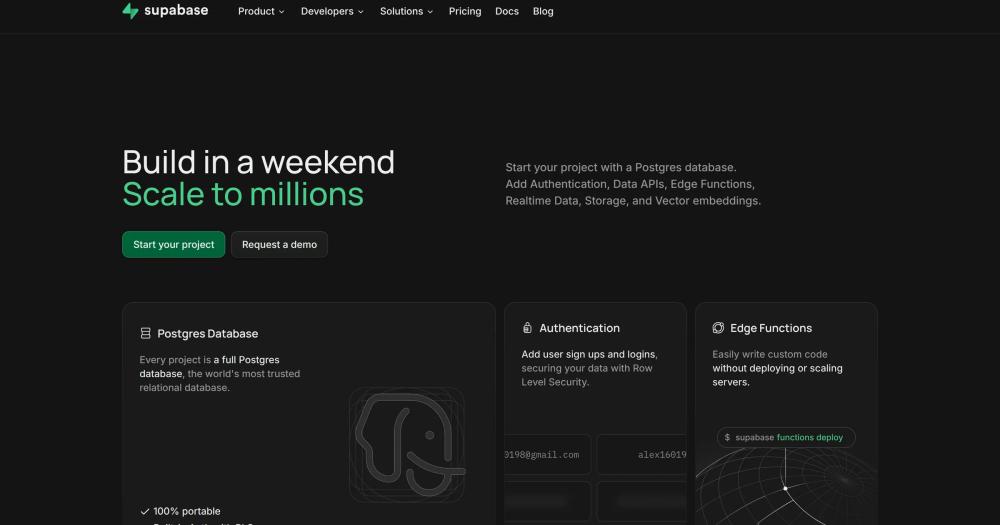
Build PostgreSQL-backed auth, storage, real-time APIs, and edge functions on an open source Firebase alternative you can self-host with Docker Compose.

Visit websiteGitHub112.2K starsDeploy on Hostinger
image of Supabase
TL;DR

Supabase is an open source, self-hosted Firebase alternative that combines PostgreSQL, auth, storage, Realtime, and edge functions so teams keep API and auth control on infrastructure they manage.

Read the full breakdownHide the full breakdownWho it is for, how it works, trade-offs, the quick start and the FAQ
who it's for

Who Supabase is for#

Startup CTOs replacing Firebase for relational control

Use Supabase when your application requires transactional data models, relational reporting, and flexible auth policies while still needing a Firebase-like developer speed.

Skip if:

Skip if your team is committed to a fully managed backend and cannot support custom infrastructure operations.

B2B teams with compliance constraints

Use Supabase for projects that require tighter control over data location, access policy reviews, and audit-friendly operations on your own infra.

Skip if:

Skip if you need zero infrastructure ownership and cannot sustain security hardening cycles.

Founders adding realtime collaboration features

Use Supabase for dashboards with live updates, notification streams, and collaborative features that need DB change event propagation.

Skip if:

Skip if your product has low write/read concurrency and no realtime requirements.

AI product teams building permissioned APIs

Use Supabase when RLS-driven API access and server-side edge logic help reduce custom middleware layers while keeping one backend surface for app APIs.

Skip if:

Skip if your architecture depends on managed ecosystem-only integrations with minimal backend customization.

the problem

The problem it solves#

Teams moving from managed backend platforms often lose control of data modeling, pricing, and access rules as apps grow. A NoSQL-first service model can make relational data and complex joins harder to express, while long-running operational costs rise with usage. Teams also run into migration friction when they later need regional control, custom extensions, or on-premise deployment for compliance.

Supabase targets this gap by providing a Postgres-first backend stack with built-in auth, APIs, Realtime, storage, and function runtime you can run under your own operational model. This makes it useful for teams that need both fast product iteration and a path away from opaque managed constraints.

how Supabase solves it

How it solves it#

PostgreSQL-first data layer

Supabase uses PostgreSQL as its core database layer, including SQL joins, transactions, and mature indexing behavior, so teams can model relational data without adding a separate persistence layer.

Auth and policy control in SQL

Auth, user sessions, and role-based checks can be wired with Row Level Security on Postgres, letting teams express data access rules centrally.

Integrated API surface

REST and related access patterns are generated from database structures, and Realtime subscriptions stream change events without building a separate websockets stack.

Edge Functions and serverless-style handlers

The backend includes an Edge Runtime for custom logic, integrations, and API-side tasks within the same deployment surface.

Self-hosted Docker deployment

The official stack uses Docker Compose with documented setup steps, making local and private-cloud deployments the default path instead of a fixed managed-only model.

strengths · trade-offs

Strengths and trade-offs#

Strengths

  • Relational backend from day oneTeams that need transactional consistency and SQL joins get a backend that aligns with mature relational patterns, which is stronger for complex business data than document-only defaults.
  • Infrastructure portabilityTeams can run it on their own servers or private cloud and reduce platform dependency while keeping a modern backend developer workflow in place.
  • No forced lock-in to one dashboard serviceOpen source repos and deployable stack components give teams the ability to adapt stack choices over time and avoid being forced into a single closed vendor ecosystem.

Trade-offs

  • -Self-hosting requires operations disciplineYou are responsible for secrets, updates, backups, monitoring, and incident response. That gives flexibility but adds runbook burden compared with managed services.
  • -Higher complexity than single-service setupsMore components mean broader failure modes, especially during upgrades, network misconfiguration, or storage/auth variable tuning.
  • -Production hardening is requiredDefault docs note the baseline setup is not production-secure out of the box, so teams need secure proxies, secret rotation, and TLS planning before launch.
  • -Some migration assumptions differ across managed and self-hostedMoving projects between hosted and self-hosted flows can require manual reconfiguration for OAuth and related environment-level settings.
versus alternatives

Supabase vs alternatives#

Supabase vs Firebase

Supabase and Firebase both target application backends with auth, storage, and API delivery, but they differ in deployment and data model philosophy. Supabase is PostgreSQL-first and self-hostable, while Firebase is a managed SaaS platform with a proprietary backend model and integrated cloud services. If your team values direct SQL, portable data strategy, and the ability to run services under your own ops model, Supabase is often the better long-run fit.

Supabase wins on control, especially when you need RLS-driven access patterns and predictable infrastructure control. Firebase can still be the better choice when you need the quickest managed setup and do not want any server maintenance now.

Supabase vs AWS Amplify

AWS Amplify and Supabase both speed backend delivery, but Amplify is tightly coupled to AWS service primitives and IAM ecosystems. Supabase offers a Postgres-led stack with an open deployment model that can fit teams requiring portability across cloud providers or private infrastructure. If your team is already standardized on AWS and prefers deep managed integration over open deployment flexibility, Amplify can still be the pragmatic choice.

install · quick start

Quick start#

bash
git clone --depth 1 https://github.com/supabase/supabase
mkdir supabase-project
cp -rf supabase/docker/* supabase-project
cp supabase/docker/.env.example supabase-project/.env
cd supabase-project
docker compose pull
sh utils/generate-keys.sh
sh utils/add-new-auth-keys.sh
docker compose up -d
tech stack · detected from GitHub

What it's built on#

Languages
JavaScriptTypeScript
Frameworks
Next.jsReact
Databases
pgvectorPostgreSQL
Runtimes
Deno
Infrastructure
AWSOAuth 2.0
Messaging
WebSocket
frequently asked

FAQ#

Is Supabase open source, and can I run it myself?

Yes. The official self-hosting path is Docker-based and documented. You can run the full stack through an official docker-compose setup with environment configuration under your control.

Do I need to write my own API layer first?

You still define your schema and security model, but Supabase provides generated API access built over PostgreSQL plus auth and storage services, so you can avoid building everything from scratch.

Can I use Supabase instead of Firebase?

In many app-builder workflows, Supabase covers similar backend responsibilities while shifting you toward relational database control and self-hosting. The architecture and operational model are different, so teams should compare migration effort up front.

How do I start a self-hosted install?

The docs canonical flow is clone, copy compose and environment files, generate keys, then run docker compose up -d in the compose directory.

Is it production-ready right away?

It can be made production-ready, but you must complete hardening tasks such as secure secrets, network controls, HTTPS, and monitoring before public exposure.

also worth a look

Similar open-source tools#

Modelence

Alternative toFirebase

Full-stack framework for building production-ready web apps

  • 432 GitHub stars
  • Apache-2.0Licence Apache-2.0

Appwrite

Alternative toFirebase

Self-hosted backend: auth, databases, storage, and functions

  • 57,737 GitHub stars
  • BSD-3-ClauseLicence BSD-3-Clause

Nhost

Alternative toFirebase

Firebase alternative: GraphQL, Postgres auth, and file storage

  • 9,364 GitHub stars
  • MITLicence MIT

Kuzzle

Alternative toFirebase

Self-hosted backend with real-time API and search built in

  • 1,668 GitHub stars
  • Apache-2.0Licence Apache-2.0

Encore

Alternative toAWS Amplify

Auto-generate infrastructure from your TypeScript or Go code

  • 12,480 GitHub stars
  • MPL-2.0Licence MPL-2.0

Manifest

Alternative toXano

One YAML file gives your app auth, CRUD, storage, and admin UI

  • 7,595 GitHub stars
  • MITLicence MIT
by category

Open source tools in these categories#

67

Backend Development

dify, graphify, Rust
61

Databases & Storage

Immich, Supabase, Redis
78

APIs & Integration

n8n, Firecrawl, iptv
Hostinger

Run Supabase on your own server

Self-host Supabase on a Hostinger VPS.

Deploy on Hostinger

Featured

Omnara

Alternative toCClaude Managed Agents

Open-source agent deployment API. Self-host or use Omnara Cloud.

  • 2,957 GitHub stars
  • Apache-2.0Licence Apache-2.0
  • #AI Agents

Inbox Zero

Alternative toSuperhuman

AI email assistant that drafts replies and clears your inbox

  • 12,712 GitHub stars
  • AGPL-3.0Licence AGPL-3.0
  • #Email

rakazo

Alternative toGrok Bot

AI teammates you own: your keys, your model, your machine.

  • 4,904 GitHub stars
  • Apache-2.0Licence Apache-2.0
  • #AI Agents
Feature your project

New open source projects by email

The projects we add and every new guide. Free, unsubscribe any time.

Find open source alternatives to paid software

/
  • Claude Code to OpenCode
  • Jira to Windshift
  • Notion to AppFlowy
  • Slack to Mattermost
  • Linear to GitLab
  • Wispr Flow to Handy
  • CapCut to Concat
  • Grok Bot to rakazo
  • Superhuman to Inbox Zero
  • Airtable to AITable
  • Muse to OpenClaw
  • GitHub Copilot to Cline
  • Datadog to Netdata
  • Microsoft Teams to Rocket.Chat
  • Pinecone to Qdrant
  • Zapier to n8n
  • Devin AI to OpenHands
  • Firebase to Supabase
  • 1Password to KeePassXC
  • Confluence to Docmost
  • Contentful to Strapi
  • Adobe Premiere Pro to Shotcut
  • ChatGPT to AnythingLLM
  • LangSmith to Langfuse