
Open Source Alternatives
  • Alternatives
  • Categories
    Categories by size881 projects
    • Developer Tools460
    • AI & Machine Learning404
    • Web Development196
    • Business & Productivity191
    • Communication & Collaboration126
    • Security & Monitoring126
    • IT Management123
    • Product & Project Management106
    • Cloud & Hosting104
    • Data & Analytics104
    Browse all 21 categoriesLLMOps & AI Tooling, Design & Creative and 9 more
  • Blog
  • Advertise
SearchNotion, Slack, password manager.../
Submit
Open Source Alternatives
  • Alternatives
    • Developer Tools460
    • AI & Machine Learning404
    • Web Development196
    • Business & Productivity191
    • Communication & Collaboration126
    • Security & Monitoring126
    • Browse all 21 categories
  • Blog
  • Advertise
Submit your project

New open source projects by email

The projects we add and every new guide. Free, unsubscribe any time.

Open Source Alternatives LogoOpen Source Alternatives

Handpicked Open Source Alternatives to Paid Softwares

Product

  • Categories
  • Tag
  • Advertise

Resources

  • Blog
  • Collection
  • Submit

Company

  • Privacy Policy
  • Terms of Service
  • Refund Policy
  • Sitemap

Alternatives

  • Claude Code
  • Jira
  • Notion
  • Slack
  • Linear
  • Wispr Flow
  • All alternatives
© 2026 Open Source Alternatives. All rights reserved.
Open SourceAlternatives
Home/Categories/AI & Machine Learning/OpenHands
OpenHands icon

OpenHands

Open source alternative to Devin AI, GitHub Copilot and Claude Code

  • 91.4K stars
  • MIT
  • Active this week
  • Last commit 1 day ago

Last verified Oct 20, 2026

Run AI agents that write code, execute commands, and complete development tasks autonomously. Self-hosted, MIT licensed, open source alternative to Devin.

Visit websiteGitHub91.4K stars1-click deploy on Hostinger
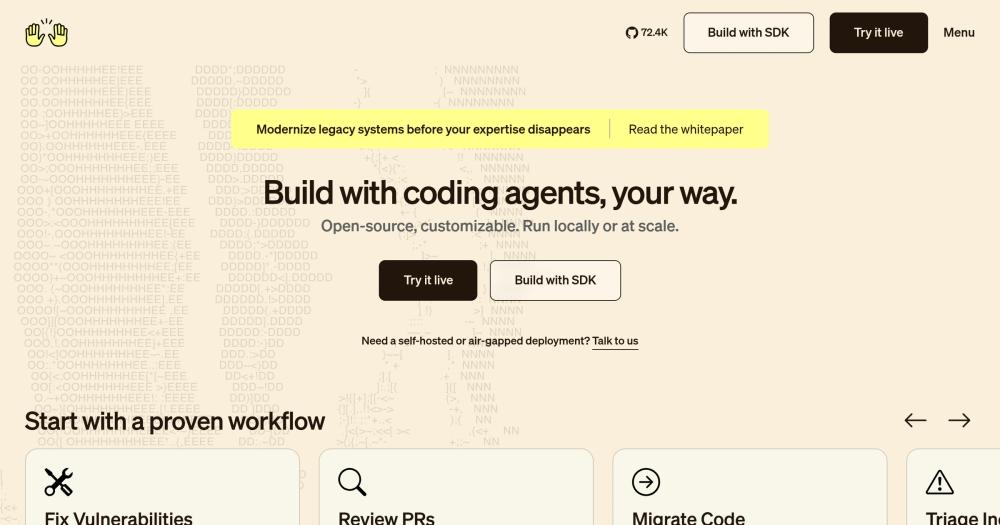
image of OpenHands
TL;DR

OpenHands is an open source Devin alternative for developers delegating repo-level coding tasks that need file edits, shell commands, tests, and reviewable diffs.

Read the full breakdownHide the full breakdownWho it is for, how it works, trade-offs, the quick start and the FAQ
who it's for

Who OpenHands is for#

Developers delegating bounded repo tasks

Use OpenHands for work such as adding tests, fixing small bugs, migrating one module, or reproducing a failing command. The agent can edit files and run commands while the developer reviews the final diff.

Skip if:

Skip if the task has unclear requirements, no testable outcome, or needs product judgment before implementation.

Engineering managers clearing maintenance backlog

Use OpenHands to process scoped issues that are important but repetitive, such as dependency fixes, vulnerability patches, and PR review chores. Reviewable outputs make it easier to keep humans in the approval loop.

Skip if:

Skip if your team does not have time to review agent output. Autonomous work still needs code review and verification.

AI platform engineers building custom coding agents

Use the Software Agent SDK when the default CLI or GUI is not enough. Teams can define specialized agents, tool sets, and workflows for internal developer automation.

Skip if:

Skip if you only need a consumer coding assistant. The SDK path adds engineering overhead that small teams may not need.

Enterprises evaluating self-hosted coding agents

Use OpenHands when source visibility, VPC deployment, and integration with existing engineering systems matter. The enterprise path supports Kubernetes deployment and team controls for larger organizations.

Skip if:

Skip if you need a fully managed SaaS experience with no infrastructure ownership. OpenHands Cloud is available, but self-hosting shifts operational work to your team.

the problem

The problem it solves#

AI coding assistants are useful for snippets, but real backlog work usually requires editing multiple files, running commands, reading failures, and trying again. Closed hosted coding agents can help with that workflow, but they leave teams with less visibility into the runtime, less control over model choice, and fewer options for running work near their own repositories.

Teams evaluating autonomous coding agents need a way to delegate bounded engineering work without turning every task into a black box. The hard part is not only generating code. The hard part is giving the agent a real workspace, letting it execute safely, and keeping the output reviewable by a human engineer.

how OpenHands solves it

How it solves it#

Local CLI and GUI workflows

Runs as a terminal CLI or a local web GUI, so developers can choose the workflow that matches the task. The docs support `uv tool install openhands --python 3.12`, `openhands`, and `openhands serve` for GUI mode.

Docker sandbox execution

Runs agent work inside a Docker sandbox for isolation and reproducibility. Teams can mount the current repository with `openhands serve --mount-cwd` or configure `SANDBOX_VOLUMES` when the agent needs write access to a workspace.

Composable software agent SDK

Provides a Python SDK for defining agents in code, running them locally, or scaling them through hosted infrastructure. This is useful when teams want custom coding agents rather than only the packaged CLI or GUI.

Model-agnostic LLM configuration

Supports Claude, GPT, and other LLM providers through settings in the CLI or GUI. Local model setups are also documented, with the caveat that agent-style tasks need capable hardware and instruction-following models.

Cloud and enterprise deployment paths

Offers OpenHands Cloud for hosted use and an enterprise option for self-hosting OpenHands Cloud in a customer VPC via Kubernetes. Cloud adds integrations such as Slack, Jira, and Linear, plus multi-user controls.

strengths · trade-offs

Strengths and trade-offs#

Strengths

  • MIT-licensed core codeThe main OpenHands code outside the `enterprise/` directory is MIT licensed, and the README states that the core `openhands` and `agent-server` Docker images are fully MIT licensed. That gives teams more auditability than a closed hosted agent.
  • More deployment choice than hosted-only agentsOpenHands can run through CLI, local GUI, OpenHands Cloud, or an enterprise VPC deployment. That range matters for teams comparing Devin-style agents but needing local runs, private infrastructure, or a path from trial use to production.
  • Built for executed engineering tasksOpenHands is positioned around fixing vulnerabilities, reviewing PRs, triaging incidents, and opening reviewable PRs, not only completing inline code suggestions. The sandbox model gives the agent a place to run commands and tests.
  • SDK path for custom agent workThe Software Agent SDK exposes the agentic core as a composable Python library. Teams building internal developer automation can define specialized agents instead of forcing every workflow through the default app.

Trade-offs

  • -Needs clear task boundariesOpenHands works best when the input looks like an engineering ticket with repo context, acceptance criteria, and a verification command. Vague product problems still need human scoping before an autonomous agent can produce reviewable work.
  • -Docker and LLM setup are real requirementsLocal GUI runs require Docker, and most model providers require an API key. Teams using local LLMs need hardware and models that can follow instructions and use tools reliably.
  • -Enterprise features use a different licenseThe core project is MIT licensed, but the `enterprise/` directory uses the PolyForm Free Trial License and requires a commercial license beyond the allowed trial use. Teams should separate core self-hosting from enterprise Cloud features when evaluating licensing.
  • -Workspace mounts need careThe Docker sandbox reduces risk, but mounted repositories can still be modified by the agent. Teams should use clean branches, review diffs, and avoid giving broad write access when testing unfamiliar tasks.
versus alternatives

OpenHands vs alternatives#

OpenHands vs Devin

OpenHands and Devin both target repository-level coding tasks rather than autocomplete. The main difference is control: OpenHands publishes its core code under MIT, supports local CLI and GUI runs, and gives teams several deployment paths. Devin-style hosted agents are a better fit when you want a managed service and do not want to operate a local sandbox or self-hosted environment.

FeatureOpenHandsDevin
LicenseMIT core, separate enterprise licenseProprietary hosted agent
Local executionCLI and local GUI supportedManaged service first
Self-hostingLocal Docker and enterprise VPC pathsEnterprise deployment depends on vendor plan
Model choiceClaude, GPT, local, and other providersVendor-controlled model stack

Choose OpenHands when source visibility, model choice, and local or self-hosted execution matter. Choose Devin when your team wants a polished managed agent and accepts less control over the runtime.

install · quick start

Quick start#

bash
# CLI, recommended uv install
uv tool install openhands --python 3.12
openhands

# Local GUI server
openhands serve

# Local GUI with current directory mounted
openhands serve --mount-cwd
tech stack · detected from GitHub

What it's built on#

Languages
JavaScriptTypeScript
Frameworks
React
frequently asked

FAQ#

Is OpenHands open source?

Yes. The main OpenHands code outside the enterprise/ directory is MIT licensed, and the README says the core openhands and agent-server Docker images are fully MIT licensed. Enterprise code uses a separate PolyForm Free Trial License.

Can OpenHands run locally?

Yes. OpenHands can run as a local CLI or a local web GUI. The official docs recommend installing with uv tool install openhands --python 3.12, then running openhands for CLI mode or openhands serve for the GUI.

Does OpenHands need Docker?

Docker is required for the local GUI and recommended sandbox workflow. The Docker sandbox gives the agent an isolated, reproducible environment, and openhands serve --mount-cwd mounts the current directory into that sandbox.

What paid tool does OpenHands replace?

OpenHands is closest to Devin or Jules when you want an autonomous agent that can work on repository-level tasks. It is a better fit than closed hosted agents when MIT-licensed core code, local execution, and model choice matter more than a fully managed experience.

Does OpenHands require an LLM API key?

Yes for most hosted model providers. The local setup docs require selecting an LLM provider, model, and API key after launch. Local LLM setups are supported, but the docs warn that agent tasks need capable hardware and instruction-following models.

Looking for more

Other ways to replace Devin AI, GitHub Copilot and Claude Code#

OpenCode

#1 in the Claude Code guide

Broad provider and model choice in a terminal-first client, MIT-licensed with AGENTS.md instructions

218,637 GitHub stars

oh-my-pi

#2 in the Claude Code guide

Direct Claude configuration inheritance with Anthropic subscription support

36,029 GitHub stars

kilocode

#3 in the Claude Code guide

Documented Claude transcript import with IDE and CLI surfaces

27,673 GitHub stars

Goose

#4 in the Claude Code guide

ACP subscription bridge that reuses an existing Claude Code or ChatGPT subscription

55,465 GitHub stars
All 22 Claude Code alternatives10 open source Claude Code alternatives, ranked
by category

Open source tools in these categories#

404

AI & Machine Learning

freeCodeCamp, OpenClaw, REA (Reverse Engineer Anything)
460

Developer Tools

REA (Reverse Engineer Anything), superpowers, Skills for Real Engineers
101

LLMOps & AI Tooling

Hermes Agent, OpenCode, MarkItDown
Hostinger

Run OpenHands on your own server

Hostinger sets OpenHands up as a one-click app on a VPS.

Deploy on Hostinger

Featured

Inbox Zero

Alternative toSuperhuman

AI email assistant that drafts replies and clears your inbox

  • 12,712 GitHub stars
  • AGPL-3.0Licence AGPL-3.0
  • #Email

Omnara

Alternative toCClaude Managed Agents

Open-source agent deployment API. Self-host or use Omnara Cloud.

  • 2,957 GitHub stars
  • Apache-2.0Licence Apache-2.0
  • #AI Agents

rakazo

Alternative toGrok Bot

AI teammates you own: your keys, your model, your machine.

  • 4,904 GitHub stars
  • Apache-2.0Licence Apache-2.0
  • #AI Agents
Feature your project

New open source projects by email

The projects we add and every new guide. Free, unsubscribe any time.

Find open source alternatives to paid software

/
  • Claude Code to OpenCode
  • Jira to Windshift
  • Notion to AppFlowy
  • Slack to Mattermost
  • Linear to GitLab
  • Wispr Flow to Handy
  • CapCut to Concat
  • Grok Bot to rakazo
  • Superhuman to Inbox Zero
  • Airtable to AITable
  • Muse to OpenClaw
  • GitHub Copilot to Cline
  • Datadog to Netdata
  • Microsoft Teams to Rocket.Chat
  • Pinecone to Qdrant
  • Zapier to n8n
  • Devin AI to OpenHands
  • Firebase to Supabase
  • 1Password to KeePassXC
  • Confluence to Docmost
  • Contentful to Strapi
  • Adobe Premiere Pro to Shotcut
  • ChatGPT to AnythingLLM
  • LangSmith to Langfuse