
Open Source Alternatives
  • Alternatives
  • Categories
    Categories by size881 projects
    • Developer Tools460
    • AI & Machine Learning404
    • Web Development196
    • Business & Productivity191
    • Communication & Collaboration126
    • Security & Monitoring126
    • IT Management123
    • Product & Project Management106
    • Cloud & Hosting104
    • Data & Analytics104
    Browse all 21 categoriesLLMOps & AI Tooling, Design & Creative and 9 more
  • Blog
  • Advertise
SearchNotion, Slack, password manager.../
Submit
Open Source Alternatives
  • Alternatives
    • Developer Tools460
    • AI & Machine Learning404
    • Web Development196
    • Business & Productivity191
    • Communication & Collaboration126
    • Security & Monitoring126
    • Browse all 21 categories
  • Blog
  • Advertise
Submit your project

New open source projects by email

The projects we add and every new guide. Free, unsubscribe any time.

Open Source Alternatives LogoOpen Source Alternatives

Handpicked Open Source Alternatives to Paid Softwares

Product

  • Categories
  • Tag
  • Advertise

Resources

  • Blog
  • Collection
  • Submit

Company

  • Privacy Policy
  • Terms of Service
  • Refund Policy
  • Sitemap

Alternatives

  • Claude Code
  • Jira
  • Notion
  • Slack
  • Linear
  • Wispr Flow
  • All alternatives
© 2026 Open Source Alternatives. All rights reserved.
Open SourceAlternatives
Home/Categories/Web Development/Strapi
icon of Strapi

Strapi

Open source alternative to Contentful, Sanity, Hygraph, Prismic and Storyblok

  • 73.4K stars
  • MIT
  • Active this week
  • Last commit 2 days ago

Last verified Oct 20, 2026

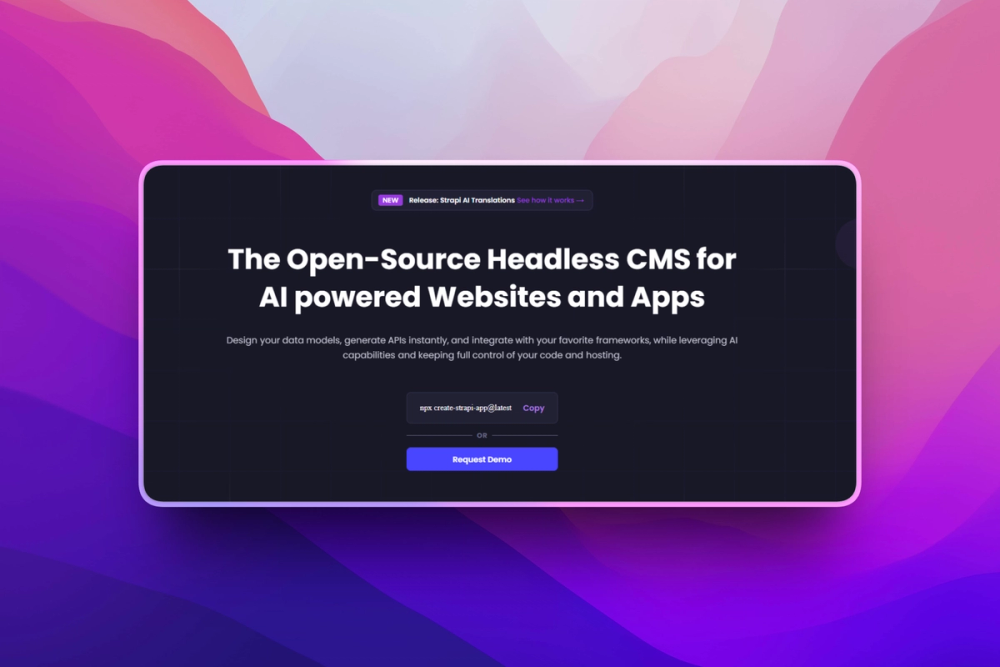
Strapi is an open source headless CMS on Node.js that auto-generates REST and GraphQL APIs from any content model you define. Self-host or use Strapi Cloud.

Visit websiteGitHub73.4K stars1-click deploy on Hostinger
image of Strapi
TL;DR

Strapi is a self-hosted headless CMS for teams replacing Contentful-style platforms with custom content models, generated APIs, and database control.

Read the full breakdownHide the full breakdownWho it is for, how it works, trade-offs, the quick start and the FAQ
who it's for

Who Strapi is for#

Agencies shipping client-editable websites

Agencies can model pages, case studies, landing pages, and reusable blocks in Strapi, then connect the content API to a custom frontend. Clients get an admin panel while the agency keeps full control over the website code.

Skip if:

The client expects a visual website builder where layout, theme, and hosting all live in one no-code product.

Product teams building content-backed SaaS features

Teams can use Strapi for help centers, in-app content, onboarding screens, changelogs, and product catalogs that need custom fields and API access. The Node.js backend makes it easier to add project-specific logic around content delivery.

Skip if:

Your content model is just a simple blog and you do not need custom APIs, roles, or backend extensions.

Developers replacing a hosted headless CMS

Strapi gives developers a self-hosted alternative when Contentful-style pricing, API quotas, or platform lock-in start to limit a project. Content stays in a relational database under the team's control.

Skip if:

Your team values hosted infrastructure, vendor support, and turnkey enterprise governance more than code-level control.

Mobile and multichannel app teams

Strapi works as a central content backend for web, mobile, kiosk, and IoT frontends because content is delivered through APIs rather than tied to one template system. Localization and media management help teams reuse content across channels.

Skip if:

Your app needs a real-time application backend, queue system, or event platform more than a CMS.

the problem

The problem it solves#

Hosted headless CMS platforms can become a bottleneck when a product team needs custom content models, backend extensions, or predictable infrastructure control. Editorial teams still need a usable admin interface, but developers often end up working around seat limits, API quotas, fixed data models, or platform-specific migration paths.

The pain gets sharper for agencies and SaaS teams that ship many content-backed products. A simple blog, mobile app backend, product catalog, or localization workflow should not require building a CMS from scratch, but it also should not force every project into a proprietary content API that the team cannot self-host or modify.

how Strapi solves it

How it solves it#

Visual content modeling

Design collection types, single types, reusable components, relations, and dynamic zones in the Content-type Builder. Strapi saves those models into the project, then exposes them through the admin panel and APIs, so developers can model content without hand-writing every schema file.

Generated REST and GraphQL APIs

Strapi generates REST endpoints for each content type and supports GraphQL through its official plugin. Frontend teams can connect Next.js, Vue, mobile apps, or internal tools to the same content backend without building a custom CRUD API first.

Role and permission controls

The Users & Permissions feature ships with public and authenticated roles, JWT-based authentication, and an access-control list strategy. Teams can decide which groups can read or write specific content instead of exposing every endpoint by default.

Multichannel content workflows

Built-in content features cover draft and publish, media management, internationalization, live preview, and dynamic zones. Editors can manage localized pages, product content, or app copy while developers keep presentation logic in the frontend.

Node.js customization surface

Strapi projects run as Node.js applications with routes, middlewares, controllers, and services. Teams can extend backend behavior, customize the admin panel, and install plugins when generated APIs are not enough.

strengths · trade-offs

Strengths and trade-offs#

Strengths

  • Self-hosted Community Edition under MIT termsStrapi's license grants MIT rights for Community Edition code outside the enterprise-only directories. That gives teams a real self-hosted path for commercial projects while keeping enterprise features and Strapi Cloud available as paid options.
  • Editor-friendly CMS without giving up backend controlContent teams work in an admin panel, while developers keep the backend as a normal JavaScript or TypeScript project. Compared with hosted-only CMS platforms, that makes Strapi a better fit when the content layer must live near custom business logic.
  • Database choice for new projectsStrapi supports SQLite, PostgreSQL, MySQL, and MariaDB for new projects. Teams can start with SQLite locally, then run production on a relational database they already operate.
  • Fast path from model to APIThe Content-type Builder and generated APIs remove much of the boilerplate behind content CRUD. Agencies and product teams can deliver a client-editable backend without spending weeks building admin screens and endpoints from scratch.

Trade-offs

  • -Content model changes are development workThe Content-type Builder is available in the development environment. Production teams need a release workflow for schema changes, migrations, and plugin updates instead of treating the CMS as a purely live-edited SaaS workspace.
  • -Relational databases onlyStrapi supports SQLite, PostgreSQL, MySQL, and MariaDB, but the official installation docs say it does not support MongoDB, NoSQL databases, or cloud-native database services. Teams committed to those stores should choose another content layer.
  • -Self-hosting shifts operations onto your teamRunning Strapi yourself means managing Node.js LTS versions, package updates, database backups, storage, deployment, and security posture. Strapi Cloud removes that work, but then the project moves back toward a managed-platform cost model.
  • -Some advanced workflow features are paid or plan-gatedStrapi's free CMS path covers the core CMS, APIs, roles, and permissions, but features such as AI-assisted content modeling, enterprise support, and some governance workflows sit behind paid cloud or enterprise plans. Budget for that if nontechnical teams need those workflows.
versus alternatives

Strapi vs alternatives#

Strapi vs Contentful

Strapi and Contentful both help teams manage structured content for websites, apps, and other digital channels. The main decision is control model: Strapi can run in your own Node.js environment, while Contentful is a hosted CMS platform.

FeatureStrapiContentful
LicenseMIT for Community Edition code pathsProprietary
Hosting modelSelf-hosted or Strapi CloudHosted CMS platform
API modelGenerated REST, GraphQL pluginHosted Content Delivery and Management APIs
Backend customizationNode.js project with routes, middleware, controllers, services, and pluginsPlatform-managed backend with hosted APIs

Strapi is the better choice when a team needs a self-hosted CMS, custom backend logic, or control over the database that stores content. Contentful is still worth choosing when the team wants managed infrastructure, vendor support, and a hosted editorial platform more than code-level control.

install · quick start

Quick start#

bash
npx create-strapi@latest my-strapi-project
cd my-strapi-project
npm run develop
tech stack · detected from GitHub

What it's built on#

Languages
JavaScriptTypeScript
Frameworks
React
Databases
MySQL
Runtimes
Node.js
Tooling
GraphQLRollup
frequently asked

FAQ#

Is Strapi open source?

Yes. Strapi's Community Edition is MIT licensed for the non-enterprise code paths, while enterprise-only directories and Strapi Cloud are governed by separate commercial terms. That distinction matters if you plan to redistribute or modify enterprise features.

How do you install Strapi?

The official CLI path is npx create-strapi@latest, followed by npm run develop inside the generated project. Strapi supports npm and pnpm, with npm recommended if you plan to deploy to Strapi Cloud.

Does Strapi support GraphQL?

Yes. Strapi generates REST APIs by default and supports GraphQL through the official GraphQL plugin. Teams can use either API style depending on frontend needs and query complexity.

What databases does Strapi support?

Strapi supports SQLite, PostgreSQL, MySQL, and MariaDB. The official docs state that MongoDB, NoSQL databases, and cloud-native database services are not supported.

Is Strapi better than Contentful?

Strapi is better when you need self-hosting, code-level customization, and database control. Contentful is still a better fit when your team wants a hosted content platform with vendor-managed infrastructure and enterprise support.

also worth a look

Similar open-source tools#

Payload CMS

Alternative toContentful

Build code-first CMS backends with TypeScript schemas

  • 45,369 GitHub stars
  • MITLicence MIT

Craft CMS

Alternative toContentful

Flexible developer-friendly CMS for content teams

  • 3,617 GitHub stars

TinaCMS

Alternative toCloudCannon

Open source headless CMS with inline editing and Git backend

  • 13,836 GitHub stars
  • Apache-2.0Licence Apache-2.0

Sulu

Alternative toContentful

Enterprise-ready open source CMS built on Symfony

  • 1,361 GitHub stars
  • MITLicence MIT

Decap CMS

Alternative toCloudCannon

Git-based content management for static site generators

  • 19,440 GitHub stars
  • MITLicence MIT

Grav

Alternative toWordPress.com

Flat-file CMS for fast, self-hosted websites.

  • 15,689 GitHub stars
  • MITLicence MIT
by category

Open source tools in these categories#

196

Web Development

freeCodeCamp, superpowers, Skills for Real Engineers
78

APIs & Integration

n8n, Firecrawl, iptv
35

No-Code & Low-Code

dify, n8n, Langflow
Hostinger

Run Strapi on your own server

Hostinger sets Strapi up as a one-click app on a VPS.

Deploy on Hostinger

Featured

rakazo

Alternative toGrok Bot

AI teammates you own: your keys, your model, your machine.

  • 4,904 GitHub stars
  • Apache-2.0Licence Apache-2.0
  • #AI Agents

Inbox Zero

Alternative toSuperhuman

AI email assistant that drafts replies and clears your inbox

  • 12,712 GitHub stars
  • AGPL-3.0Licence AGPL-3.0
  • #Email

Omnara

Alternative toCClaude Managed Agents

Open-source agent deployment API. Self-host or use Omnara Cloud.

  • 2,957 GitHub stars
  • Apache-2.0Licence Apache-2.0
  • #AI Agents
Feature your project

New open source projects by email

The projects we add and every new guide. Free, unsubscribe any time.

Find open source alternatives to paid software

/
  • Claude Code to OpenCode
  • Jira to Windshift
  • Notion to AppFlowy
  • Slack to Mattermost
  • Linear to GitLab
  • Wispr Flow to Handy
  • CapCut to Concat
  • Grok Bot to rakazo
  • Superhuman to Inbox Zero
  • Airtable to AITable
  • Muse to OpenClaw
  • GitHub Copilot to Cline
  • Datadog to Netdata
  • Microsoft Teams to Rocket.Chat
  • Pinecone to Qdrant
  • Zapier to n8n
  • Devin AI to OpenHands
  • Firebase to Supabase
  • 1Password to KeePassXC
  • Confluence to Docmost
  • Contentful to Strapi
  • Adobe Premiere Pro to Shotcut
  • ChatGPT to AnythingLLM
  • LangSmith to Langfuse