Open Source Alternatives
  • Alternatives
  • Categories
    Categories by size882 projects
    • Developer Tools461
    • AI & Machine Learning404
    • Web Development196
    • Business & Productivity191
    • Communication & Collaboration126
    • Security & Monitoring126
    • IT Management123
    • Product & Project Management106
    • Cloud & Hosting105
    • Data & Analytics104
    Browse all 21 categoriesLLMOps & AI Tooling, Design & Creative and 9 more
  • Blog
  • Advertise
SearchNotion, Slack, password manager.../
Submit
Open Source Alternatives
  • Alternatives
    • Developer Tools461
    • AI & Machine Learning404
    • Web Development196
    • Business & Productivity191
    • Communication & Collaboration126
    • Security & Monitoring126
    • Browse all 21 categories
  • Blog
  • Advertise
Submit your project

New open source projects by email

The projects we add and every new guide. Free, unsubscribe any time.

Open Source Alternatives LogoOpen Source Alternatives

Handpicked Open Source Alternatives to Paid Softwares

Product

  • Categories
  • Tag
  • Advertise

Resources

  • Blog
  • Collection
  • Submit

Company

  • Privacy Policy
  • Terms of Service
  • Refund Policy
  • Sitemap

Alternatives

  • Claude Code
  • Jira
  • Notion
  • Slack
  • Linear
  • Wispr Flow
  • All alternatives
© 2026 Open Source Alternatives. All rights reserved.
Open SourceAlternatives
Home/Categories/Backend Development/Payload CMS
icon of Payload CMS

Payload CMS

Open source alternative to Contentful, Sanity and Storyblok

  • 45.4K stars
  • MIT
  • Active this week
  • Last commit 2 days ago

Last verified Oct 20, 2026

Build code-first CMS backends with TypeScript schemas, API access, admin UI, and self-hosted deployment.

Visit websiteGitHub45.4K starsDeploy on Hostinger
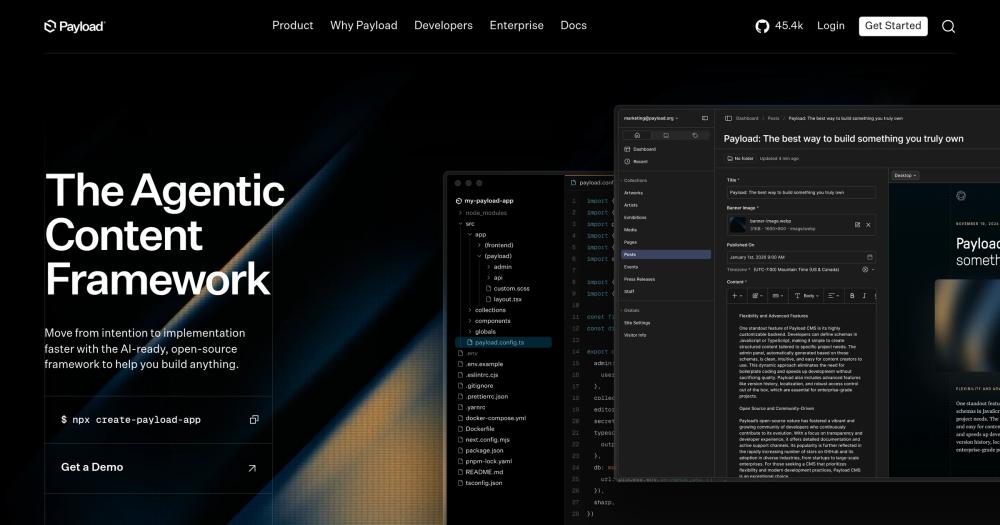
image of Payload CMS
TL;DR

Payload CMS is an open source, code-first headless CMS for teams that want TypeScript-defined content models, an admin UI, REST and GraphQL APIs, and self-hosted deployment. It is strongest when developers own the data model and need CMS changes to move through the same review process as application code.

Read the full breakdownHide the full breakdownWho it is for, how it works, trade-offs and the FAQ
who it's for

Who Payload CMS is for#

Build a self-hosted headless CMS

Use Payload when a marketing site, documentation hub, or content-heavy app needs structured content APIs without usage-based vendor pricing.

Skip if:

Choose a managed CMS if your team does not want to operate the app, database, upgrades, and backups.

Add content workflows to a product backend

Use Payload for internal tools, product catalogs, media libraries, or admin workflows where content records need custom access rules and typed backend logic.

Skip if:

Skip it when the CMS should be completely separate from application code and owned entirely by non-technical editors.

the problem

The problem it solves#

Hosted CMS platforms can slow engineering teams down when schema changes, access rules, hooks, and deployment timing live outside the application codebase. Developers end up coordinating dashboard edits, API contracts, and vendor limits separately from the rest of the product. Payload CMS solves that by keeping collections, fields, hooks, authentication, and API behavior in TypeScript while still giving editors a web admin panel. Teams get a CMS that fits their release process, database choices, and hosting requirements instead of adapting their content model to a third-party content API.

how Payload CMS solves it

How it solves it#

Define schemas in TypeScript

Model collections, fields, validation, hooks, access control, and API behavior in code so CMS changes move through review with the rest of the application.

Ship editor workflows

Give content teams a browser admin panel with drafts, uploads, localization, authentication, and publishing workflows without adopting a hosted content API.

Expose REST and GraphQL APIs

Serve structured content through generated APIs while keeping database choice, deployment timing, and extension points under your control.

strengths · trade-offs

Strengths and trade-offs#

Strengths

  • Strong fit for Next.js teamsPayload works well when a team already builds in TypeScript and wants content schemas, backend logic, and application code in one release process.
  • Full source and data controlSelf-hosting lets teams choose infrastructure, database options, backup strategy, and compliance boundaries instead of depending on a proprietary content lake.

Trade-offs

  • -Requires engineering ownershipPayload is code-first, so non-technical teams may prefer a hosted CMS with a visual schema builder and managed operations.
versus alternatives

Payload CMS vs alternatives#

Payload CMS is an open-source, code-first headless CMS and self-hosted alternative to Contentful, Strapi, and Sanity for building content backends with full TypeScript support.

vs Contentful: Contentful is a cloud-only SaaS headless CMS with pricing that scales steeply by record count and API calls, becoming expensive at scale. Payload runs on your own infrastructure with no usage-based fees; hosting costs only. Contentful has a mature ecosystem, managed CDN, and polished editor UX; Payload gives developers complete control over data models via TypeScript configuration and ships with its own admin UI, REST API, and GraphQL API out of the box.

vs Strapi: Strapi is the most direct open-source comparison because both tools are self-hosted Node.js headless CMSs. Payload differentiates with first-class TypeScript support built into the core from v2, a code-first configuration model that version-controls schemas naturally, and deep Next.js integration. Strapi's GUI-driven schema builder is more accessible for non-developers and has a larger plugin ecosystem; Payload is preferred by engineering teams who want schema-as-code and type safety throughout the content layer.

vs Sanity: Sanity offers a hosted content lake with a generous free tier, real-time collaborative editing, and a flexible GROQ query language. Payload is fully self-hosted, giving teams complete data ownership with no dependency on a third-party content API. Sanity's hosted CDN and live collaboration features are hard to replicate with self-hosted Payload without additional infrastructure investment, but Payload is the better choice when data sovereignty or offline operation is required.

tech stack · detected from GitHub

What it's built on#

Languages
JavaScriptTypeScript
Frameworks
ExpressNext.jsReact
Databases
MongoDBPostgreSQL
Runtimes
Node.js
Infrastructure
AWS
Tooling
GraphQL
frequently asked

FAQ#

Is Payload CMS open source?

Yes. Payload CMS is MIT licensed, and the primary product code repository is payloadcms/payload on GitHub.

What is Payload CMS best for?

Payload CMS is best for TypeScript and Next.js teams that want code-defined content models, generated APIs, and self-hosted control.

How does Payload CMS compare with Contentful?

Contentful is a managed SaaS content platform. Payload CMS is self-hosted and code-first, so teams trade vendor-managed operations for source, schema, and infrastructure control.

also worth a look

Similar open-source tools#

Strapi

Alternative toContentful

Headless CMS with auto-generated REST and GraphQL for any content model.

  • 73,351 GitHub stars
  • MITLicence MIT

Craft CMS

Alternative toContentful

Flexible developer-friendly CMS for content teams

  • 3,617 GitHub stars

TinaCMS

Alternative toCloudCannon

Open source headless CMS with inline editing and Git backend

  • 13,836 GitHub stars
  • Apache-2.0Licence Apache-2.0

Sulu

Alternative toContentful

Enterprise-ready open source CMS built on Symfony

  • 1,361 GitHub stars
  • MITLicence MIT

Decap CMS

Alternative toCloudCannon

Git-based content management for static site generators

  • 19,440 GitHub stars
  • MITLicence MIT

Grav

Alternative toWordPress.com

Flat-file CMS for fast, self-hosted websites.

  • 15,689 GitHub stars
  • MITLicence MIT
by category

Open source tools in these categories#

67

Backend Development

dify, graphify, Rust
34

Web & App Development

Flutter, Rust, Nvm
Hostinger

Run Payload CMS on your own server

Self-host Payload CMS on a Hostinger VPS.

Deploy on Hostinger

Featured

Omnara

Alternative toCClaude Managed Agents

Open-source agent deployment API. Self-host or use Omnara Cloud.

  • 2,957 GitHub stars
  • Apache-2.0Licence Apache-2.0
  • #AI Agents

Inbox Zero

Alternative toSuperhuman

AI email assistant that drafts replies and clears your inbox

  • 12,712 GitHub stars
  • AGPL-3.0Licence AGPL-3.0
  • #Email

rakazo

Alternative toGrok Bot

AI teammates you own: your keys, your model, your machine.

  • 4,904 GitHub stars
  • Apache-2.0Licence Apache-2.0
  • #AI Agents
Feature your project

New open source projects by email

The projects we add and every new guide. Free, unsubscribe any time.

Find open source alternatives to paid software

/
  • Claude Code to OpenCode
  • Jira to Windshift
  • Notion to AppFlowy
  • Slack to Mattermost
  • Linear to GitLab
  • Wispr Flow to Handy
  • CapCut to Concat
  • Grok Bot to rakazo
  • Superhuman to Inbox Zero
  • Airtable to AITable
  • Muse to OpenClaw
  • GitHub Copilot to Cline
  • Datadog to Netdata
  • Microsoft Teams to Rocket.Chat
  • Pinecone to Qdrant
  • Zapier to n8n
  • Devin AI to OpenHands
  • Firebase to Supabase
  • 1Password to KeePassXC
  • Confluence to Docmost
  • Contentful to Strapi
  • Adobe Premiere Pro to Shotcut
  • ChatGPT to AnythingLLM
  • LangSmith to Langfuse