Open Source Alternatives
  • Alternatives
  • Categories
    Categories by size882 projects
    • Developer Tools461
    • AI & Machine Learning404
    • Web Development196
    • Business & Productivity191
    • Communication & Collaboration126
    • Security & Monitoring126
    • IT Management123
    • Product & Project Management106
    • Cloud & Hosting105
    • Data & Analytics104
    Browse all 21 categoriesLLMOps & AI Tooling, Design & Creative and 9 more
  • Blog
  • Advertise
SearchNotion, Slack, password manager.../
Submit
Open Source Alternatives
  • Alternatives
    • Developer Tools461
    • AI & Machine Learning404
    • Web Development196
    • Business & Productivity191
    • Communication & Collaboration126
    • Security & Monitoring126
    • Browse all 21 categories
  • Blog
  • Advertise
Submit your project

New open source projects by email

The projects we add and every new guide. Free, unsubscribe any time.

Open Source Alternatives LogoOpen Source Alternatives

Handpicked Open Source Alternatives to Paid Softwares

Product

  • Categories
  • Tag
  • Advertise

Resources

  • Blog
  • Collection
  • Submit

Company

  • Privacy Policy
  • Terms of Service
  • Refund Policy
  • Sitemap

Alternatives

  • Claude Code
  • Jira
  • Notion
  • Slack
  • Linear
  • Wispr Flow
  • All alternatives
© 2026 Open Source Alternatives. All rights reserved.
Open SourceAlternatives
Home/Categories/Backend Development/Manifest
icon of Manifest

Manifest

Open source alternative to Xano, Firebase and AWS Amplify

  • 7.6K stars
  • MIT
  • Active this week
  • Last commit 1 day ago

Last verified Oct 20, 2026

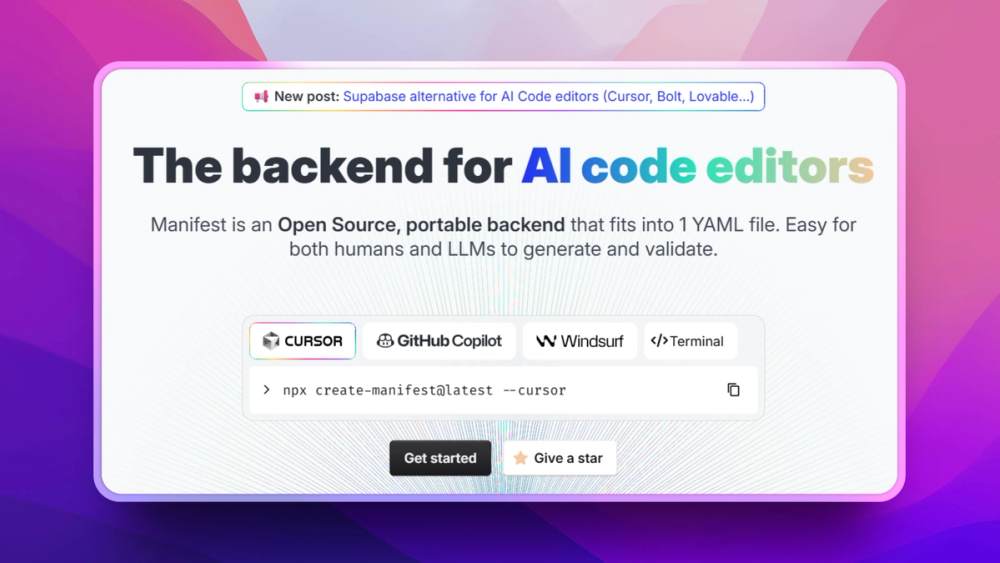
Manifest is an open source backend that fits into a single YAML file, providing auth, CRUD, storage, and an admin panel for AI-assisted development workflows. MIT licensed; runs on Node.js.

Visit websiteGitHub7.6K starsDeploy on Hostinger
image of Manifest
TL;DR

Manifest is an MIT-licensed smart model router for AI agents and applications that need to cut LLM cost without hardcoding every provider decision. It routes requests across API keys, subscriptions, local models, and custom OpenAI-compatible providers from a self-hosted Docker service. Best for AI product teams that call several model providers and want routing control before building their own gateway.

Read the full breakdownHide the full breakdownWho it is for, how it works, trade-offs, the quick start and the FAQ
who it's for

Who Manifest is for#

AI products reducing model spend

Manifest helps teams route simple requests to cheaper models while preserving access to stronger models for complex work.

Skip if:

Use one provider directly if your app has low model volume and does not need routing, fallback, or cost controls.

Agent teams standardizing provider access

Teams can put multiple model backends behind one gateway instead of wiring every agent to every provider separately.

Skip if:

Skip it if vendor-managed observability, enterprise SLAs, and a hosted AI gateway are required.

the problem

The problem it solves#

AI apps often start with one model API, then grow into a mix of premium models, cheaper fallbacks, local models, and subscription-backed providers. Without a routing layer, developers scatter provider logic across application code and lose visibility into cost, fallback behavior, and model selection.

Managed AI gateways can solve routing, but they add another vendor to a sensitive part of the stack. Teams that already manage model keys and local inference may want a self-hosted control point instead.

how Manifest solves it

How it solves it#

Smart model routing

Manifest routes each query to a model based on complexity, specificity, and custom HTTP headers, helping teams reserve expensive models for requests that need them.

Provider mix in one gateway

The README documents API keys, paid subscriptions, local models, and custom OpenAI-compatible providers behind the same routing layer.

Cost tracking and controls

Manifest tracks spend and supports notifications and limits, giving teams a clearer view of LLM usage before bills grow.

Self-hosted Docker deployment

The project ships as a Docker image with a one-command self-hosted installer and a local admin account created on first sign-up.

MIT license

The GitHub repository reports MIT licensing, which is permissive for commercial and internal use.

strengths · trade-offs

Strengths and trade-offs#

Strengths

  • Fast model-gateway setupManifest gives teams a routing layer without building provider selection, fallback behavior, and spend tracking from scratch.
  • Useful for AI-assisted productsAgents and AI apps can route routine calls to cheaper models while keeping stronger models available for harder prompts.
  • Keeps routing under team controlSelf-hosting lets teams manage keys, provider choices, and model policy closer to their own infrastructure.

Trade-offs

  • -Routing quality needs tuningA model router only helps if its policies match the product's quality bar. Teams should test routing decisions against real prompts before trusting cost savings.
  • -Provider limits still applyManifest can route across providers, but each upstream model API, subscription, or local runtime still has its own reliability, latency, and terms.
versus alternatives

Manifest vs alternatives#

Manifest vs Portkey

Manifest and Portkey both sit between AI applications and model providers, but Manifest emphasizes a self-hosted smart router with local models, paid subscriptions, API keys, and custom providers behind one gateway. Portkey is a managed AI gateway with hosted observability, policy, and enterprise workflow features.

Manifest is the better fit when a team wants a lightweight self-hosted router and direct control over model provider choices. Portkey is still better when the organization wants a managed AI gateway with vendor-operated dashboards, enterprise controls, and less infrastructure ownership.

install · quick start

Quick start#

bash
bash <(curl -sSL https://raw.githubusercontent.com/mnfst/manifest/main/docker/install.sh)
tech stack · detected from GitHub

What it's built on#

Languages
JavaScriptTypeScript
Frameworks
NestJSReact
Databases
PostgreSQL
Infrastructure
AWS
frequently asked

FAQ#

What does Manifest do?

Manifest routes AI requests across model providers, local models, and subscription-backed providers while tracking cost and fallback behavior.

Is Manifest self-hosted?

Yes. Manifest ships as a Docker image and includes a self-hosted install script in the official README.

Is Manifest still a backend generator?

No. The current README says the legacy manifest npm package is deprecated and no longer published. The project now focuses on model routing for agents and AI applications.

also worth a look

Similar open-source tools#

InsForge

Alternative toSupabase

Backend-as-a-service platform built for AI coding agents

  • 13,152 GitHub stars
  • Apache-2.0Licence Apache-2.0

Modelence

Alternative toFirebase

Full-stack framework for building production-ready web apps

  • 432 GitHub stars
  • Apache-2.0Licence Apache-2.0

Supabase

Alternative toFirebase

Open source Firebase: Postgres database, auth, and file storage

  • 112,232 GitHub stars
  • Apache-2.0Licence Apache-2.0

Appwrite

Alternative toFirebase

Self-hosted backend: auth, databases, storage, and functions

  • 57,737 GitHub stars
  • BSD-3-ClauseLicence BSD-3-Clause

Directus

Alternative toContentful

Wrap any SQL database with REST and GraphQL APIs and an admin UI

  • 38,631 GitHub stars

Nhost

Alternative toFirebase

Firebase alternative: GraphQL, Postgres auth, and file storage

  • 9,364 GitHub stars
  • MITLicence MIT
by category

Open source tools in these categories#

67

Backend Development

dify, graphify, Rust
404

AI & Machine Learning

freeCodeCamp, OpenClaw, REA (Reverse Engineer Anything)
463

Developer Tools

REA (Reverse Engineer Anything), superpowers, Skills for Real Engineers
Hostinger

Run Manifest on your own server

Self-host Manifest on a Hostinger VPS.

Deploy on Hostinger

Featured

Omnara

Alternative toCClaude Managed Agents

Open-source agent deployment API. Self-host or use Omnara Cloud.

  • 2,957 GitHub stars
  • Apache-2.0Licence Apache-2.0
  • #AI Agents

Inbox Zero

Alternative toSuperhuman

AI email assistant that drafts replies and clears your inbox

  • 12,712 GitHub stars
  • AGPL-3.0Licence AGPL-3.0
  • #Email

rakazo

Alternative toGrok Bot

AI teammates you own: your keys, your model, your machine.

  • 4,904 GitHub stars
  • Apache-2.0Licence Apache-2.0
  • #AI Agents
Feature your project

New open source projects by email

The projects we add and every new guide. Free, unsubscribe any time.

Find open source alternatives to paid software

/
  • Claude Code to OpenCode
  • Jira to Windshift
  • Notion to AppFlowy
  • Slack to Mattermost
  • Linear to GitLab
  • Wispr Flow to Handy
  • CapCut to Concat
  • Grok Bot to rakazo
  • Superhuman to Inbox Zero
  • Airtable to AITable
  • Muse to OpenClaw
  • GitHub Copilot to Cline
  • Datadog to Netdata
  • Microsoft Teams to Rocket.Chat
  • Pinecone to Qdrant
  • Zapier to n8n
  • Devin AI to OpenHands
  • Firebase to Supabase
  • 1Password to KeePassXC
  • Confluence to Docmost
  • Contentful to Strapi
  • Adobe Premiere Pro to Shotcut
  • ChatGPT to AnythingLLM
  • LangSmith to Langfuse