Open Source Alternatives
  • Alternatives
  • Categories
    Categories by size882 projects
    • Developer Tools461
    • AI & Machine Learning404
    • Web Development196
    • Business & Productivity191
    • Communication & Collaboration126
    • Security & Monitoring126
    • IT Management123
    • Product & Project Management106
    • Cloud & Hosting105
    • Data & Analytics104
    Browse all 21 categoriesLLMOps & AI Tooling, Design & Creative and 9 more
  • Blog
  • Advertise
SearchNotion, Slack, password manager.../
Submit
Open Source Alternatives
  • Alternatives
    • Developer Tools461
    • AI & Machine Learning404
    • Web Development196
    • Business & Productivity191
    • Communication & Collaboration126
    • Security & Monitoring126
    • Browse all 21 categories
  • Blog
  • Advertise
Submit your project

New open source projects by email

The projects we add and every new guide. Free, unsubscribe any time.

Open Source Alternatives LogoOpen Source Alternatives

Handpicked Open Source Alternatives to Paid Softwares

Product

  • Categories
  • Tag
  • Advertise

Resources

  • Blog
  • Collection
  • Submit

Company

  • Privacy Policy
  • Terms of Service
  • Refund Policy
  • Sitemap

Alternatives

  • Claude Code
  • Jira
  • Notion
  • Slack
  • Linear
  • Wispr Flow
  • All alternatives
© 2026 Open Source Alternatives. All rights reserved.
Open SourceAlternatives
Home/Categories/DevOps & CI/CD/Radar
icon of Radar

Radar

Open source alternative to Lens, K8Studio and Aptakube

  • 3.9K stars
  • Apache-2.0
  • Active this week
  • Last commit 2 days ago

Last verified Oct 20, 2026

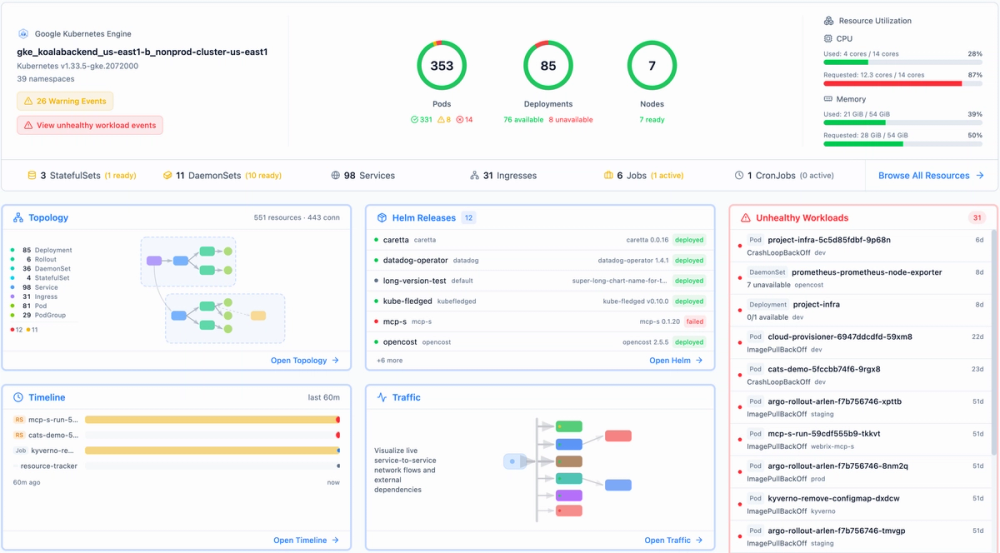
Visualize Kubernetes clusters as live topology, Helm, GitOps, and traffic maps with a built-in MCP server for AI agents.

Visit websiteGitHub3.9K starsDeploy on Hostinger
image of Radar
TL;DR

Radar is an open source Kubernetes UI that replaces commercial tools like Lens, K8Studio, and Aptakube with a free, Apache-licensed alternative. It ships as a single ~30MB Go binary with no cloud account required, covers topology, Helm, GitOps, traffic, and 44 audit checks, and includes a built-in MCP server so AI agents can query live cluster state directly. Best for platform engineers and DevOps teams debugging multi-cluster environments who want both a human-readable UI and AI-agent-ready cluster context in one tool.

Read the full breakdownHide the full breakdownWho it is for, how it works, trade-offs, the quick start and the FAQ
who it's for

Who Radar is for#

Platform engineers debugging multi-cluster incidents

Search across every cluster from one bar, rewind the event timeline to the moment before an incident, and share a direct link to the relevant view. The topology view shows cross-namespace dependencies and live traffic without kubectl roulette across multiple contexts.

Skip if:

Your team manages a single small cluster and already has a working kubectl debugging workflow. Radar's value compounds with cluster count and team size.

DevOps teams managing Helm releases and GitOps workflows

Every Helm release history and ArgoCD or Flux sync state in one view alongside cluster resources. Roll back with a click. No separate ArgoCD UI or Helm diff tooling needed for standard release management and change auditing.

Skip if:

Your team uses a dedicated ArgoCD UI and Helm release management is not a pain point. Radar adds the most value when GitOps visibility is fragmented across separate tools.

Engineers evaluating AI-assisted incident response

The built-in MCP server gives AI agents like Claude direct access to live cluster state, workload details, and event history. The Radar website cites a benchmark where AI investigations diagnosed faults three times faster on average with Radar than with plain kubectl.

Skip if:

Your team is not yet using AI agents in engineering workflows. The MCP server adds no value if you are not using MCP-compatible AI tools.

Teams migrating away from Lens or other subscription-gated Kubernetes UIs

Radar is a direct alternative to Lens, K8Studio, and Aptakube, with topology, resource browser, Helm, GitOps, and audit views all included at no cost. The project reached 73,000+ downloads in 2026 and 3,866 GitHub stars, reflecting broad adoption among teams managing production clusters.

Skip if:

You rely on Lens IDE's extension marketplace or have Lens Pro integrations that Radar does not replicate. Radar does not have a plugin extension ecosystem.

the problem

The problem it solves#

Kubernetes is designed to be queried, not understood. kubectl gives you point-in-time answers for a single engineer at a single moment, but your team manages dozens of clusters across regions, and when an alert fires at 2am nobody has time to SSH through three jump hosts and grep for pods. The typical platform team juggles five or more tools to debug a single incident: kubectl for resources, a separate dashboard for topology, another for Helm releases, yet another for GitOps state.

Kubernetes also deletes events after one hour by default, so by the time you notice something went wrong, the timeline is already gone. As AI agents become part of incident-response workflows, there is still no structured way to give them cluster context without building custom tooling on top of an already fragmented stack.

how Radar solves it

How it solves it#

Live topology view

Every Deployment, Service, and Ingress rendered as a live graph with real-time traffic flows, TLS health, and cross-namespace dependencies. Two modes show the full resource hierarchy or the network traffic path. Click any node to drill into logs, events, and manifests. Auto-layout updates as the cluster changes, with filtering by namespace, resource kind, or app label.

Built-in MCP server for AI agents

An embedded Model Context Protocol server lets AI agents query live cluster state, topology, and workload details through any MCP-compatible client. The same data the UI shows is queryable by agents, so investigation workflows can read real cluster context without custom tooling or separate APIs. Pass --no-mcp to disable it or --mcp-read-only to restrict agents to read-only tools.

Event timeline with extended history

A unified timeline of Kubernetes events and resource changes retained beyond the default one-hour cluster window. Storage backends include memory, SQLite, and Postgres. Rewind to any moment before an incident to see what changed, including resource diffs showing exact replica counts and image tags.

Helm release management

Every Helm release in the cluster shows full revision history, value file diffs between revisions, and one-click rollback. The audit trail shows exactly what changed and when, making upgrades reversible without kubectl commands or separate Helm tooling.

Native GitOps state for ArgoCD and Flux

ArgoCD and FluxCD integration surfaces the sync state of every Application alongside the resources it produced. Drift and sync failures appear in the same view as the rest of the cluster, with no separate ArgoCD UI required for standard GitOps visibility.

44 cluster audit checks

A built-in audit view runs 44 checks against your cluster configuration, covering resource hygiene, security posture, and common misconfigurations. Results surface alongside topology and resource views, so audit failures appear in context rather than in a separate security tool.

strengths · trade-offs

Strengths and trade-offs#

Strengths

  • Apache 2.0 with no feature gatesThe full feature set is Apache-licensed with no paid tier required for individual engineers or teams. Unlike Lens, which moved core features behind a Lens Pro subscription, the Radar OSS binary is not a crippled version of a paid product. Every topology, Helm, GitOps, and audit view is included at no cost.
  • Single binary with no cluster-side dependenciesA single ~30MB Go binary reads the Kubernetes API directly from your kubeconfig. No agents, no CRDs, and no cluster-side components are required in local mode. Works on any conformant cluster including GKE, EKS, AKS, k3s, kind, and minikube, and runs in air-gapped environments with no outbound internet access required.
  • Privacy-first by defaultCluster data stays on your machine in local mode. No account is required and no cloud sync occurs. Usage reporting is off by default; the opt-in telemetry sends only anonymous counts and coarse cluster facts like Kubernetes version and node-count range, not workload details or resource names.
  • MCP server for AI agent workflowsThe built-in MCP server is the only Kubernetes UI in the Lens/K8Studio/Aptakube category that gives AI agents direct structured access to live cluster state. Teams using Claude or other MCP-compatible tools for incident investigation can query Radar's data layer without additional tooling.

Trade-offs

  • -124 open issues on a fast-moving early codebaseThe repository launched in January 2026 and had 124 open issues by October 2026. Rapid growth and active feedback account for most of it, but edge cases including slow or high-latency clusters, specific ingress controllers, and very large namespace counts have known issues in flight. The docs cover tuning flags for these scenarios.
  • -Alerts and cross-cluster fleet features require Radar CloudAutomated failure alerts delivered to Slack or webhooks, AI root cause investigations, and the aggregated cross-cluster fleet view are Radar Cloud features. The OSS binary and self-hosted Helm deployment cover full cluster inspection per instance; the fleet-level and notification features are cloud-only. Radar Cloud has a free tier for up to three clusters.
  • -Kubernetes-only scopeRadar covers Kubernetes clusters and their workloads. It does not monitor non-Kubernetes infrastructure such as bare metal nodes, VMs, or cloud-provider resources outside the cluster API. Teams needing broader infrastructure observability need a separate tool alongside it.
  • -In-memory timeline is lost on restartThe default timeline storage backend is in-memory. History is lost when the binary restarts. Persistent incident history requires setting the --timeline-storage flag to sqlite or postgres and provisioning the relevant database. The default is fine for local use but not for long-running in-cluster deployments where history retention matters.
versus alternatives

Radar vs alternatives#

Radar vs Lens

Both are Kubernetes UIs with topology visualization and resource browsing, but they diverged on licensing and deployment model. Lens moved core features behind a paid Lens Pro subscription, while Radar is Apache 2.0 with the full feature set in the OSS binary.

FeatureRadarLens
LicenseApache 2.0Proprietary (paid Pro tier)
MCP server for AI agentsYesNo
Price for individualsFree foreverFree tier + paid subscription
In-cluster Helm deploymentYesNo

Radar is the better choice for teams that need in-cluster shared deployment under an open source license, native GitOps visibility, or an MCP server for AI agent workflows. Lens still has an advantage for engineers who rely on its extension marketplace or have existing Lens Pro integrations.

Radar vs K8Studio and Aptakube

K8Studio and Aptakube are commercial Kubernetes desktop UIs with polished interfaces and paid license models. Radar's primary advantages are Apache 2.0 licensing with no per-seat cost, Helm-based in-cluster deployment for team access, and the built-in MCP server. Neither K8Studio nor Aptakube offer an open source tier or an MCP endpoint.

K8Studio or Aptakube may fit better when a team wants a commercial support contract, a native desktop experience with dedicated vendor support, and does not need open source licensing or AI agent integration.

install · quick start

Quick start#

bash
Install Radar with the quick-install script or Homebrew, then run kubectl radar.

```bash
curl -fsSL https://get.radarhq.io | sh && kubectl radar
```

For shared in-cluster deployment, Helm handles the setup.

```bash
helm repo add skyhook https://skyhook-io.github.io/helm-charts
helm install radar skyhook/radar -n radar --create-namespace
```
tech stack · detected from GitHub

What it's built on#

Languages
GoTypeScript
Frameworks
React
Infrastructure
GitOpsKubernetes
frequently asked

FAQ#

Is Radar free to use?

Yes. The OSS binary is Apache 2.0 licensed and free to run on your laptop or in-cluster via Helm forever, with no feature gates. Radar Cloud (alerts, AI investigations, shared multi-user views) has a free tier for up to three clusters and paid plans above that.

Does Radar require installing anything on the cluster?

No. Local mode runs on your laptop and talks to the Kubernetes API using your existing kubeconfig without installing anything on the cluster. In-cluster mode, which provides shared team access and persistent event history, deploys as a Helm chart.

Can AI agents use Radar to query cluster state?

Yes. Radar includes a built-in MCP server (Model Context Protocol) that any compatible AI client, including Claude, can use to query topology, workloads, events, and audit results. The same data the browser UI shows is available to agents over the MCP endpoint. Pass --no-mcp to disable it or --mcp-read-only to restrict agents to read-only tools.

How does Radar compare to Lens?

Lens moved core features behind a paid Lens Pro subscription after years as a free tool. Radar covers the same categories (topology, resource browser, Helm, GitOps) under Apache 2.0 with no paid tier required for individual engineers, plus adds a built-in MCP server and native ArgoCD/Flux support. Lens still has an advantage for engineers who rely on its extension marketplace.

Does Radar work on air-gapped clusters?

Yes. The OSS binary is self-contained and connects directly to the Kubernetes API with no outbound internet access required. Usage reporting is off by default. In-cluster Helm deployment also works in air-gapped environments if you mirror the container image to a private registry.

also worth a look

Similar open-source tools#

Homeio

Alternative toUnraid

Browser desktop for your self-hosted home server

  • 90 GitHub stars
  • AGPL-3.0Licence AGPL-3.0

Keda

Alternative toKedify

Event-driven Kubernetes autoscaling with 70+ scalers and scale to zero

  • 10,646 GitHub stars
  • Apache-2.0Licence Apache-2.0

trivy

Alternative toAqua Security

Scan cloud-native workloads for security issues

  • 38,543 GitHub stars
  • Apache-2.0Licence Apache-2.0

Kamal

Alternative toFly.io

Zero-downtime Docker deploys to any server, no managed platform.

  • 14,675 GitHub stars
  • MITLicence MIT

CapRover

Alternative toHeroku

Self-hosted PaaS: deploys any language, automatic HTTPS, zero fees.

  • 15,187 GitHub stars
  • CustomLicence Apache-2.0 with additional terms

Dokploy

Alternative toHeroku

Self-hosted PaaS to deploy apps and databases across multiple servers

  • 37,935 GitHub stars
by category

Open source tools in these categories#

88

DevOps & CI/CD

Nvm, Uptime Kuma, Netdata
107

Cloud & Hosting

dify, RuView, rtk
126

Security & Monitoring

REA (Reverse Engineer Anything), RustDesk, Uptime Kuma
Hostinger

Run Radar on your own server

Self-host Radar on a Hostinger VPS.

Deploy on Hostinger

Featured

Omnara

Alternative toCClaude Managed Agents

Open-source agent deployment API. Self-host or use Omnara Cloud.

  • 2,957 GitHub stars
  • Apache-2.0Licence Apache-2.0
  • #AI Agents

Inbox Zero

Alternative toSuperhuman

AI email assistant that drafts replies and clears your inbox

  • 12,712 GitHub stars
  • AGPL-3.0Licence AGPL-3.0
  • #Email

rakazo

Alternative toGrok Bot

AI teammates you own: your keys, your model, your machine.

  • 4,904 GitHub stars
  • Apache-2.0Licence Apache-2.0
  • #AI Agents
Feature your project

New open source projects by email

The projects we add and every new guide. Free, unsubscribe any time.

Find open source alternatives to paid software

/
  • Claude Code to OpenCode
  • Jira to Windshift
  • Notion to AppFlowy
  • Slack to Mattermost
  • Linear to GitLab
  • Wispr Flow to Handy
  • CapCut to Concat
  • Grok Bot to rakazo
  • Superhuman to Inbox Zero
  • Airtable to AITable
  • Muse to OpenClaw
  • GitHub Copilot to Cline
  • Datadog to Netdata
  • Microsoft Teams to Rocket.Chat
  • Pinecone to Qdrant
  • Zapier to n8n
  • Devin AI to OpenHands
  • Firebase to Supabase
  • 1Password to KeePassXC
  • Confluence to Docmost
  • Contentful to Strapi
  • Adobe Premiere Pro to Shotcut
  • ChatGPT to AnythingLLM
  • LangSmith to Langfuse