Homeio vs Portainer Business
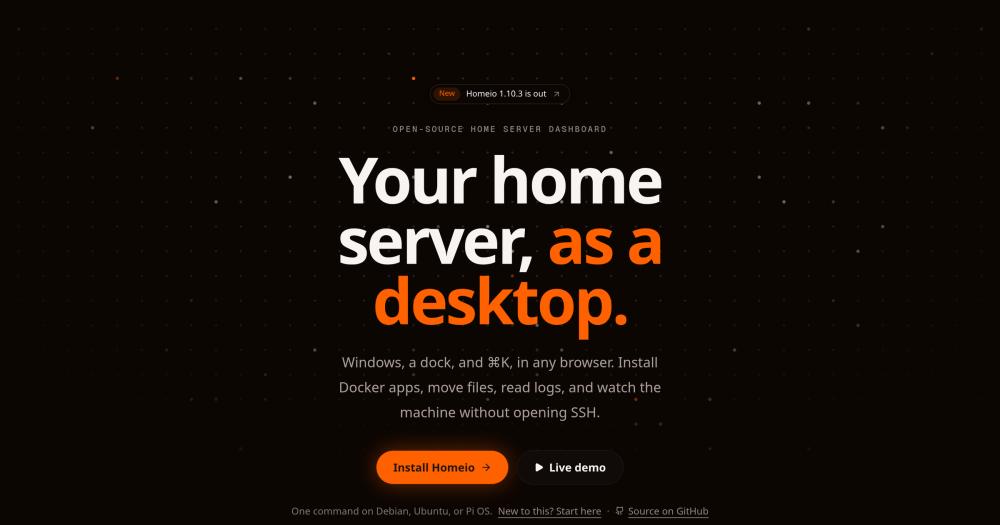
Both Homeio and Portainer Business manage Docker containers from a web interface, but they serve different scales. Portainer Business is built for multi-node, multi-team environments; Homeio is a single-user home server tool with a desktop metaphor and built-in services that Portainer does not include.
| Feature | Homeio | Portainer Business |
|---|
| License | AGPL-3.0 (free) | Proprietary (paid above 5 nodes) |
| Self-hosting | Yes | Yes |
| File manager | Yes | No |
| Browser terminal | Yes (host shell + container shell) | Yes (container shell only) |
| App catalogue | 166+ Compose stacks | No |
| Remote access tunnels | Tailscale + Cloudflare Tunnel built in | No |
| Multi-user support | No | Yes |
| Multi-node management | No | Yes |
Homeio is the better choice for a single home server operator who wants Docker management, file browsing, system metrics, and remote access in one browser tab. Portainer Business is the better choice when you manage Docker across multiple hosts or need team-based access control. At that scale, Homeio's single-user, single-host architecture is a hard constraint.
Homeio vs Unraid
Unraid is a NAS and server operating system focused on parity storage, media serving, and VM management, with a web UI that includes a Docker tab. Homeio and Unraid overlap in Docker app management but differ in scope and cost.
| Feature | Homeio | Unraid |
|---|
| License | AGPL-3.0 (free) | Proprietary (per-machine license) |
| Self-hosting | Yes (any Linux) | Yes (dedicated boot drive required) |
| App catalogue | 166+ Compose stacks | Community Applications plugin |
| File manager | Yes | Yes |
| Parity storage / RAID | No | Yes |
| VM management | No | Yes |
| Multi-user support | No | Yes |
Homeio is a better fit for standard Linux servers and Raspberry Pi machines where you want a free, open-source control plane without committing to the Unraid boot drive model. Unraid is the stronger choice when parity-protected storage, virtual machine management, or the mature Unraid ecosystem are priorities. Its per-machine license cost is the main friction for operators running several machines.