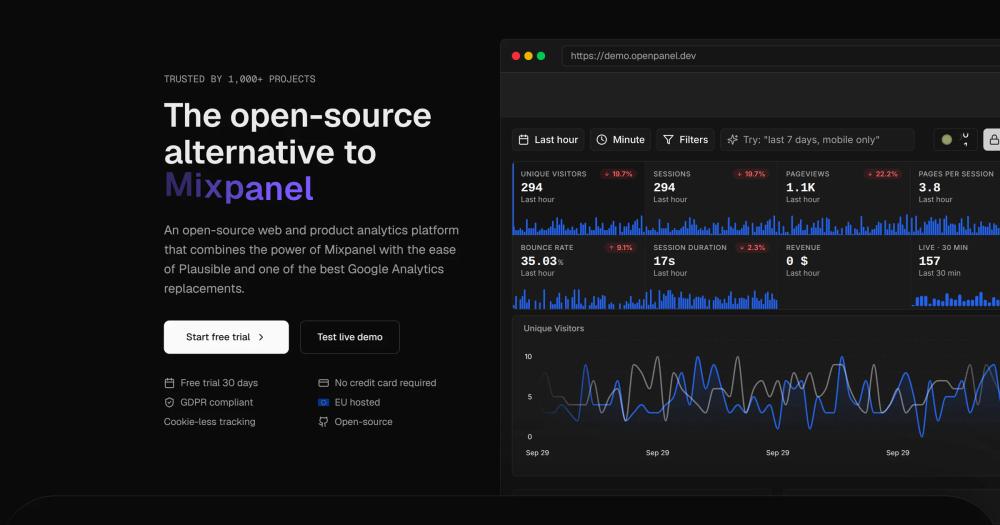
OpenPanel vs Mixpanel
OpenPanel and Mixpanel overlap almost entirely on product analytics features: custom event tracking, funnels, cohort retention, user profiles, A/B testing, and session replay. The practical differences are data ownership, self-hosting availability, and cost at scale.
| Feature | OpenPanel | Mixpanel |
|---|
| License | AGPL-3.0 | Proprietary |
| Self-hosting | Yes | No |
| Cookieless tracking | Yes | No |
| Session replay cap | None | 5,000/month (free), 20,000/month (paid) |
| GDPR compliance | Yes (EU hosted by default) | Yes (with configuration) |
| MCP server | Yes (38 tools) | No |
OpenPanel is the better choice when data ownership matters, when self-hosting avoids per-event costs at scale, or when the team needs cookieless tracking without a cookie consent setup. Mixpanel is the better choice when you need a platform with years of production hardening, established enterprise compliance certifications, or a larger ecosystem of third-party integrations. OpenPanel launched in 2024 and is actively maintained; Mixpanel has a decade-plus track record. Teams migrating from Mixpanel will find OpenPanel covers the same core workflows, but should expect some rough edges from a younger platform.
OpenPanel vs Amplitude
Both OpenPanel and Amplitude target product analytics: events, funnels, cohort retention, and user profiles. OpenPanel is open-source under AGPL-3.0 and includes a self-hosted path with no event limits; Amplitude is a proprietary commercial platform. For teams that want product analytics depth without paying commercial analytics pricing, OpenPanel covers the core use case. Amplitude's advantage is a more mature platform with stronger enterprise support and a longer track record. OpenPanel is the better starting point for product teams that need analytics depth without committing to enterprise pricing.