Open Source Alternatives
  • Alternatives
  • Categories
    Categories by size892 projects
    • Developer Tools463
    • AI & Machine Learning404
    • Web Development196
    • Business & Productivity194
    • Communication & Collaboration128
    • Security & Monitoring128
    • IT Management123
    • Cloud & Hosting108
    • Product & Project Management106
    • Data & Analytics104
    Browse all 21 categoriesLLMOps & AI Tooling, Design & Creative and 9 more
  • Blog
  • Advertise
SearchNotion, Slack, password manager.../
Submit
Open Source Alternatives
  • Alternatives
    • Developer Tools463
    • AI & Machine Learning404
    • Web Development196
    • Business & Productivity194
    • Communication & Collaboration128
    • Security & Monitoring128
    • Browse all 21 categories
  • Blog
  • Advertise
Submit your project

New open source projects by email

The projects we add and every new guide. Free, unsubscribe any time.

Open Source Alternatives LogoOpen Source Alternatives

Handpicked Open Source Alternatives to Paid Softwares

Product

  • Categories
  • Tag
  • Advertise

Resources

  • Blog
  • Collection
  • Submit

Company

  • Privacy Policy
  • Terms of Service
  • Refund Policy
  • Sitemap

Alternatives

  • Claude Code
  • Jira
  • Notion
  • Slack
  • Linear
  • Wispr Flow
  • All alternatives
© 2026 Open Source Alternatives. All rights reserved.
Open SourceAlternatives
Home/Categories/Communication & Collaboration/MediaWiki
icon of Mediawiki

MediaWiki

Open source alternative to Confluence, SharePoint and Tettra

  • 5.2K stars
  • GPL-2.0-or-later
  • Active this week
  • Last commit today

Last verified Oct 22, 2026

Build collaborative knowledge bases with the open source wiki platform that powers Wikipedia, available in 350+ languages and self-hosted on any server.

Visit websiteGitHub5.2K starsDeploy on Hostinger
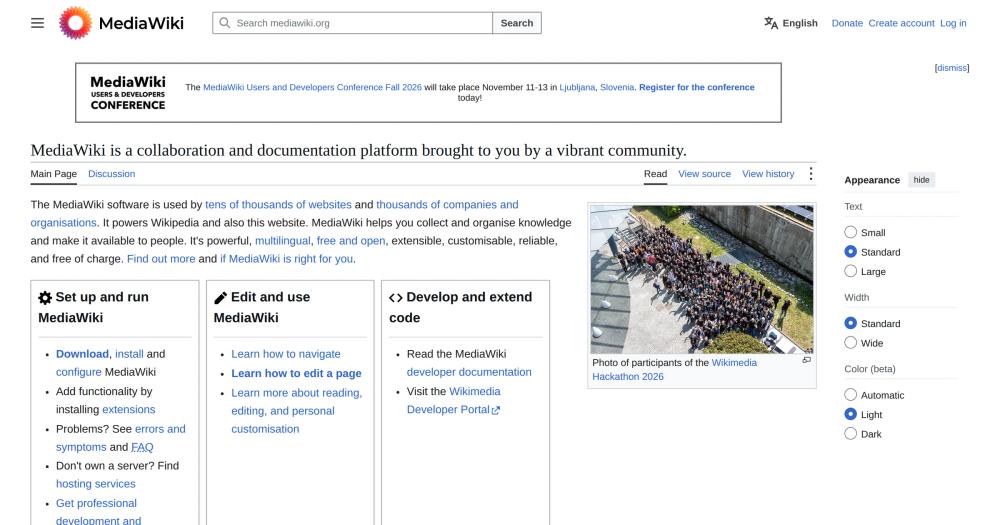
image of Mediawiki
TL;DR

MediaWiki is the open-source PHP wiki software that runs Wikipedia and tens of thousands of other sites, used by hundreds of millions of people each month. It replaces paid team wikis like Confluence and SharePoint, offering self-hosted deployment with no per-seat licensing under the GPL-2.0-or-later license. Best for organizations that need a long-lived, community-editable knowledge base where full data ownership matters more than a polished managed service.

Read the full breakdownHide the full breakdownWho it is for, how it works, trade-offs and the FAQ
who it's for

Who MediaWiki is for#

Engineering teams building internal documentation wikis

MediaWiki gives engineers version-controlled, searchable, link-rich documentation. Page categories, templates, and transclusion let teams reuse content blocks without copying. The edit history doubles as an audit trail for architectural decisions and technical notes.

Skip if:

If your team primarily wants Markdown-based docs checked into git alongside source code, a static site generator has lower operational overhead and tighter code-review integration.

Organizations running community or open source project wikis

Built for community-maintained documentation. Anonymous or registered contribution workflows, talk pages for discussion, and a proven permissions model make MediaWiki the natural choice for projects that invite public or contributor edits at any scale.

Skip if:

If your documentation is maintained by a small closed team with no community editing needs, simpler tools carry less operational overhead.

Enterprises needing multilingual internal knowledge bases

The built-in 350+ language support and interface localization make MediaWiki the most practical self-hosted option for globally distributed organizations that need a single knowledge base accessible in multiple languages simultaneously.

Skip if:

If your team operates in a single language with no near-term localization requirements, the multilingual infrastructure adds setup complexity without benefit.

Academic institutions and research organizations

Universities, research labs, and archives have used MediaWiki for decades to maintain institutional knowledge. The open license, standard export formats, and independence from vendor roadmaps suit long-horizon knowledge preservation requirements.

Skip if:

If your use case requires structured data or formal ontologies rather than narrative wiki pages, consider semantic extensions or a dedicated knowledge graph tool alongside MediaWiki.

the problem

The problem it solves#

Team knowledge bases have a scaling problem: documentation scattered across disparate files and communication channels is invisible to new team members and impossible to search systematically. Paid wiki tools like Confluence charge per-seat fees that grow with headcount, lock documents in proprietary export formats, and push teams toward managed cloud instances with no clear data exit path.

The second problem is longevity. A tool that makes editing expensive in time or effort stops receiving updates from contributors. Pages go stale within months. MediaWiki was designed from the start to make every edit trivially easy and every revision recoverable, which is why hundreds of millions of people rely on the wikis it powers each month.

how MediaWiki solves it

How it solves it#

Extension library with hundreds of add-ons

Extends core functionality through community-built extensions covering semantic data, visual editing, math rendering, diagrams, access control, and media management. The extension framework lets teams add capabilities without patching core code, keeping upgrades clean.

Full revision history on every page

Every edit to every article is versioned and stored, with per-edit attribution, diff views between any two revisions, and one-click reversion. Teams with large wikis can audit who changed what and when without a separate version control layer.

Multilingual support across 350+ languages

Ships with localization for over 350 languages. Interface translations, right-to-left layout support, and language-variant rendering are built in, making it the practical choice for multilingual organizations or international open source projects.

Scalable from small teams to Wikipedia's load

Runs on most hardware and software combinations. The same codebase handles single-team internal documentation and Wikipedia-scale deployments serving hundreds of millions of readers. Teams can start small and grow without changing platforms.

Community-maintained extension ecosystem

Hundreds of community-built extensions are available covering syntax highlighting, diagrams, semantic data, and access control. Extensions install alongside core without modifying it, so the upgrade path for core MediaWiki stays clean regardless of how many extensions are active.

strengths · trade-offs

Strengths and trade-offs#

Strengths

  • Battle-tested at Wikipedia's scaleWikipedia runs on MediaWiki and serves hundreds of millions of readers each month. The software handles extreme concurrency, large datasets, and continuous editing by large contributor communities. A self-hosted instance at team or organization scale operates well within those proven bounds.
  • GPL-2.0 license with no seat limitsGPL-2.0-or-later allows running, modifying, and redistributing the software freely, including for commercial purposes. There are no seat limits, no cloud-only tiers, and no restriction on internal commercial use. Organizations keep full ownership of their data and schema.
  • Active development under Wikimedia Foundation governanceThe Wikimedia Foundation maintains MediaWiki with regular security and maintenance releases. Security updates were released in 2026 across the active 1.43 through 1.46 version line. Foundation governance reduces acquisition risk and license-change risk compared to vendor-owned tools.
  • Extensible without forking core codeThe hook and extension model lets teams add features without modifying the codebase. Modifications isolate to extension directories, which makes upgrading core MediaWiki significantly easier than tools that require patching core files for customization.

Trade-offs

  • -Wikitext markup requires training for non-technical editorsThe default editing interface relies on wikitext markup. Non-technical contributors often find the syntax unfamiliar, especially for tables, templates, and transclusion. Visual editor add-ons are available but require additional installation and configuration steps.
  • -Self-hosting requires server administration knowledgeInstalling and maintaining MediaWiki requires a configured web server, PHP, and database setup. Periodic manual upgrades are necessary. Unlike managed tools such as Confluence Cloud or SharePoint Online, there is no automatic update or hosted backup layer; those responsibilities fall to the team running the server.
  • -No official managed hosting serviceMediaWiki has no official managed cloud tier. The product website directs teams without their own servers to third-party hosting providers. Teams that want wiki functionality without infrastructure management must evaluate whether third-party hosters meet their data residency and support requirements.
versus alternatives

MediaWiki vs alternatives#

MediaWiki vs Confluence

Both tools serve team knowledge management, but they operate on different fundamentals. MediaWiki is a self-hosted open-source wiki with no per-seat pricing; Confluence is Atlassian's commercial wiki with per-user cloud pricing and licensed Data Center tiers.

FeatureMediaWikiConfluence
LicenseGPL-2.0-or-laterProprietary
Self-hostingYes (own server required)Cloud or Data Center
PricingFree (server costs only)Per user, commercial
Multi-language350+ languages built inLimited
Extension ecosystemHundreds of community add-onsAtlassian Marketplace

MediaWiki is the stronger choice for organizations that need to host at scale without per-user cost, require multilingual support, or want unconditional data portability. Confluence's advantage is its tighter integration with Jira and other Atlassian tools, plus a cloud tier that eliminates server administration. Teams already committed to the Atlassian ecosystem will find Confluence's workflow integrations difficult to replicate in MediaWiki; teams building a long-lived independent knowledge base will find MediaWiki's cost structure and data portability more durable.

MediaWiki vs Tettra

Tettra is a knowledge management tool focused on internal Q&A with messaging platform integrations. MediaWiki is a general-purpose wiki with no built-in AI search or messaging integration.

FeatureMediaWikiTettra
LicenseGPL-2.0-or-laterProprietary (SaaS)
Self-hostingYesNo
PricingFree (server costs only)Per user, commercial
ScaleWikipedia-provenSMB-focused

Tettra fits small teams that want a low-overhead internal knowledge base without server management. MediaWiki fits teams that need a full wiki with revision history, community editing workflows, or long-lived documentation at any scale. Tettra has no self-hosting option; for teams where data residency or cost predictability at growth drives the decision, MediaWiki is the natural alternative.

tech stack · detected from GitHub

What it's built on#

Languages
JavaScriptPHP
Frameworks
Vue
frequently asked

FAQ#

Is MediaWiki free to use for commercial purposes?

Yes. MediaWiki is released under the GPL-2.0-or-later license, which permits running and using the software for any purpose including commercial use at no cost. If you distribute modified versions of MediaWiki itself, you must do so under the same GPL license and provide the source code. Running a private internal wiki does not trigger the distribution clause.

Does MediaWiki require specialized server infrastructure?

No. MediaWiki runs on standard PHP with a compatible database server on most hardware and software combinations. The project describes it as simple to install on common setups. No specialized infrastructure is required for typical team wikis.

How does MediaWiki compare to Confluence for team wikis?

MediaWiki is self-hosted and free to run at any scale under the GPL-2.0-or-later license; Confluence is a commercial product with per-user pricing. MediaWiki requires server administration that Confluence Cloud eliminates. Confluence's advantage is tighter integration with Jira and other Atlassian tools and a managed cloud tier with automatic updates. Teams without Atlassian dependencies will find MediaWiki's cost structure more predictable at scale.

Can non-technical contributors edit a MediaWiki site?

Yes, though the default wikitext markup has a learning curve for contributors unfamiliar with it. MediaWiki's extension library includes visual editor add-ons that provide a more familiar editing interface. Organizations should plan for editor onboarding and extension setup when rolling out a wiki to non-technical teams.

What languages does MediaWiki support?

MediaWiki ships with localization for over 350 languages, including right-to-left scripts. Interface translations and language-variant rendering are built into the core, not added through third-party plugins. This makes MediaWiki the most practical self-hosted option for multilingual organizations.

also worth a look

Similar open-source tools#

BookStack

Alternative toConfluence

Self-hosted team wiki with WYSIWYG editing and built-in diagrams

  • 299 GitHub stars
  • MITLicence MIT

Oxynote

Alternative toNotion

Technical wiki with live metrics, draft reviews, and real-time editing

  • 244 GitHub stars
  • Apache-2.0Licence Apache-2.0

Anytype

Alternative toNotion

Local-first knowledge OS with E2E encryption and P2P sync

  • 8,949 GitHub stars

Outline

Alternative toNotion

Team wiki and knowledge base with realtime collaboration

  • 40,988 GitHub stars

Docusaurus

Alternative toGitBook

React-based static site generator for documentation

  • 66,537 GitHub stars
  • MITLicence MIT

Typemill

Alternative toDocument360

Flat-file CMS: write Markdown, publish docs and user manuals

  • 2 GitHub stars
  • MITLicence MIT
by category

Open source tools in these categories#

128

Communication & Collaboration

freeCodeCamp, iptv, Excalidraw
194

Business & Productivity

OpenClaw, Excalidraw, RustDesk
Hostinger

Run MediaWiki on your own server

Self-host MediaWiki on a Hostinger VPS.

Deploy on Hostinger

Featured

Inbox Zero

Alternative toSuperhuman

AI email assistant that drafts replies and clears your inbox

  • 12,712 GitHub stars
  • AGPL-3.0Licence AGPL-3.0
  • #Email

rakazo

Alternative toGrok Bot

AI teammates you own: your keys, your model, your machine.

  • 4,904 GitHub stars
  • Apache-2.0Licence Apache-2.0
  • #AI Agents

Omnara

Alternative toCClaude Managed Agents

Open-source agent deployment API. Self-host or use Omnara Cloud.

  • 2,957 GitHub stars
  • Apache-2.0Licence Apache-2.0
  • #AI Agents
Feature your project

New open source projects by email

The projects we add and every new guide. Free, unsubscribe any time.

Find open source alternatives to paid software

/
  • Claude Code to OpenCode
  • Jira to Windshift
  • Notion to AppFlowy
  • Slack to Mattermost
  • Linear to GitLab
  • Wispr Flow to Handy
  • CapCut to Concat
  • Grok Bot to rakazo
  • Superhuman to Inbox Zero
  • Airtable to AITable
  • Muse to OpenClaw
  • GitHub Copilot to Cline
  • Datadog to Netdata
  • Microsoft Teams to Rocket.Chat
  • Confluence to Docmost
  • Pinecone to Qdrant
  • Zapier to n8n
  • Devin AI to OpenHands
  • Firebase to Supabase
  • 1Password to KeePassXC
  • Contentful to Strapi
  • Adobe Premiere Pro to Shotcut
  • ChatGPT to AnythingLLM
  • LangSmith to Langfuse