Open Source Alternatives
  • Alternatives
  • Categories
    Categories by size882 projects
    • Developer Tools461
    • AI & Machine Learning404
    • Web Development196
    • Business & Productivity191
    • Communication & Collaboration126
    • Security & Monitoring126
    • IT Management123
    • Product & Project Management106
    • Cloud & Hosting105
    • Data & Analytics104
    Browse all 21 categoriesLLMOps & AI Tooling, Design & Creative and 9 more
  • Blog
  • Advertise
SearchNotion, Slack, password manager.../
Submit
Open Source Alternatives
  • Alternatives
    • Developer Tools461
    • AI & Machine Learning404
    • Web Development196
    • Business & Productivity191
    • Communication & Collaboration126
    • Security & Monitoring126
    • Browse all 21 categories
  • Blog
  • Advertise
Submit your project

New open source projects by email

The projects we add and every new guide. Free, unsubscribe any time.

Open Source Alternatives LogoOpen Source Alternatives

Handpicked Open Source Alternatives to Paid Softwares

Product

  • Categories
  • Tag
  • Advertise

Resources

  • Blog
  • Collection
  • Submit

Company

  • Privacy Policy
  • Terms of Service
  • Refund Policy
  • Sitemap

Alternatives

  • Claude Code
  • Jira
  • Notion
  • Slack
  • Linear
  • Wispr Flow
  • All alternatives
© 2026 Open Source Alternatives. All rights reserved.
Open SourceAlternatives
Home/Categories/Business & Productivity/Anytype
icon of Anytype

Anytype

Open source alternative to Notion, Coda, Airtable, ClickUp, Confluence, Craft.do and Roam Research

  • 8.9K stars
  • Active this month
  • Last commit 9 days ago

Last verified Oct 20, 2026

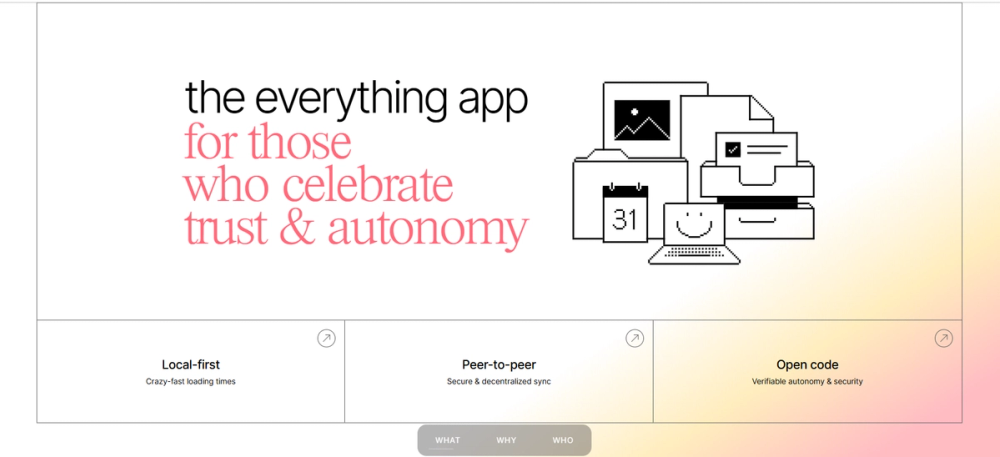
Manage notes, tasks, databases, and wikis locally with end-to-end encryption, peer-to-peer sync, and no server required. Free for personal use.

Visit websiteGitHub8.9K starsDeploy on Hostinger
image of Anytype
TL;DR

Anytype is a local-first knowledge workspace for notes, tasks, databases, and wikis, with end-to-end encryption and peer-to-peer sync. It replaces commercial platforms like Notion and Confluence for personal and non-commercial use, keeping all data on your device under zero-knowledge encryption. Licensed under the Any Source Available License 1.0 (ASAL), personal and non-commercial self-hosting is free and unrestricted; commercial use requires operating on a network authorized by Any Association.

Read the full breakdownHide the full breakdownWho it is for, how it works, trade-offs, the quick start and the FAQ
who it's for

Who Anytype is for#

Privacy-focused individuals building a personal knowledge base

Anytype stores notes, journals, and research entirely on your device with zero-knowledge encryption. Local account creation means you control your encryption keys from the start, with no cloud dependency for the core experience. This is the primary use case the product is designed and optimized for.

Skip if:

Skip if you need real-time collaborative editing with multiple simultaneous contributors. Anytype's peer-to-peer sync is not designed for concurrent multi-user editing in the way Notion handles it, and shared workspaces with heavy collaboration may surface limitations.

Non-commercial teams replacing Notion or Confluence

Small teams, open source projects, and non-profit organizations can use Anytype as a shared wiki and task tracker with no seat fees. The ASAL license permits this use without restriction. Offline-first means the workspace stays accessible during network outages.

Skip if:

Skip if your team's work qualifies as commercial and your sync network is not on the Allowed Networks list. Commercial use under ASAL requires verified network authorization, so companies replacing Confluence for paid-product work must check license compliance before relying on Anytype.

Developers building integrations on a local-first data store

The gRPC API exposes Anytype's object model for automation and custom tooling. Developers can build workflows on top of the local vault without sending data to an external service. The any-sync protocol is documented and the sync layer is not a black box.

Skip if:

Skip if your integration requires data in standard SQL or flat JSON formats. Anytype uses its own object model and protocol, so the integration surface is narrower than a headless CMS or a conventional database-backed tool.

the problem

The problem it solves#

Most knowledge management tools store your data on vendor-controlled servers. You pay per seat, accept their pricing changes, and depend on their uptime. When a platform changes block limits or raises prices, there is no portable export path that fully preserves structure and formatting.

The privacy challenge runs deeper than cost. Proprietary services like Notion, Coda, and Roam Research process your content on their servers to power search and collaboration features. For individuals and teams handling sensitive research, client notes, or personal knowledge bases, there is no self-hosted path on these commercial platforms and no guarantee that the vendor cannot access your data.

how Anytype solves it

How it solves it#

Local, on-device encryption

Every object in your vault is encrypted on your device before any sync occurs. Only you hold the encryption keys: neither Any Association nor any sync server can read your content. This is enforced structurally by the any-sync protocol, not just a privacy policy claim.

Peer-to-peer sync across devices

Devices on the same local network sync directly without routing data through a central server. When an internet-connected backup node is used, traffic is encrypted end-to-end so the node handles ciphertext only. Sync works offline and on local networks without depending on Any's hosted infrastructure.

Block-based editor with multiple database views

Pages are built from composable blocks: text, images, code, embeds, and inline databases. Database views include Table, Kanban, Gallery, and Graph, so the same data set can be displayed in different formats depending on your workflow. Custom Types let you define your own object schema.

Cross-platform desktop and mobile clients

The desktop client runs on macOS, Windows, and Linux, built with Electron and TypeScript. Mobile apps for iOS and Android provide the same vault access with native touch and scroll, and both work fully offline.

gRPC API and extensible AI Agents layer

A gRPC API exposes Anytype's object model for custom integrations and automation. An experimental AI Agents layer (documented in AGENTS.md in the repo) allows building AI-assisted workflows on top of the local data store without sending data to an external service unless you configure one.

strengths · trade-offs

Strengths and trade-offs#

Strengths

  • Zero-knowledge privacy by designEncryption happens on-device before data leaves your machine. The sync layer never handles plaintext. This is a structural guarantee enforced by the protocol, meaning it holds even if Any Association's servers are compromised. Notion and Confluence both process content server-side with no equivalent guarantee.
  • No per-seat fee for personal and non-commercial usePersonal and non-commercial self-hosting is free with no block limits, no seat caps, and no feature tiers. Teams on commercial platforms like Notion pay $8 to $16 per user per month for features that are unrestricted in Anytype for qualifying use cases.
  • Offline-first with no server dependencyThe vault lives entirely on your device. Notes, tasks, and databases work with no internet connection. Sync is additive: it works when available but is never required. This makes Anytype usable during network outages where Notion or Confluence would be inaccessible.
  • Self-hostable sync infrastructureThe any-sync protocol is published and the sync backend can be self-hosted independently of Any Association's servers. Non-commercial teams can run their own node and operate entirely outside Any's hosted service, with no vendor dependency on the sync layer.

Trade-offs

  • -Commercial use restricted to authorized networksThe ASAL permits commercial use only on networks expressly authorized by Any Association (the Allowed Networks list at networks.any.coop). Authorization can be withdrawn on reasonable notice. Companies self-hosting a sync node for commercial work must verify their network's authorized status and monitor it over time. This restriction does not exist in MIT or Apache-licensed tools.
  • -Source-available license, not OSI-approved open sourceASAL is source-available rather than OSI-certified open source. You can read and modify the code, but redistribution and commercial use carry the restrictions above. Forks must carry the same ASAL terms, so the code cannot be relicensed or incorporated into permissively licensed projects.
  • -Multi-step build process with significant prerequisitesBuilding from source requires cloning two repositories (anytype-ts and anytype-heart), installing bun, fetching prebuilt middleware binaries via a shell script, generating protobuf bindings, and then running the platform-specific dist command. Linux additionally requires system packages for the protobuf compiler.
  • -Database feature maturity behind Notion and AirtableWith 205 open GitHub issues at the time of writing, Anytype has a visible backlog. Formula support and rollups in databases are less mature than in Notion or Airtable. Teams that depend on calculated columns or complex relational views should evaluate the current state before migrating from a more established tool.
versus alternatives

Anytype vs alternatives#

Anytype vs Notion

Both tools offer block-based pages, relational databases, and collaborative wikis. The core difference is data custody: Notion stores all content on its servers; Anytype stores data on your device with end-to-end encryption.

FeatureAnytypeNotion
LicenseASAL 1.0 (source-available)Proprietary
Data locationLocal device (encrypted)Notion's servers
Self-hostingClient and sync node: yesNo
Pricing (team use)Free for non-commercial$8 to $16 per user per month
Formula supportLimitedFull formulas and rollups

Anytype is the stronger choice when data privacy is the primary requirement: encrypted local storage with zero-knowledge sync is not available in any Notion tier. Notion is still the better fit when you need mature formula support, a large template library, or real-time collaborative editing with many simultaneous users.

Anytype vs Confluence

Many teams evaluating Anytype are looking for a self-hosted replacement for Confluence that removes Atlassian's per-seat cost and cloud dependency.

FeatureAnytypeConfluence
LicenseASAL 1.0 (source-available)Proprietary
Self-hostingClient and sync: yesData Center only (high cost)
PricingFree for non-commercial$5.75+ per user per month
End-to-end encryptionYesNo
Integration ecosystemLimitedExtensive (Jira, 1,000+ apps)

For non-commercial teams, Anytype is a practical Confluence replacement for documentation and wikis. For commercial teams that need Jira integration, compliance tooling, or a large plugin ecosystem, Confluence remains the stronger fit.

Anytype vs Roam Research

Both tools target personal knowledge management with a graph view of connected notes. Roam Research charges $15 per month and stores data on its servers; Anytype is free for personal use and stores data locally.

Anytype's graph view shows connections between objects in the vault. Roam's bidirectional links and block-level transclusion are more mature for the networked-thought workflow. Anytype covers more surface area (databases, kanban, tasks) while Roam focuses on outliner-style note-taking. If daily notes and bidirectional linking are your primary workflow, Roam's feature depth is greater; if you want a broader workspace with local encryption and no subscription fee, Anytype is the stronger personal choice.

install · quick start

Quick start#

bash
Install the Anytype desktop client by building from source with bun and the project's setup scripts.
```bash
git clone https://github.com/anyproto/anytype-ts.git && cd anytype-ts
bun install
./update.sh ubuntu-latest amd
bun run dist:linux
```
tech stack · detected from GitHub

What it's built on#

Languages
JavaScriptTypeScript
Frameworks
React
frequently asked

FAQ#

Is Anytype free to use?

Personal and non-commercial use is free with no block limits, no seat caps, and no feature paywalls. The ASAL license grants unrestricted use for personal and non-commercial self-hosting. A free backup sync node is provided by Any Association; running your own sync node is also permitted for non-commercial use.

Is Anytype open source?

Anytype's source code is publicly available and can be read, modified, and built, but it is not OSI-certified open source. It is licensed under the Any Source Available License 1.0 (ASAL). Personal and non-commercial use is unrestricted; commercial use is permitted only on networks authorized by Any Association, and that authorization can be withdrawn on reasonable notice.

How does Anytype sync data across devices?

Anytype uses the any-sync peer-to-peer protocol to sync data directly between devices on a local network without a central server. For sync across the internet, it uses an encrypted backup node (hosted by Any or self-hosted by you). The backup node only handles encrypted ciphertext; your plaintext content never leaves your device unencrypted.

Can I self-host Anytype?

Yes. The desktop client stores all data locally on macOS, Windows, or Linux with no server dependency. You can also self-host the any-sync infrastructure (the sync backend) on your own server for full control over backups and sync. Building from source requires bun, the anytype-heart repository, and protobuf tooling.

How does Anytype compare to Notion for team use?

Anytype covers the same core use cases as Notion: block-based pages, databases, kanban boards, and wikis. Key differences: Anytype stores data locally with end-to-end encryption while Notion stores data on its servers; Anytype has no per-seat pricing for personal and non-commercial use while Notion charges $8 to $16 per user per month on team plans. Notion has a more mature feature set including formulas and rollups that Anytype is still developing.

Looking for more

Other ways to replace Notion, Coda, Airtable, ClickUp, Confluence, Craft.do and Roam Research#

AppFlowy

#1 in the Notion guide

Full Notion replacement for small teams

77,613 GitHub stars

AFFiNE

#2 in the Notion guide

Docs, whiteboards, and databases in one workspace

73,684 GitHub stars

Outline

#3 in the Notion guide

Polished team wiki and internal knowledge base

40,988 GitHub stars

Macro Docs

#4 in the Notion guide

Markdown-native docs that agents and teammates edit together

4,782 GitHub stars
All 21 Notion alternatives9 open source Notion alternatives, ranked
by category

Open source tools in these categories#

191

Business & Productivity

OpenClaw, Excalidraw, RustDesk
106

Product & Project Management

freeCodeCamp, agency-agents, Gstack
126

Security & Monitoring

REA (Reverse Engineer Anything), RustDesk, Uptime Kuma
Hostinger

Run Anytype on your own server

Self-host Anytype on a Hostinger VPS.

Deploy on Hostinger

Featured

rakazo

Alternative toGrok Bot

AI teammates you own: your keys, your model, your machine.

  • 4,904 GitHub stars
  • Apache-2.0Licence Apache-2.0
  • #AI Agents

Omnara

Alternative toCClaude Managed Agents

Open-source agent deployment API. Self-host or use Omnara Cloud.

  • 2,957 GitHub stars
  • Apache-2.0Licence Apache-2.0
  • #AI Agents

Inbox Zero

Alternative toSuperhuman

AI email assistant that drafts replies and clears your inbox

  • 12,712 GitHub stars
  • AGPL-3.0Licence AGPL-3.0
  • #Email
Feature your project

New open source projects by email

The projects we add and every new guide. Free, unsubscribe any time.

Find open source alternatives to paid software

/
  • Claude Code to OpenCode
  • Jira to Windshift
  • Notion to AppFlowy
  • Slack to Mattermost
  • Linear to GitLab
  • Wispr Flow to Handy
  • CapCut to Concat
  • Grok Bot to rakazo
  • Superhuman to Inbox Zero
  • Airtable to AITable
  • Muse to OpenClaw
  • GitHub Copilot to Cline
  • Datadog to Netdata
  • Microsoft Teams to Rocket.Chat
  • Pinecone to Qdrant
  • Zapier to n8n
  • Devin AI to OpenHands
  • Firebase to Supabase
  • 1Password to KeePassXC
  • Confluence to Docmost
  • Contentful to Strapi
  • Adobe Premiere Pro to Shotcut
  • ChatGPT to AnythingLLM
  • LangSmith to Langfuse