Open Source Alternatives
  • Alternatives
  • Categories
    Categories by size882 projects
    • Developer Tools461
    • AI & Machine Learning404
    • Web Development196
    • Business & Productivity191
    • Communication & Collaboration126
    • Security & Monitoring126
    • IT Management123
    • Product & Project Management106
    • Cloud & Hosting105
    • Data & Analytics104
    Browse all 21 categoriesLLMOps & AI Tooling, Design & Creative and 9 more
  • Blog
  • Advertise
SearchNotion, Slack, password manager.../
Submit
Open Source Alternatives
  • Alternatives
    • Developer Tools461
    • AI & Machine Learning404
    • Web Development196
    • Business & Productivity191
    • Communication & Collaboration126
    • Security & Monitoring126
    • Browse all 21 categories
  • Blog
  • Advertise
Submit your project

New open source projects by email

The projects we add and every new guide. Free, unsubscribe any time.

Open Source Alternatives LogoOpen Source Alternatives

Handpicked Open Source Alternatives to Paid Softwares

Product

  • Categories
  • Tag
  • Advertise

Resources

  • Blog
  • Collection
  • Submit

Company

  • Privacy Policy
  • Terms of Service
  • Refund Policy
  • Sitemap

Alternatives

  • Claude Code
  • Jira
  • Notion
  • Slack
  • Linear
  • Wispr Flow
  • All alternatives
© 2026 Open Source Alternatives. All rights reserved.
Open SourceAlternatives
Home/Categories/Developer Tools/Void Cloud
icon of Void Cloud

Void Cloud

Open source alternative to Vercel, Netlify, Cloudflare Pages, Railway and Render

  • 507 stars
  • MIT
  • Active this week
  • Last commit 2 days ago

Last verified Oct 20, 2026

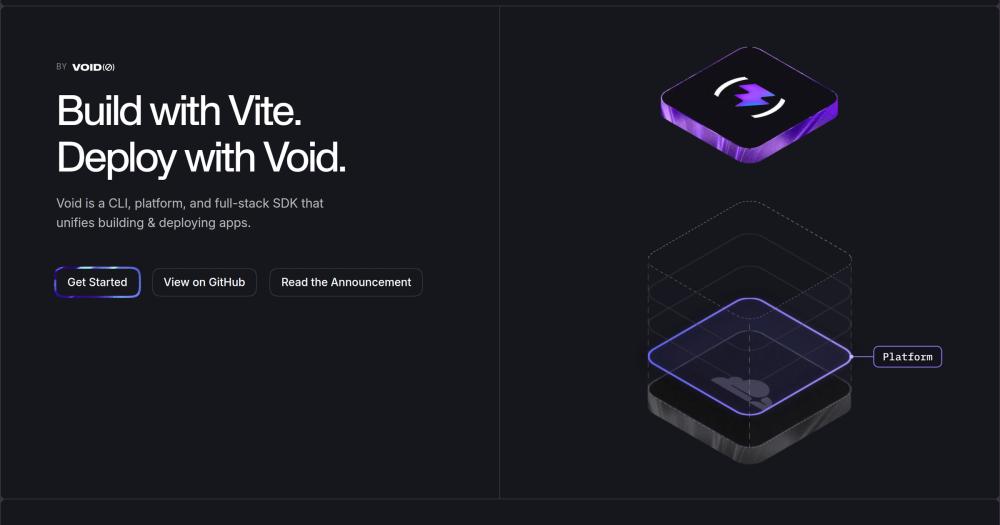
Deploy full-stack Vite apps to Cloudflare Workers with a unified CLI, SDK, and self-hosted team platform. MIT-licensed and TypeScript-native.

Visit websiteGitHub507 starsDeploy on Hostinger
Image for Void Cloud
TL;DR

Void Cloud is an open source CLI, SDK, and self-hosted Platform that deploys full-stack Vite apps to Cloudflare Workers with a single command. It replaces the deployment and build-pipeline layer of paid services like Vercel and Netlify, letting teams self-host the control plane in their own Cloudflare account. MIT-licensed, it is best suited for teams using coding agents or developers building on Cloudflare who want database migrations, typed APIs, and resource provisioning without manual Wrangler configuration.

Read the full breakdownHide the full breakdownWho it is for, how it works, trade-offs, the quick start and the FAQ
who it's for

Who Void Cloud is for#

Teams deploying Vite apps with coding agents

Void's platform lets admins grant agents deploy access without sharing Cloudflare API keys. Agents run `void deploy` through the platform's access layer; admins monitor deployments and revoke access from the admin UI or CLI.

Skip if:

Teams not yet using AI-assisted development who manage deployments manually. The platform access layer adds infrastructure overhead that a solo developer deploying from their own Cloudflare account does not need.

Solo developers adding full-stack features to Vite projects

A single `npm install -D void` and `npx void init` adds server routes, a D1 database, and typed loaders to an existing Vite project. The deploy command provisions and migrates resources without a separate Terraform or Wrangler step.

Skip if:

Developers already using a fully managed platform like Vercel or Netlify who do not need database migrations or self-hosting. The setup overhead is higher than a drag-and-drop deploy service.

Organizations running an internal deployment platform for compliance

The Void Platform is forkable and runs in the organization's own Cloudflare account. Admins manage users, projects, and access policies. The fork-and-customize path lets security teams build in their own policies without relying on a third-party service.

Skip if:

Organizations whose compliance posture permits third-party deployment services and do not need to self-host the control plane. Running the platform adds infrastructure to own and maintain.

Frontend developers adding backend features without a new meta-framework

Void's SDK adds file-based server routes and database access to any Vite project without migrating to SvelteKit, Nuxt, or another meta-framework. Import `defineHandler` and `db` from the `void` package and the CLI provisions the matching Cloudflare resources on deploy.

Skip if:

Teams already invested in SvelteKit, Nuxt, or TanStack Start and using Wrangler directly for Cloudflare deployment. Void integrates with those frameworks but adds limited benefit over their native deployment paths.

the problem

The problem it solves#

Deploying a full-stack Vite app normally means stitching together separate services: a static host, a database provider, an auth layer, a migration runner, and a deploy step tied to your CI pipeline. Each service adds a vendor, a billing relationship, and credentials your team must manage. Teams using coding agents face this more acutely: agents can build and modify code, but provisioning cloud resources and managing Cloudflare access credentials safely still requires a human in the loop.

Most commercial deployment platforms hold your Cloudflare keys on your behalf, which means surrendering direct control over who can trigger a deployment or read logs. For organizations with security or compliance requirements that prevent third-party services from holding infrastructure credentials, there is no fully self-hosted path through Vercel, Netlify, or Cloudflare Pages.

how Void Cloud solves it

How it solves it#

One-command deployment to Cloudflare Workers

Running `npx void deploy` builds the Vite app, provisions the Cloudflare resources it needs (Workers, D1 databases, R2 storage), applies pending database migrations, and prints the deployed URL. No separate Wrangler configuration or infrastructure step required.

Full-stack SDK with inferred resource provisioning

Import database, storage, auth, queue, and AI clients from the `void` package. Void detects which resources each import requires and provisions them automatically on the next deploy. No YAML configuration or infrastructure manifests to write.

Database-to-UI type safety

Types flow from the D1 database schema through server loaders and actions to React, Vue, Svelte, or Solid page components. The `InferProps` helper carries the server loader's return type to the page component, catching schema mismatches at compile time.

Self-hosted team platform with Cloudflare access controls

The Void Platform installs inside your own Cloudflare account and can be upgraded or rolled back from the CLI. Admins control who can sign in (via Cloudflare Access, Google, GitHub, or OIDC) and which projects each user can deploy to, keeping Cloudflare credentials off developer machines.

Framework-agnostic Vite adapter layer

Works with TanStack Start, SvelteKit, Nuxt, and other Vite-compatible frameworks alongside built-in adapters for async React, Vue, Svelte, and Solid. Teams can add server-side features (routes, auth, databases) to an existing Vite project without migrating to a new meta-framework.

strengths · trade-offs

Strengths and trade-offs#

Strengths

  • Cloudflare credentials stay inside your accountUnlike Vercel or Netlify, which hold deployment credentials on your behalf, the Void Platform installs in your own Cloudflare account. Admins retain the API keys; coding agents and team members deploy through the platform without ever touching them directly.
  • Single command from local dev to live deployment`npx void deploy` handles the full lifecycle: Vite build, Cloudflare Workers publish, D1 migration, and resource provisioning. Teams skip the separate CI job, migration runner, and manual resource creation that most Cloudflare deployments require.
  • MIT license with no tooling-layer restrictionsThe entire Void project (SDK, CLI, Platform) is MIT-licensed. Teams can fork the platform, customize it, and run it commercially without a license fee or usage-based billing on the tooling itself. Cloudflare's own usage billing still applies to Workers, D1, and R2.
  • Coding-agent-ready project setup`void init` writes an `AGENTS.md` file and links bundled skills for detected coding agents. The platform's access controls let admins delegate deploy rights to agents while retaining Cloudflare credential ownership, making it practical for AI-assisted development workflows.

Trade-offs

  • -Early-stage project with active open issuesThe repo was created in February 2026 and carries 31 open issues as of October 2026. Less-used framework adapters or resource types may have rough edges. Teams adopting Void in production should track the changelog and pin to specific versions rather than following main.
  • -Deployment target locked to Cloudflare WorkersVoid's CLI and Platform provision resources (Workers, D1, R2, Queues) on Cloudflare's infrastructure exclusively. There is no AWS, GCP, or VPS deployment path. Teams that need multi-cloud or bare-metal deployment must look elsewhere.
  • -Requires Node.js 24 or laterThe README specifies Node.js 24.21.0 as the minimum runtime. Teams on Node.js 20 LTS or older must upgrade their local toolchain and CI environments before adopting Void, which is a higher floor than most comparable deployment tools require.
versus alternatives

Void Cloud vs alternatives#

Void vs Vercel

Both Void and Vercel provide a deployment layer for frontend and full-stack applications, but they differ on where the infrastructure control sits. Vercel is a managed service: it provisions compute and storage on your behalf, holds your deployment credentials, and charges per seat, per build, or on usage tiers. Void is an open source toolkit you install into your own Cloudflare account; the CLI, SDK, and Platform code are MIT-licensed and free to run.

FeatureVoidVercel
LicenseMITProprietary
Self-hostingYes (Cloudflare account)No
Target runtimeCloudflare WorkersEdge / Serverless
Pricing modelFree tooling; Cloudflare usagePer seat / build-minute tiers
Team access controlsAdmin-managed, OIDC/GitHub/GoogleVercel-managed

Void is the stronger choice when your team needs to keep Cloudflare credentials inside your own account, has a security or compliance policy against third-party services holding infrastructure keys, or is building with coding agents that need deploy access without credential exposure. Vercel is the better fit when you want a polished managed experience with no infrastructure to operate, use non-Cloudflare runtimes, or rely on Vercel's preview environments and analytics.

Void vs Netlify

Netlify and Void overlap on static and full-stack deployment, but from different starting points. Netlify evolved from static hosting to supporting serverless functions and edge runtimes; Void was designed for Cloudflare Workers from the start. Netlify is a commercial service with no self-hosted option; Void's Platform can be forked and run in your Cloudflare account.

FeatureVoidNetlify
LicenseMITProprietary
Self-hostingYesNo
Database supportD1 (built-in, with migrations)Third-party only
Framework supportVite ecosystemAny web framework
Deploy control planeYour Cloudflare accountNetlify-managed

Teams building on Vite and Cloudflare gain the most from Void: migrations, typed loaders, and resource provisioning are first-class. Netlify supports more frameworks and runtimes, making it the better fit for teams with non-Vite projects or those that need Netlify's form handling or identity features.


install · quick start

Quick start#

bash
Install the Void package with Node.js 24.21.0 or later, then initialize and deploy.
```bash
npm install -D void
npx void init
npx void deploy
```
tech stack · detected from GitHub

What it's built on#

Languages
JavaScriptTypeScript
Frameworks
Vue
frequently asked

FAQ#

Is Void Cloud free to use?

The Void CLI, SDK, and Platform are MIT-licensed and free to run yourself. Cloudflare's billing for Workers, D1, R2, and Queues usage still applies, but the tooling layer has no per-seat fee or Void subscription cost.

Does Void work with SvelteKit, Nuxt, or TanStack Start?

Yes. Void supports SvelteKit, Nuxt, TanStack Start, and other Vite-compatible frameworks through adapters. Teams keep their existing routing and rendering framework while Void handles resource provisioning, migrations, and the deploy step to Cloudflare Workers.

How do I self-host the Void Platform?

Run void platform install to deploy the Platform to your Cloudflare account, then connect local projects with npx void connect <url>. The platform can be upgraded, rolled back, or repaired from the same CLI. The source is MIT-licensed, so teams can fork and customize it.

What Cloudflare resources does Void provision automatically?

Void infers which resources each import needs at build time and provisions Workers, D1 databases, R2 storage buckets, Queues, and scheduled jobs on the first deploy. Subsequent deploys apply D1 migrations and update the Worker without manual Wrangler configuration.

Is Void ready for production use given it launched in early 2026?

The core deploy path (Workers, D1, R2) is functional and actively maintained, with the last push dated October 2026. The repo carries 31 open issues, and less-common adapters or resource types may have rough edges. Teams should pin to specific versions and monitor the changelog when using Void in production.

also worth a look

Similar open-source tools#

Dokploy

Alternative toHeroku

Self-hosted PaaS to deploy apps and databases across multiple servers

  • 37,935 GitHub stars

Kamal

Alternative toFly.io

Zero-downtime Docker deploys to any server, no managed platform.

  • 14,675 GitHub stars
  • MITLicence MIT

CapRover

Alternative toHeroku

Self-hosted PaaS: deploys any language, automatic HTTPS, zero fees.

  • 15,187 GitHub stars
  • CustomLicence Apache-2.0 with additional terms

openship

Alternative toHeroku

Self-hosted deployment platform with built-in CI/CD

  • 14,865 GitHub stars
  • Apache-2.0Licence Apache-2.0

VoidZero

Alternative toVercel

Next-generation unified JavaScript tooling infrastructure

  • 6,409 GitHub stars
  • MITLicence MIT

Coolify

Alternative toVercel

Self-hosted Heroku and Vercel alternative for any app

  • 63,265 GitHub stars
  • Apache-2.0Licence Apache-2.0
by category

Open source tools in these categories#

463

Developer Tools

REA (Reverse Engineer Anything), superpowers, Skills for Real Engineers
107

Cloud & Hosting

dify, RuView, rtk
196

Web Development

freeCodeCamp, superpowers, Skills for Real Engineers
88

DevOps & CI/CD

Nvm, Uptime Kuma, Netdata
Hostinger

Run Void Cloud on your own server

Self-host Void Cloud on a Hostinger VPS.

Deploy on Hostinger

Featured

rakazo

Alternative toGrok Bot

AI teammates you own: your keys, your model, your machine.

  • 4,904 GitHub stars
  • Apache-2.0Licence Apache-2.0
  • #AI Agents

Omnara

Alternative toCClaude Managed Agents

Open-source agent deployment API. Self-host or use Omnara Cloud.

  • 2,957 GitHub stars
  • Apache-2.0Licence Apache-2.0
  • #AI Agents

Inbox Zero

Alternative toSuperhuman

AI email assistant that drafts replies and clears your inbox

  • 12,712 GitHub stars
  • AGPL-3.0Licence AGPL-3.0
  • #Email
Feature your project

New open source projects by email

The projects we add and every new guide. Free, unsubscribe any time.

Find open source alternatives to paid software

/
  • Claude Code to OpenCode
  • Jira to Windshift
  • Notion to AppFlowy
  • Slack to Mattermost
  • Linear to GitLab
  • Wispr Flow to Handy
  • CapCut to Concat
  • Grok Bot to rakazo
  • Superhuman to Inbox Zero
  • Airtable to AITable
  • Muse to OpenClaw
  • GitHub Copilot to Cline
  • Datadog to Netdata
  • Microsoft Teams to Rocket.Chat
  • Pinecone to Qdrant
  • Zapier to n8n
  • Devin AI to OpenHands
  • Firebase to Supabase
  • 1Password to KeePassXC
  • Confluence to Docmost
  • Contentful to Strapi
  • Adobe Premiere Pro to Shotcut
  • ChatGPT to AnythingLLM
  • LangSmith to Langfuse