Open Source Alternatives
  • Alternatives
  • Categories
    Categories by size882 projects
    • Developer Tools461
    • AI & Machine Learning404
    • Web Development196
    • Business & Productivity191
    • Communication & Collaboration126
    • Security & Monitoring126
    • IT Management123
    • Product & Project Management106
    • Cloud & Hosting105
    • Data & Analytics104
    Browse all 21 categoriesLLMOps & AI Tooling, Design & Creative and 9 more
  • Blog
  • Advertise
SearchNotion, Slack, password manager.../
Submit
Open Source Alternatives
  • Alternatives
    • Developer Tools461
    • AI & Machine Learning404
    • Web Development196
    • Business & Productivity191
    • Communication & Collaboration126
    • Security & Monitoring126
    • Browse all 21 categories
  • Blog
  • Advertise
Submit your project

New open source projects by email

The projects we add and every new guide. Free, unsubscribe any time.

Open Source Alternatives LogoOpen Source Alternatives

Handpicked Open Source Alternatives to Paid Softwares

Product

  • Categories
  • Tag
  • Advertise

Resources

  • Blog
  • Collection
  • Submit

Company

  • Privacy Policy
  • Terms of Service
  • Refund Policy
  • Sitemap

Alternatives

  • Claude Code
  • Jira
  • Notion
  • Slack
  • Linear
  • Wispr Flow
  • All alternatives
© 2026 Open Source Alternatives. All rights reserved.
Open SourceAlternatives
Home/Categories/Business & Productivity/Scryer
icon of Scryer

Scryer

  • 388 stars
  • GPL-3.0
  • Active this week
  • Last commit today

Last verified Oct 22, 2026

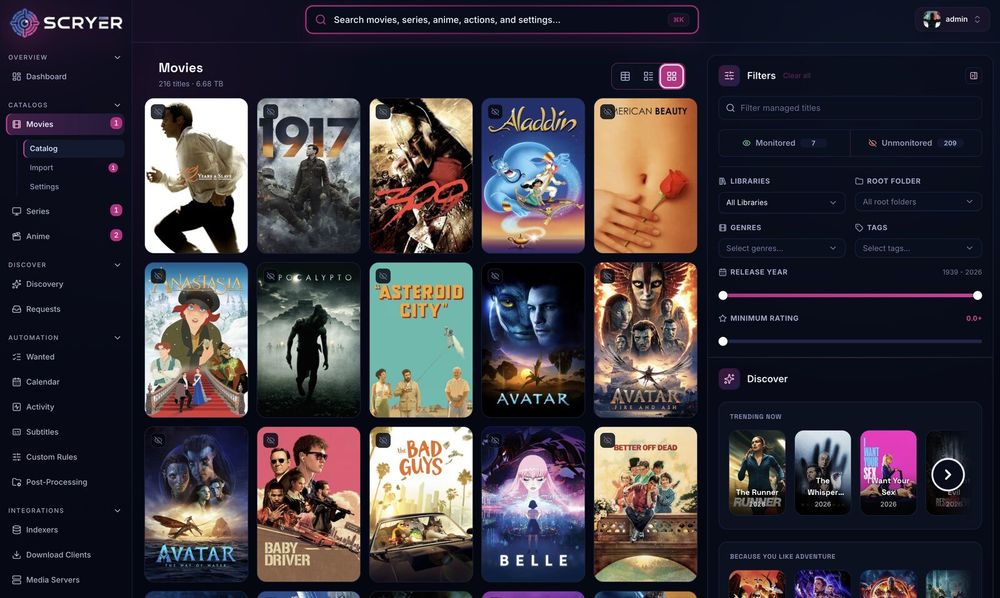
Manage movies, TV, and anime in a single self-hosted Rust binary with automated quality upgrades, subtitle sync, and indexer search.

Visit websiteGitHub388 starsDeploy on Hostinger
image of Scryer
TL;DR

Scryer is a self-hosted media manager for movies, TV, and anime, packaged as a single GPL-3.0-licensed Rust binary. It replaces the fragmented *arr stack, handling library monitoring, indexer search, quality upgrades, file organization, subtitle sync, and discovery in one process. Deployment options include Docker, a native Windows MSI installer, a macOS .dmg, and a first-party Unraid app. Best for self-hosters consolidating Sonarr, Radarr, Bazarr, and Seerr into one service, and for anime collectors who need accurate metadata across AniDB, AniList, and MAL.

Read the full breakdownHide the full breakdownWho it is for, how it works, trade-offs, the quick start and the FAQ
who it's for

Who Scryer is for#

Self-hosters running multiple arr services

If you currently maintain Sonarr, Radarr, Bazarr, and Seerr as separate containers, Scryer collapses all four into one binary with one config store. The migration target is the same functionality with less maintenance overhead.

Skip if:

If your current setup works reliably and you prefer established, community-documented tools, the *arr stack has a larger support base and more third-party integrations than a project created in early 2026.

Anime collectors needing accurate metadata

Scryer uses AniDB, AniList, and MAL as concurrent metadata sources and understands anime-specific conventions: split-cour season numbering, episode and multi-season pack handling, and the filler vs canon distinction. This covers the metadata accuracy gap that makes Sonarr unreliable for large anime libraries.

Skip if:

If your anime library is small and you are already satisfied with Sonarr's handling or a dedicated tool, the additional migration effort may not be worthwhile.

NAS and Raspberry Pi operators

Scryer runs as a single native binary, which uses less memory than running Sonarr, Radarr, and Bazarr as separate Docker containers. The first-party Unraid community app makes installation a one-click process on that platform, and native binaries are published for macOS ARM and Intel.

Skip if:

If your NAS runs a platform with no Docker or native binary support, verify that a Scryer binary exists for your architecture before committing to it.

the problem

The problem it solves#

Running a home media automation setup typically means maintaining Sonarr for TV, Radarr for movies, Bazarr for subtitle management, and Seerr for discovery requests as separate services. Each runs its own database and requires individual upgrades; a broken indexer or misconfigured quality profile in one affects the others, and debugging spans multiple admin interfaces.

Anime adds another layer of complexity. The standard *arr tools were designed around Western TV conventions and struggle with anime's distinct numbering systems: multi-season packs, split-cour seasons, and the difference between filler arcs and canon episodes often result in mismatched library entries. Users typically bolt on separate anime-specific tooling or accept persistent metadata mismatches.

how Scryer solves it

How it solves it#

Unified acquisition pipeline

Monitors libraries and tracked titles, queries indexers, evaluates releases against quality and rules policies, coordinates downloads, and organizes files for your media server, all within a single Rust binary. No cross-service communication or shared database setup required.

Anime-native metadata handling

Uses AniDB, AniList, and MAL simultaneously as metadata sources rather than relying on a single database. Understands anime season and episode numbering conventions, handles multi-season and episode packs cleanly, and distinguishes filler episodes and arcs from canon material.

Subtitle management with timing correction

Finds missing subtitles across configured providers and downloads them automatically. Includes timing correction to resync subtitle tracks when release timing drifts from the reference, which covers the most common reason subtitles go out of sync with a video file.

Plugin runtime for indexers and clients

An embedded plugin runtime handles indexers, download clients, subtitle providers, and notification targets. The GraphQL API and SQLite or PostgreSQL-backed state make it straightforward to integrate with existing home-lab tooling without additional middleware.

strengths · trade-offs

Strengths and trade-offs#

Strengths

  • Single binary cuts five services to oneThe entire acquisition stack (library monitor, indexer search, download coordination, file organization, subtitle sync) runs as one Rust process. Replacing four to six Docker containers with one binary reduces memory footprint and eliminates cross-service config drift.
  • GPL-3.0 licensed with no paid tiersScryer is free under GPL-3.0 with no premium features behind a paywall. Self-hosters get the full feature set including subtitle sync, quality upgrade automation, and anime metadata without a subscription. The GPL-3.0 license requires sharing source changes if you distribute a modified version, but has no restriction on private or commercial internal use.
  • Accurate anime metadata across multiple databasesUses AniDB, AniList, and MAL as concurrent sources, which is more accurate than the *arr tools' single-database approach. Handles the specific numbering conventions that cause mismatches in Sonarr: split-cour seasons, multi-episode packs, and the filler vs canon distinction.

Trade-offs

  • -Young project with an active issue backlogCreated in February 2026 with 362 stars and 42 open issues as of October 2026. Eight months is a short track record for production media automation software. Users who need a battle-tested, community-supported system may prefer the established *arr tools while Scryer matures.
  • -macOS requires a quarantine bypass on first launchScryer is not signed with an Apple Developer ID and is not notarized. On macOS 15 and later, users must open it once, dismiss the warning, then approve it in System Settings under Privacy and Security. On macOS 14 and earlier, right-clicking and selecting Open works instead. Either step is a one-time action, but it will block users unfamiliar with macOS security prompts.
  • -Acquisition only, no media server includedScryer manages the acquisition and organization pipeline but does not include a media server for playback. You still need Jellyfin, Emby, Plex, or a similar tool to serve files to your devices. This is by design but requires maintaining a separate media server alongside Scryer.
versus alternatives

Scryer vs alternatives#

Scryer vs Plex Pass

Plex is the dominant commercial media platform for home use. Its free tier provides basic streaming, while Plex Pass (a paid subscription) unlocks library metadata management, subtitle sync, and download automation features. Scryer and Plex Pass serve different functions in the same ecosystem: Plex Pass is a media server with acquisition as an add-on, while Scryer is a dedicated acquisition manager that delivers organized files to any media server, including Plex.

FeatureScryerPlex Pass
LicenseGPL-3.0 (free)Proprietary (subscription)
Media serverNoYes
Acquisition automationYesLimited
Anime metadataAniDB, AniList, MALLimited
Self-hostingSingle binary, no accountServer self-hosted; account required
CostFreePaid subscription

Scryer is the better choice when you want granular release quality control, deep anime metadata handling, and a self-hosted pipeline with no recurring costs or account requirements. Plex Pass is worth choosing when you prioritize a polished playback experience across smart TVs, mobile devices, and streaming sticks, and the commercial app ecosystem that comes with it.

Scryer vs Emby Premiere

Emby Premiere (a paid subscription tier) extends the free Emby media server with premium subtitle management, hardware transcoding, and live TV features. Like Plex, Emby focuses on media playback rather than automated acquisition. Scryer handles the acquisition pipeline that feeds an Emby library but does not replace Emby's playback and transcoding role.

If you currently pay for Emby Premiere primarily for its subtitle management features, Scryer's built-in subtitle sync with timing correction covers the same need at no recurring cost. The combination of Scryer plus a free media server covers most of what Emby Premiere's subscription adds for acquisition-focused users.


install · quick start

Quick start#

bash
Self-hosting setup starts from the official repository.
```bash
git clone https://github.com/scryer-media/scryer
```
tech stack · detected from GitHub

What it's built on#

Languages
JavaScriptRustTypeScript
Frameworks
React
Tooling
esbuild
frequently asked

FAQ#

Does Scryer replace Sonarr and Radarr?

Yes. Scryer is designed as a single-binary replacement for the combined Sonarr, Radarr, Bazarr, and Seerr stack. It handles TV, movies, and anime library monitoring, release search, quality management, file organization, and subtitle sync in one service. The README describes it as 'Sonarr + Radarr + Seerr + Bazarr, with some extra bits from other *arr tools.'

Does Scryer handle anime better than the standard arr tools?

Yes, and anime handling is an explicit design goal. Scryer pulls metadata from AniDB, AniList, and MAL simultaneously rather than a single source, which improves accuracy for titles with complex episode numbering. It also understands which episodes are filler and which are canon, and handles multi-season and episode packs without the manual corrections Sonarr often requires.

What license is Scryer released under?

Scryer is released under GPL-3.0. This means you can run it freely on your own infrastructure, use it for internal commercial purposes, and modify it. If you distribute a modified version to others, GPL-3.0 requires you to share those changes under the same license. Running it self-hosted for personal or team use does not trigger that requirement.

Can Scryer run on a Raspberry Pi or a NAS?

Yes. The website explicitly lists a Raspberry Pi and a NAS as target deployment environments. Scryer runs as a single native binary, which keeps resource usage lower than running multiple separate arr containers. Docker, native binaries, and a first-party Unraid community app are the available install paths.

also worth a look

Similar open-source tools#

FckSignups

InCustomer Support

Open-source tools that work instantly, no signup required

  • 4,511 GitHub stars
  • GPL-3.0Licence GPL-3.0

Apache PDFBox

Alternative toiText 7

Open source Java library for creating and parsing PDFs

  • 3,133 GitHub stars
  • Apache-2.0Licence Apache-2.0

OpenClaw

Featured

Alternative toMuse

Self-hosted AI assistant for WhatsApp, Telegram, and more

  • 392,969 GitHub stars
  • MITLicence MIT

Inbox Zero

Featured

Alternative toSuperhuman

AI email assistant that drafts replies and clears your inbox

  • 12,712 GitHub stars
  • AGPL-3.0Licence AGPL-3.0

rakazo

Featured

Alternative toGrok Bot

AI teammates you own: your keys, your model, your machine.

  • 4,904 GitHub stars
  • Apache-2.0Licence Apache-2.0

paperclip

Featured

Alternative toGrok Bot

Self-hosted AI agent management with org charts and budgets

  • 105,118 GitHub stars
  • MITLicence MIT
by category

Open source tools in these categories#

191

Business & Productivity

OpenClaw, Excalidraw, RustDesk
67

Backend Development

dify, graphify, Rust
Hostinger

Run Scryer on your own server

Self-host Scryer on a Hostinger VPS.

Deploy on Hostinger

Featured

Omnara

Alternative toCClaude Managed Agents

Open-source agent deployment API. Self-host or use Omnara Cloud.

  • 2,957 GitHub stars
  • Apache-2.0Licence Apache-2.0
  • #AI Agents

Inbox Zero

Alternative toSuperhuman

AI email assistant that drafts replies and clears your inbox

  • 12,712 GitHub stars
  • AGPL-3.0Licence AGPL-3.0
  • #Email

rakazo

Alternative toGrok Bot

AI teammates you own: your keys, your model, your machine.

  • 4,904 GitHub stars
  • Apache-2.0Licence Apache-2.0
  • #AI Agents
Feature your project

New open source projects by email

The projects we add and every new guide. Free, unsubscribe any time.

Find open source alternatives to paid software

/
  • Claude Code to OpenCode
  • Jira to Windshift
  • Notion to AppFlowy
  • Slack to Mattermost
  • Linear to GitLab
  • Wispr Flow to Handy
  • CapCut to Concat
  • Grok Bot to rakazo
  • Superhuman to Inbox Zero
  • Airtable to AITable
  • Muse to OpenClaw
  • GitHub Copilot to Cline
  • Datadog to Netdata
  • Microsoft Teams to Rocket.Chat
  • Pinecone to Qdrant
  • Zapier to n8n
  • Devin AI to OpenHands
  • Firebase to Supabase
  • 1Password to KeePassXC
  • Confluence to Docmost
  • Contentful to Strapi
  • Adobe Premiere Pro to Shotcut
  • ChatGPT to AnythingLLM
  • LangSmith to Langfuse