Open Source Alternatives
  • Alternatives
  • Categories
    Categories by size882 projects
    • Developer Tools461
    • AI & Machine Learning404
    • Web Development196
    • Business & Productivity191
    • Communication & Collaboration126
    • Security & Monitoring126
    • IT Management123
    • Product & Project Management106
    • Cloud & Hosting105
    • Data & Analytics104
    Browse all 21 categoriesLLMOps & AI Tooling, Design & Creative and 9 more
  • Blog
  • Advertise
SearchNotion, Slack, password manager.../
Submit
Open Source Alternatives
  • Alternatives
    • Developer Tools461
    • AI & Machine Learning404
    • Web Development196
    • Business & Productivity191
    • Communication & Collaboration126
    • Security & Monitoring126
    • Browse all 21 categories
  • Blog
  • Advertise
Submit your project

New open source projects by email

The projects we add and every new guide. Free, unsubscribe any time.

Open Source Alternatives LogoOpen Source Alternatives

Handpicked Open Source Alternatives to Paid Softwares

Product

  • Categories
  • Tag
  • Advertise

Resources

  • Blog
  • Collection
  • Submit

Company

  • Privacy Policy
  • Terms of Service
  • Refund Policy
  • Sitemap

Alternatives

  • Claude Code
  • Jira
  • Notion
  • Slack
  • Linear
  • Wispr Flow
  • All alternatives
© 2026 Open Source Alternatives. All rights reserved.
Open SourceAlternatives
Home/Categories/AI & Machine Learning/orbi
icon of orbi

orbi

Open source alternative to Conductor and Claude Code

  • 224 stars
  • AGPL-3.0
  • Active this week
  • Last commit today

Last verified Oct 21, 2026

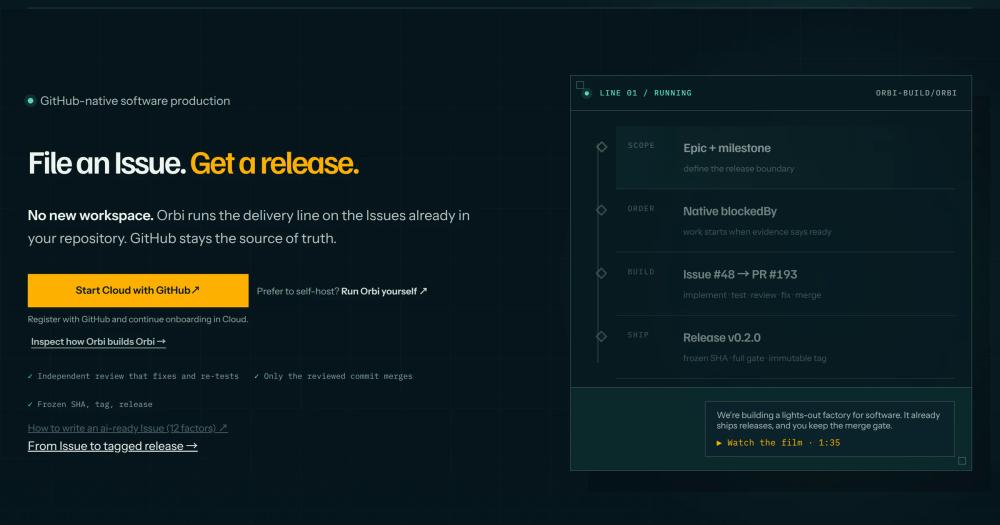
Automate GitHub Issue delivery with a self-hosted, open-source (AGPL-3.0) AI coding agent that develops, reviews, and merges code into tagged releases.

Visit websiteGitHub224 starsDeploy on Hostinger
image of orbi
TL;DR

orbi is a self-hosted AI coding agent that takes labeled GitHub Issues and delivers tagged releases through an automated pipeline. Development runs in an isolated worktree; an independent review session can then patch the code, rerun tests, and approve only the reviewed head for merge. Unlike interactive tools like Claude Code, Orbi handles unattended delivery rather than pairing with a developer at the keyboard. It runs under AGPL-3.0, which permits personal and internal company use and requires publishing changes to a modified Orbi offered as a network service. Best for teams with a well-organized GitHub backlog who want review-gated automated delivery.

Read the full breakdownHide the full breakdownWho it is for, how it works, trade-offs, the quick start and the FAQ
who it's for

Who orbi is for#

Engineering teams automating a well-scoped GitHub backlog

Orbi runs delivery loops over your existing issues without requiring a new workflow, new tooling, or changes to branch protection rules. The team writes issues, labels them ai-ready, and the agent develops, reviews, and merges them as standard pull requests. Works best when issues are scoped to single bounded changes with clear acceptance criteria.

Skip if:

The repository lacks a test suite or has no passing CI baseline. Orbi reruns tests during review, but if the baseline is failing or absent, the reviewer has nothing to verify against and issues land in an ai-blocked state.

Solo developers and teams shipping to internal repositories

Orbi is available under AGPL-3.0 for personal use and internal company use at any scale. A solo developer or a small team using Orbi on their own repositories pays nothing for the self-hosted core and brings their own model credentials. This covers most solo and startup workloads.

Skip if:

If you plan to modify Orbi and offer it as a network service but cannot publish your changes, AGPL-3.0 may not fit that deployment.

Teams evaluating autonomous delivery before committing to a cloud service

Orbi's self-hosted mode and its Managed Cloud offering share the same GitHub-native delivery model. A team can run the self-hosted version on their own machine first, inspect the delivery record on GitHub, and migrate to Managed Cloud later without changing their workflow. The first three managed deliveries are free with no credit card required.

Skip if:

If your goal is interactive code pairing rather than unattended delivery from a backlog, Orbi is not designed for that workflow. Tools like Claude Code serve interactive use cases better.

the problem

The problem it solves#

AI coding agents have changed how fast code gets written. Shipping it still needs a system. Reviewing AI-generated diffs, coordinating branch dependencies, keeping test suites green, tagging versions, and maintaining an audit trail of what shipped and why all require human supervision at each step. For teams running agents at any scale, the gap between code written and code in production becomes the bottleneck.

State management compounds the pain. When a run crashes halfway or a test suite fails mid-merge, most automated tools leave an ambiguous half-finished state spread across local files, logs, and a dangling pull request. Reconstructing what happened and deciding what to retry takes longer than the original run. Teams either accept that cost or build their own recovery logic around every tool they run.

how orbi solves it

How it solves it#

GitHub Issues as the sole state store

Work is dispatched from issues labeled ai-ready in your repository. All coordination writes back to GitHub: comments, labels, pull request bodies, and run IDs. No external database, queue, or separate task system is required. Every delivery record is a standard GitHub event, inspectable at any time without additional tooling.

Independent review that can rewrite and retest

After a development session opens a pull request, a separate review session reads the exact diff independently. That session can change the branch rather than only comment on it, reruns the test suite against its own repairs, and approves only the repaired head for merge. AI-generated code is never merged without a review pass from a session distinct from the one that wrote the code.

State recovery without a second story

A killed process, a failed test, or a model timeout leaves run state in GitHub rather than in process memory. The next scheduled tick returns to the same issue, branch, worktree, pull request, and run ID. Recoverable failures resume from the same PR; unrecoverable ones mark the issue ai-blocked with a log record, and no silent fallback runs.

Any OpenAI-compatible model or local endpoint

Orbi drives the agent through your own API credentials and supports any OpenAI-compatible endpoint, including locally hosted models. Model spend goes to your provider at your rate with no platform markup. You can change the model without changing your workflow.

Scoped releases with dependency ordering

Epics and milestones define the boundary of a release. The blockedBy field in GitHub Issues controls work ordering: a task enters production only after its blockers close. A Release Issue then validates scope across the repository, freezes the SHA, and publishes an immutable tagged version.

strengths · trade-offs

Strengths and trade-offs#

Strengths

  • Unattended delivery with human-controlled merge gatesThe scheduler triggers a new tick every five minutes and runs unattended until the issue closes. Every merge still passes through your existing GitHub branch protection, required checks, and human approval requirements. You retain the final gate without supervising each step of the pipeline.
  • Review session catches and repairs errors before mergeA separate session reviews the AI's diff before merge, and that reviewer can change the branch rather than just comment. It reruns the tests against its own repairs and approves only the repaired head. The review step is active code repair, not a comment thread a human still needs to act on.
  • Self-hosted with code staying on your machineOrbi runs where the repository and model access already live. No code or keys are uploaded to a third-party service in self-hosted mode. The self-hosted core is available under AGPL-3.0 for personal and internal company use at any scale.
  • Fully auditable delivery trail in GitHubEvery step of a delivery, from issue claim through worktree creation, PR opening, review comments, and release tag, is recorded as a normal GitHub event. The run ID appears in every journal log and GitHub comment, so the full timeline can be reconstructed with one grep.

Trade-offs

  • -AGPL-3.0 requires sharing changes to modified network servicesOrbi is free to self-host for personal and internal business use. Under AGPL-3.0, offering a modified Orbi as a network service means publishing your changes. Teams using it internally pay nothing regardless of company size or repository count.
  • -Requires Python 3.14+, gh CLI 2.94+, and systemd or launchdThe standard install path requires Python 3.14 or later and the GitHub CLI at version 2.94 or newer. Ubuntu 24.04 ships Python 3.12 and GitHub CLI 2.45.0, both below the minimums, so both need out-of-band upgrades before Orbi can run on a fresh Ubuntu server. The installer can provision a compatible Python interpreter, but the GitHub CLI upgrade is manual.
  • -Early-stage project with an open issue backlogThe repository was created in August 2026 and had 33 open issues at the time of listing. Development is active with daily commits, but Orbi has a short production history. Teams with strict stability requirements should review the current open issue list before deploying it against critical repositories.
versus alternatives

orbi vs alternatives#

Orbi vs Claude Code

Orbi and Claude Code both apply AI to software development, but they address different parts of the workflow. Claude Code is an interactive assistant you work alongside at the keyboard; Orbi is an autonomous delivery system that takes labeled GitHub Issues and closes them as tagged releases without a developer supervising each step.

FeatureOrbiClaude Code
LicenseAGPL-3.0Proprietary
Self-hostingYesNo
Workflow modelUnattended issue-to-release deliveryInteractive pairing at the keyboard
Review stepAutomated separate sessionHuman reviewer
CostFree for internal useSubscription

Orbi is the better choice when the goal is unattended delivery of a well-scoped backlog in a repository with clear issues, a test suite, and branch protection already configured. The review session catches errors and repairs them before merge, so teams get AI coding speed without losing code quality gates. Because all delivery state lives in GitHub, every step is auditable without additional tooling. For teams that prefer not to operate their own infrastructure, Orbi's Managed Cloud option runs the same GitHub-native delivery model on hosted servers.

Claude Code remains the better fit for interactive work, including exploratory development, debugging unfamiliar codebases, writing code that requires real-time judgment calls, or any situation where a developer wants to guide each step of the implementation. As an agentic assistant rather than an autonomous pipeline, Claude Code fits workflows where the developer stays in the loop throughout. Handing a labeled issue to a pipeline with no further input does not suit those scenarios.

install · quick start

Quick start#

bash
Self-hosting uses the uv package manager; the setup command installs scheduler units and configures issue labels in one pass.

```bash
git clone https://github.com/orbi-build/orbi.git && cd orbi
uv tool install --force --reinstall --editable --python python3 .
cp src/orbi/example_config.toml orbi.toml
orbi setup --config orbi.toml
```
tech stack · detected from GitHub

What it's built on#

Languages
Python
frequently asked

FAQ#

Is Orbi free to use?

The self-hosted core is available under AGPL-3.0 for personal and internal company use of any size. The Sustainable Use License remains available as an optional alternative. Managed Cloud starts with three free deliveries, then runs at $79 per month with 300M tokens of model usage included; when the token allowance runs out, new deliveries pause until the next billing cycle.

How is Orbi different from Claude Code?

Claude Code is an interactive AI coding tool you work alongside at the keyboard to write and review code in real time. Orbi handles unattended delivery from a labeled issue to a tagged release, running without supervision at each step. The review runs in a separate automated session that can modify the branch and rerun tests rather than waiting for a human to act on comments. The two tools address different parts of the development workflow rather than competing directly.

What happens when a run crashes or a test fails mid-delivery?

The next scheduled tick returns to the same scene. The issue, pull request, branch, labels, and run ID all live in GitHub rather than in process memory, so Orbi reconstructs the delivery state from that record and continues the same run. If the failure is unrecoverable, the issue is marked ai-blocked for a human to review; no silent fallback occurs and a second duplicate run is never started.

Which AI models does Orbi support?

Any OpenAI-compatible API endpoint, including locally hosted models. You bring your own credentials and the model spend goes to your provider at your rate with no platform markup on the self-hosted core. You can switch models without changing your workflow. No GPU is required for the Orbi process itself; the model runs remotely or via a locally hosted API endpoint.

What does Orbi require to run?

Python 3.14 or later (the uv installer can provision a compatible interpreter if your system Python is older), the GitHub CLI at version 2.94 or newer, git, and either systemd on Linux or launchd on macOS for scheduling. No GPU is required. The orbi doctor command names any missing prerequisite after installation. macOS support via launchd exists but is listed as not yet verified on real hardware in the README.

Looking for more

Other ways to replace Conductor and Claude Code#

paperclip

Featuredfor Conductor

Self-hosted AI agent management with org charts and budgets

105,118 GitHub starsVisit

OpenCode

#1 in the Claude Code guide

Broad provider and model choice in a terminal-first client, MIT-licensed with AGENTS.md instructions

218,637 GitHub stars

oh-my-pi

#2 in the Claude Code guide

Direct Claude configuration inheritance with Anthropic subscription support

36,029 GitHub stars

kilocode

#3 in the Claude Code guide

Documented Claude transcript import with IDE and CLI surfaces

27,673 GitHub stars
All 22 Claude Code alternatives10 open source Claude Code alternatives, ranked
by category

Open source tools in these categories#

404

AI & Machine Learning

freeCodeCamp, OpenClaw, REA (Reverse Engineer Anything)
461

Developer Tools

REA (Reverse Engineer Anything), superpowers, Skills for Real Engineers
86

DevOps & CI/CD

Nvm, Uptime Kuma, Netdata
Hostinger

Run orbi on your own server

Self-host orbi on a Hostinger VPS.

Deploy on Hostinger

Featured

Inbox Zero

Alternative toSuperhuman

AI email assistant that drafts replies and clears your inbox

  • 12,712 GitHub stars
  • AGPL-3.0Licence AGPL-3.0
  • #Email

rakazo

Alternative toGrok Bot

AI teammates you own: your keys, your model, your machine.

  • 4,904 GitHub stars
  • Apache-2.0Licence Apache-2.0
  • #AI Agents

Omnara

Alternative toCClaude Managed Agents

Open-source agent deployment API. Self-host or use Omnara Cloud.

  • 2,957 GitHub stars
  • Apache-2.0Licence Apache-2.0
  • #AI Agents
Feature your project

New open source projects by email

The projects we add and every new guide. Free, unsubscribe any time.

Find open source alternatives to paid software

/
  • Claude Code to OpenCode
  • Jira to Windshift
  • Notion to AppFlowy
  • Slack to Mattermost
  • Linear to GitLab
  • Wispr Flow to Handy
  • CapCut to Concat
  • Grok Bot to rakazo
  • Superhuman to Inbox Zero
  • Airtable to AITable
  • Muse to OpenClaw
  • GitHub Copilot to Cline
  • Datadog to Netdata
  • Microsoft Teams to Rocket.Chat
  • Pinecone to Qdrant
  • Zapier to n8n
  • Devin AI to OpenHands
  • Firebase to Supabase
  • 1Password to KeePassXC
  • Confluence to Docmost
  • Contentful to Strapi
  • Adobe Premiere Pro to Shotcut
  • ChatGPT to AnythingLLM
  • LangSmith to Langfuse