
Open Source Alternatives
  • Alternatives
  • Categories
    Categories by size882 projects
    • Developer Tools461
    • AI & Machine Learning404
    • Web Development196
    • Business & Productivity191
    • Communication & Collaboration126
    • Security & Monitoring126
    • IT Management123
    • Product & Project Management106
    • Cloud & Hosting105
    • Data & Analytics104
    Browse all 21 categoriesLLMOps & AI Tooling, Design & Creative and 9 more
  • Blog
  • Advertise
SearchNotion, Slack, password manager.../
Submit
Open Source Alternatives
  • Alternatives
    • Developer Tools461
    • AI & Machine Learning404
    • Web Development196
    • Business & Productivity191
    • Communication & Collaboration126
    • Security & Monitoring126
    • Browse all 21 categories
  • Blog
  • Advertise
Submit your project

New open source projects by email

The projects we add and every new guide. Free, unsubscribe any time.

Open Source Alternatives LogoOpen Source Alternatives

Handpicked Open Source Alternatives to Paid Softwares

Product

  • Categories
  • Tag
  • Advertise

Resources

  • Blog
  • Collection
  • Submit

Company

  • Privacy Policy
  • Terms of Service
  • Refund Policy
  • Sitemap

Alternatives

  • Claude Code
  • Jira
  • Notion
  • Slack
  • Linear
  • Wispr Flow
  • All alternatives
© 2026 Open Source Alternatives. All rights reserved.
Open SourceAlternatives
Home/Categories/Data & Analytics/Kestra
icon of Kestra

Kestra

Open source alternative to Google Cloud Composer, AWS Step Functions and Azure Data Factory

  • 29.9K stars
  • Apache-2.0
  • Active this week
  • Last commit 2 days ago

Last verified Oct 20, 2026

Orchestrate data, AI, and infrastructure workflows in YAML or UI without locking your team into a managed cloud orchestrator.

Visit websiteGitHub29.9K stars1-click deploy on Hostinger
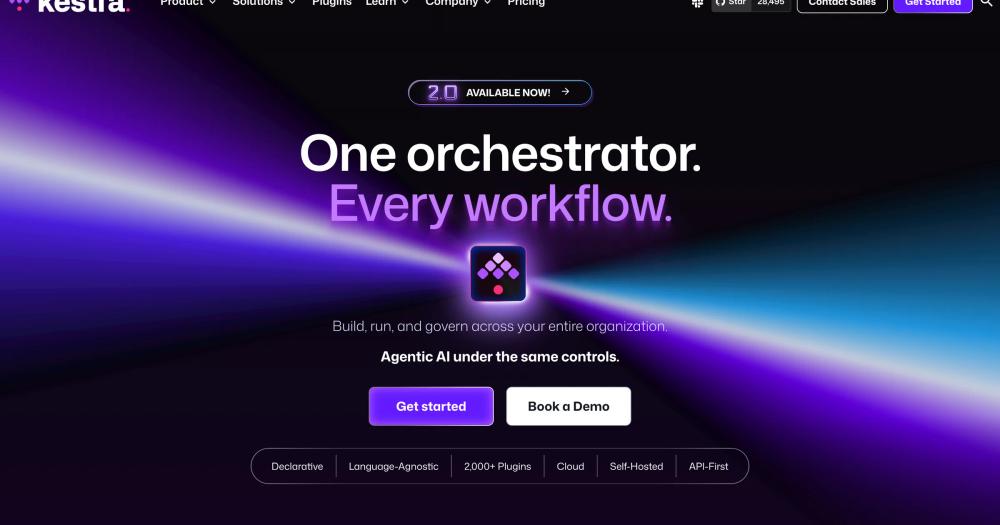
image of Kestra
TL;DR

Kestra is an open source orchestration platform for scheduled and event-driven data, AI, and infrastructure workflows. It replaces managed orchestrators like AWS Step Functions, Azure Data Factory, or Google Cloud Composer when teams want YAML-defined flows, a built-in UI, and self-hosting on their own infrastructure. Best for engineering and data teams that want Git-backed workflow automation without per-execution vendor lock-in.

Read the full breakdownHide the full breakdownWho it is for, how it works, trade-offs, the quick start and the FAQ
who it's for

Who Kestra is for#

Data engineers standardizing pipeline orchestration

Kestra gives data teams one place to schedule ETL jobs, react to upstream events, run SQL or script tasks, and inspect failures without splitting work across cron, CI, and cloud-native schedulers.

Skip if:

Skip if your team only needs a single managed ETL connector service and does not want to run its own orchestrator.

Platform teams automating infrastructure workflows

Teams can use the same orchestration layer for provisioning steps, deployment automations, retries, error handling, and notifications, while keeping workflows in Git and reviewing them like code.

Skip if:

Skip if all orchestration must stay inside one cloud provider's managed control plane with no self-hosted component.

AI and analytics teams running event-driven jobs

Kestra fits workloads that mix schedules with event triggers, such as model retraining, file arrival pipelines, webhook-driven jobs, and multi-step analytics workflows that need observability.

Skip if:

Skip if your jobs are simple single-step scripts with no dependency graph, retries, or audit needs.

the problem

The problem it solves#

Workflow automation breaks down when schedules, event triggers, scripts, SQL, and cloud tasks live in separate tools. Teams end up stitching together cron jobs, CI pipelines, Airflow DAGs, cloud-native workflow services, and custom scripts, then lose visibility when failures happen or when handoffs move across environments.

The cost is not only operational sprawl. Managed services such as AWS Step Functions, Azure Data Factory, and Google Cloud Composer can tie orchestration logic to one cloud stack, one billing model, or one deployment pattern. That makes it harder to keep workflows in Git, reuse the same orchestration model across data and infrastructure tasks, or run the platform in regulated and self-hosted environments.

how Kestra solves it

How it solves it#

Git-backed YAML workflows

Define flows in YAML and keep them in version control even when teammates edit from the UI. Kestra automatically writes workflow changes back to the declarative definition, which keeps CI/CD and review workflows intact.

Scheduled and event-driven triggers

Run cron-style jobs and real-time automations in the same platform through trigger definitions. Kestra is built around both scheduled and event-driven execution, so one flow model can cover batch pipelines, webhooks, and message-driven work.

Plugin ecosystem and language support

Hundreds of built-in plugins let teams query databases, call APIs, move files, and run scripts in Python, Node.js, R, Go, shell, and other runtimes. That reduces the need for custom operators just to integrate common infrastructure.

Visual UI with topology and validation

Build and inspect flows in the UI with code editing, syntax validation, auto-completion, and a live DAG-style topology view. Non-specialists can review workflows without taking ownership away from engineers.

Scalable deployment paths

Start locally with Docker, then move to Docker Compose, Kubernetes, or public cloud templates as volume grows. Kestra documents high-availability and fault-tolerant operation for teams running large workflow estates.

strengths · trade-offs

Strengths and trade-offs#

Strengths

  • One model for data and infrastructure workKestra handles data pipelines, AI workflows, and infrastructure automations in the same orchestration layer. That is a practical advantage over tools that focus only on ETL or only on cloud-step execution.
  • UI that preserves workflow as codeMany low-code orchestrators split visual editing from version-controlled definitions. Kestra keeps the YAML source of truth even when flows are changed through the UI, which is useful for teams that need reviewable automation changes.
  • Self-hosting without cloud lock-inKestra can run locally or on your own infrastructure instead of forcing usage through a vendor-managed control plane. Compared with AWS Step Functions or Azure Data Factory, that makes multi-cloud and regulated deployments easier to govern.

Trade-offs

  • -YAML-first model still favors technical teamsKestra offers a visual UI, but the product is still centered on declarative YAML workflows and operational concepts such as triggers, retries, namespaces, and task runners. Business users looking for spreadsheet-simple automation may find lighter SaaS tools easier to adopt.
  • -Production deployment is more involved than a managed serviceThe Docker quickstart is fast, but running Kestra as a durable team platform means operating its own infrastructure and choosing a production deployment path such as Docker Compose, Kubernetes, or cloud templates. Managed services reduce that operational burden at the cost of control.
versus alternatives

Kestra vs alternatives#

Kestra vs Apache Airflow

Kestra is the better fit when teams want declarative YAML workflows, a built-in UI, event-driven triggers, and orchestration across data, AI, infrastructure, and business operations. Airflow remains stronger for organizations with mature DAG-heavy data platforms and a deep operator ecosystem. Choose Kestra for broader automation standardization; choose Airflow when established data engineering patterns are the main requirement.

install · quick start

Quick start#

bash
docker run --pull=always -it -p 8080:8080 --user=root \
  --name kestra --restart=always \
  -v kestra_data:/app/storage \
  -v /var/run/docker.sock:/var/run/docker.sock \
  -v /tmp:/tmp \
  kestra/kestra:latest server local
tech stack · detected from GitHub

What it's built on#

Languages
JavaJavaScriptTypeScript
Frameworks
ReactVue
Infrastructure
Infrastructure as Code
frequently asked

FAQ#

Is Kestra self-hosted?

Yes. Kestra documents local Docker, Docker Compose, Kubernetes, and cloud deployment paths, so you can run it on your own infrastructure instead of relying on a hosted control plane.

Does Kestra only work for data pipelines?

No. The project positions itself for data, AI, and infrastructure workflows, with plugins and scripting support that let teams orchestrate APIs, scripts, cloud operations, and event-driven automations alongside ETL work.

How does Kestra compare with AWS Step Functions or Azure Data Factory?

Kestra gives you a self-hosted, YAML-defined orchestration layer that can span multiple environments and workflow types. AWS Step Functions and Azure Data Factory reduce operational work, but they keep teams inside a managed cloud service and billing model.

Can Kestra run tasks in languages other than Java?

Yes. While Kestra itself is built in Java, its plugin and scripting model supports Python, Node.js, R, Go, shell, SQL, and other task types inside workflows. That lets teams orchestrate existing scripts instead of rewriting them into one runtime.

also worth a look

Similar open-source tools#

Dagster

Alternative toGoogle Cloud Composer

Asset-based data pipeline orchestration with a built-in catalog

  • 16,301 GitHub stars
  • Apache-2.0Licence Apache-2.0

Ploomber

Alternative toGoogle Cloud Composer

Build reproducible Python data pipelines with DAG orchestration

  • 3,620 GitHub stars
  • Apache-2.0Licence Apache-2.0

Temporal

Alternative toAWS Step Functions

Durable workflow orchestration for reliable, long-running apps

  • 23,857 GitHub stars
  • MITLicence MIT

FckSignups

InCustomer Support

Open-source tools that work instantly, no signup required

  • 4,511 GitHub stars
  • GPL-3.0Licence GPL-3.0

Homeio

Alternative toUnraid

Browser desktop for your self-hosted home server

  • 90 GitHub stars
  • AGPL-3.0Licence AGPL-3.0

Duckle

Alternative toFivetran

Self-hosted ETL on DuckDB with 385 connectors and no per-row billing.

  • 1,517 GitHub stars
  • Apache-2.0Licence Apache-2.0
by category

Open source tools in these categories#

104

Data & Analytics

Firecrawl, ragflow, Worldmonitor
86

DevOps & CI/CD

Nvm, Uptime Kuma, Netdata
123

IT Management

RustDesk, Immich, Stirling PDF
Hostinger

Run Kestra on your own server

Hostinger sets Kestra up as a one-click app on a VPS.

Deploy on Hostinger

Featured

Inbox Zero

Alternative toSuperhuman

AI email assistant that drafts replies and clears your inbox

  • 12,712 GitHub stars
  • AGPL-3.0Licence AGPL-3.0
  • #Email

rakazo

Alternative toGrok Bot

AI teammates you own: your keys, your model, your machine.

  • 4,904 GitHub stars
  • Apache-2.0Licence Apache-2.0
  • #AI Agents

Omnara

Alternative toCClaude Managed Agents

Open-source agent deployment API. Self-host or use Omnara Cloud.

  • 2,957 GitHub stars
  • Apache-2.0Licence Apache-2.0
  • #AI Agents
Feature your project

New open source projects by email

The projects we add and every new guide. Free, unsubscribe any time.

Find open source alternatives to paid software

/
  • Claude Code to OpenCode
  • Jira to Windshift
  • Notion to AppFlowy
  • Slack to Mattermost
  • Linear to GitLab
  • Wispr Flow to Handy
  • CapCut to Concat
  • Grok Bot to rakazo
  • Superhuman to Inbox Zero
  • Airtable to AITable
  • Muse to OpenClaw
  • GitHub Copilot to Cline
  • Datadog to Netdata
  • Microsoft Teams to Rocket.Chat
  • Pinecone to Qdrant
  • Zapier to n8n
  • Devin AI to OpenHands
  • Firebase to Supabase
  • 1Password to KeePassXC
  • Confluence to Docmost
  • Contentful to Strapi
  • Adobe Premiere Pro to Shotcut
  • ChatGPT to AnythingLLM
  • LangSmith to Langfuse