
Open Source Alternatives
  • Alternatives
  • Categories
    Categories by size882 projects
    • Developer Tools461
    • AI & Machine Learning404
    • Web Development196
    • Business & Productivity191
    • Communication & Collaboration126
    • Security & Monitoring126
    • IT Management123
    • Product & Project Management106
    • Cloud & Hosting105
    • Data & Analytics104
    Browse all 21 categoriesLLMOps & AI Tooling, Design & Creative and 9 more
  • Blog
  • Advertise
SearchNotion, Slack, password manager.../
Submit
Open Source Alternatives
  • Alternatives
    • Developer Tools461
    • AI & Machine Learning404
    • Web Development196
    • Business & Productivity191
    • Communication & Collaboration126
    • Security & Monitoring126
    • Browse all 21 categories
  • Blog
  • Advertise
Submit your project

New open source projects by email

The projects we add and every new guide. Free, unsubscribe any time.

Open Source Alternatives LogoOpen Source Alternatives

Handpicked Open Source Alternatives to Paid Softwares

Product

  • Categories
  • Tag
  • Advertise

Resources

  • Blog
  • Collection
  • Submit

Company

  • Privacy Policy
  • Terms of Service
  • Refund Policy
  • Sitemap

Alternatives

  • Claude Code
  • Jira
  • Notion
  • Slack
  • Linear
  • Wispr Flow
  • All alternatives
© 2026 Open Source Alternatives. All rights reserved.
Open SourceAlternatives
Home/Categories/Data & Analytics/Dagster
icon of Dagster

Dagster

Open source alternative to Google Cloud Composer, Databricks and Azure Data Factory

  • 16.3K stars
  • Apache-2.0
  • Active this week
  • Last commit 2 days ago

Last verified Oct 20, 2026

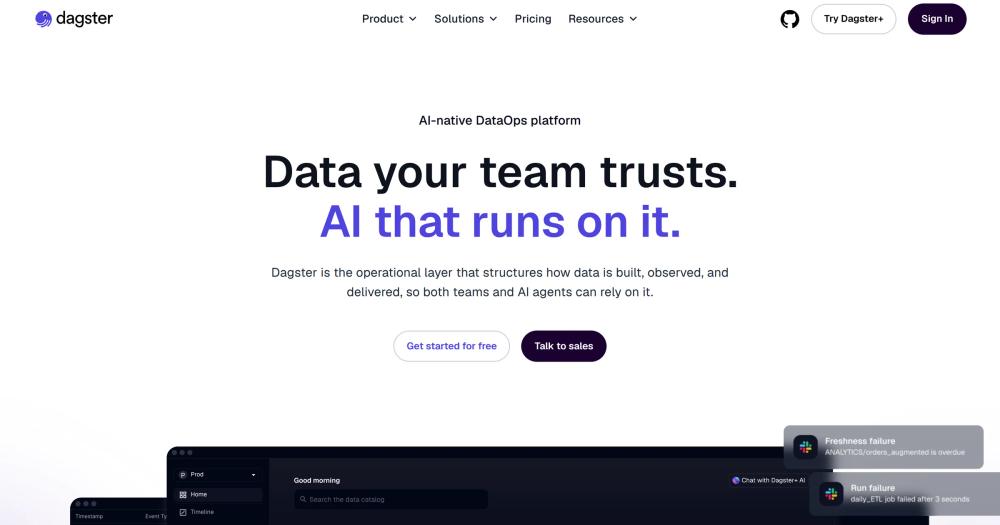
Dagster is an open source data pipeline orchestrator with an asset-centric model, built-in data catalog, and scheduling for AI and analytics workflows. Apache 2.0 licensed.

Visit websiteGitHub16.3K stars
image of Dagster
TL;DR

Dagster is an Apache-2.0 data orchestration tool for building, observing, and operating data assets and pipelines. It replaces parts of Airflow, Google Cloud Composer, and managed workflow tools for data teams that want asset-aware orchestration, typed development patterns, and better local-to-production workflows.

Read the full breakdownHide the full breakdownWho it is for, how it works, trade-offs and the FAQ
who it's for

Who Dagster is for#

Data platform teams managing asset lineage

Dagster helps teams see which data assets exist, what produces them, and what downstream jobs depend on them. This fits warehouses, lakehouses, dbt projects, and ML feature pipelines.

Skip if:

Skip it if your workflow is only a few simple cron jobs with no data lineage or asset ownership problem.

Analytics engineers coordinating dbt and Python

Dagster can orchestrate dbt transformations alongside Python jobs, checks, and external resources. It gives analytics teams a way to operate data workflows as software.

Skip if:

Use a warehouse-native scheduler if all transformations already live in one managed SQL environment and orchestration needs are minimal.

the problem

The problem it solves#

Data pipelines fail when teams can only see tasks instead of the data assets those tasks produce. Airflow-style DAGs can schedule jobs, but they often leave lineage, testing, asset ownership, and data quality checks scattered across notebooks, warehouse SQL, and monitoring tools.\u000A\u000AAs data teams support analytics, machine learning, and production AI features, they need orchestration that explains what data exists, how it updates, and what broke. A generic scheduler is not enough once data assets become part of product reliability.

how Dagster solves it

How it solves it#

Asset-aware orchestration

Dagster models data assets directly, not only tasks. Teams can understand dependencies between tables, files, models, and downstream products in the same system that runs the jobs.

Python development workflow

Pipelines are defined in Python with testable code, local development tools, and clear resource configuration. That fits engineering-heavy data teams that want version control and review around orchestration logic.

Observability for runs and assets

Dagster tracks runs, materializations, metadata, and failures so teams can debug which asset changed and why. This is more actionable than a task-only success or failure log.

Integrations for modern data stacks

Dagster integrates with warehouses, dbt, Spark, Kubernetes, cloud storage, and ML workflows. It can coordinate data engineering and analytics engineering in one orchestration layer.

strengths · trade-offs

Strengths and trade-offs#

Strengths

  • Better mental model for data productsAssets make Dagster easier to reason about when the real output is a table, feature set, dashboard input, or model artifact. That helps teams connect orchestration to business-facing data reliability.
  • Open source with managed optionThe core is Apache-2.0 licensed, and Dagster Cloud is available for teams that want hosted operations. Teams can start self-hosted and move to managed support if operations become the bottleneck.

Trade-offs

  • -Migration from Airflow takes redesignDagster's asset model is different from task-first DAGs. Teams migrating from Airflow should plan to rethink pipeline boundaries rather than mechanically port every operator.
  • -Python-centric workflowDagster is strongest for teams comfortable with Python-defined orchestration. Teams that want a visual-only low-code data pipeline tool may prefer managed ETL products.
versus alternatives

Dagster vs alternatives#

Dagster vs Airflow\u000A\u000ADagster and Airflow both orchestrate data workflows, but Dagster centers the data assets those workflows produce while Airflow centers scheduled tasks.\u000A\u000A| Criterion | Dagster | Airflow |\u000A| --- | --- | --- |\u000A| License | Apache-2.0 | Apache-2.0 |\u000A| Core model | Data assets and jobs | Task DAGs |\u000A| Development | Python with local tooling | Python DAG files and operators |\u000A| Best fit | Asset-aware data products | Broad scheduler ecosystem and legacy DAGs |\u000A\u000ADagster is the better choice when lineage, asset ownership, and data quality are central to the workflow. Airflow remains attractive when a team already has many DAGs, existing operators, and a mature Airflow operations practice.

tech stack · detected from GitHub

What it's built on#

Languages
PythonTypeScript
Frameworks
Next.jsReact
Tooling
Webpack
frequently asked

FAQ#

What is Dagster used for?

Dagster is used to orchestrate data assets, pipelines, dbt jobs, ML workflows, and production data processes. It focuses on data lineage and asset observability, not just task scheduling.

Is Dagster open source?

Yes. Dagster's core project is Apache-2.0 licensed. Dagster Labs also offers Dagster Cloud for teams that want managed orchestration operations.

How does Dagster compare to Airflow?

Dagster models data assets and their dependencies, while Airflow traditionally focuses on task DAGs. Airflow has broader legacy adoption; Dagster is often a better fit for teams that want asset-aware data operations.

also worth a look

Similar open-source tools#

Kestra

Alternative toGoogle Cloud Composer

Declarative workflow orchestration for data and DevOps teams

  • 29,909 GitHub stars
  • Apache-2.0Licence Apache-2.0

Renart

Alternative todbt Cloud

SQL and Python pipelines, notebooks, and dashboards in Git

  • 93 GitHub stars
  • Apache-2.0Licence Apache-2.0

marin

Alternative toDatabricks

Open lab for training foundation models together

  • 3,987 GitHub stars
  • Apache-2.0Licence Apache-2.0

open-notebook

Alternative toNotebookLM

Self-host private AI research notebooks

  • 40,406 GitHub stars
  • MITLicence MIT

CocoIndex

Alternative toLlamaIndex

Incremental data framework for AI agents.

  • 11,726 GitHub stars
  • Apache-2.0Licence Apache-2.0

Ollama

Alternative toLM Studio

Run large language models locally on Mac, Linux, or Windows

  • 184,070 GitHub stars
  • MITLicence MIT
by category

Open source tools in these categories#

104

Data & Analytics

Firecrawl, ragflow, Worldmonitor
404

AI & Machine Learning

freeCodeCamp, OpenClaw, REA (Reverse Engineer Anything)
86

DevOps & CI/CD

Nvm, Uptime Kuma, Netdata

Featured

Inbox Zero

Alternative toSuperhuman

AI email assistant that drafts replies and clears your inbox

  • 12,712 GitHub stars
  • AGPL-3.0Licence AGPL-3.0
  • #Email

rakazo

Alternative toGrok Bot

AI teammates you own: your keys, your model, your machine.

  • 4,904 GitHub stars
  • Apache-2.0Licence Apache-2.0
  • #AI Agents

Omnara

Alternative toCClaude Managed Agents

Open-source agent deployment API. Self-host or use Omnara Cloud.

  • 2,957 GitHub stars
  • Apache-2.0Licence Apache-2.0
  • #AI Agents
Feature your project

New open source projects by email

The projects we add and every new guide. Free, unsubscribe any time.

Find open source alternatives to paid software

/
  • Claude Code to OpenCode
  • Jira to Windshift
  • Notion to AppFlowy
  • Slack to Mattermost
  • Linear to GitLab
  • Wispr Flow to Handy
  • CapCut to Concat
  • Grok Bot to rakazo
  • Superhuman to Inbox Zero
  • Airtable to AITable
  • Muse to OpenClaw
  • GitHub Copilot to Cline
  • Datadog to Netdata
  • Microsoft Teams to Rocket.Chat
  • Pinecone to Qdrant
  • Zapier to n8n
  • Devin AI to OpenHands
  • Firebase to Supabase
  • 1Password to KeePassXC
  • Confluence to Docmost
  • Contentful to Strapi
  • Adobe Premiere Pro to Shotcut
  • ChatGPT to AnythingLLM
  • LangSmith to Langfuse