Open Source Alternatives
  • Alternatives
  • Categories
    Categories by size905 projects
    • Developer Tools471
    • AI & Machine Learning408
    • Web Development198
    • Business & Productivity196
    • Security & Monitoring131
    • Communication & Collaboration128
    • IT Management126
    • Cloud & Hosting109
    • Product & Project Management106
    • Data & Analytics105
    Browse all 21 categoriesDesign & Creative, LLMOps & AI Tooling and 9 more
  • Blog
  • Advertise
SearchNotion, Slack, password manager.../
Submit
Open Source Alternatives
  • Alternatives
    • Developer Tools471
    • AI & Machine Learning408
    • Web Development198
    • Business & Productivity196
    • Security & Monitoring131
    • Communication & Collaboration128
    • Browse all 21 categories
  • Blog
  • Advertise
Submit your project

New open source projects by email

The projects we add and every new guide. Free, unsubscribe any time.

Open Source Alternatives LogoOpen Source Alternatives

Handpicked Open Source Alternatives to Paid Softwares

Product

  • Categories
  • Tag
  • Advertise

Resources

  • Blog
  • Collection
  • Submit

Company

  • Privacy Policy
  • Terms of Service
  • Refund Policy
  • Sitemap

Alternatives

  • Claude Code
  • Jira
  • Notion
  • Slack
  • Linear
  • Wispr Flow
  • All alternatives
© 2026 Open Source Alternatives. All rights reserved.
Open SourceAlternatives
Home/Categories/Developer Tools/Cyrus
icon of Cyrus

Cyrus

  • 214 stars
  • MIT
  • Active this week
  • Last commit 2 days ago

Last verified Oct 21, 2026

Build high-performance systems software with explicit memory control, no garbage collector, and LLVM-backed native compilation. MIT licensed.

Visit websiteGitHub214 stars
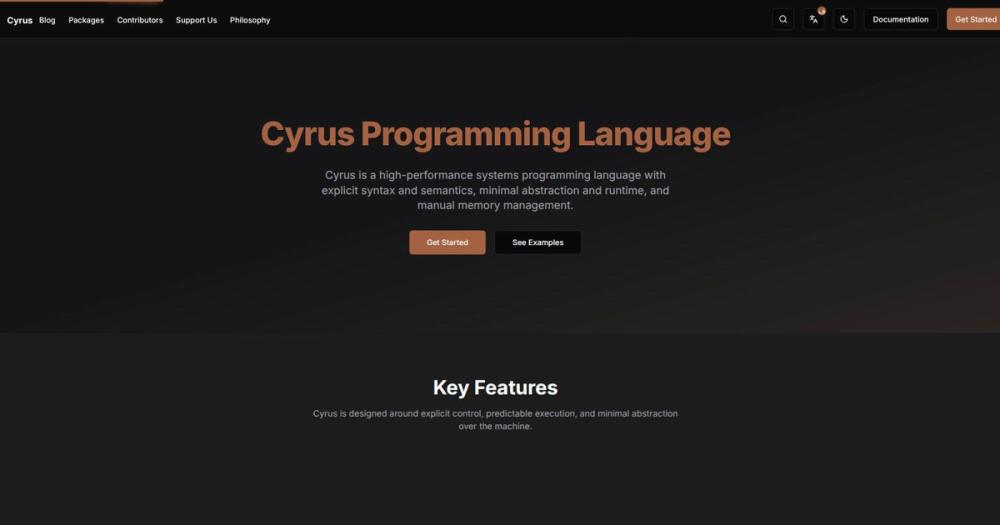
Image for Cyrus
TL;DR

Cyrus is a systems programming language that compiles ahead-of-time through LLVM to native machine code, with no garbage collector, no borrow checker, and no hidden runtime overhead. It targets developers who want C-level machine control with modern ergonomics: generics, algebraic types, a real module system, and `defer`-based resource cleanup, without adopting Rust's lifetime model. The license is MIT. Best for embedded engineers, OS-level developers, and infrastructure tooling teams who prioritize explicit control.

Read the full breakdownHide the full breakdownWho it is for, how it works, trade-offs and the FAQ
who it's for

Who Cyrus is for#

Systems developers moving off C

Cyrus provides the control of C with generics, a real module system, algebraic types, and `defer`-based resource cleanup. If C's lack of these constructs has led to hand-rolled workarounds in your codebase, Cyrus gives a path forward without adopting a garbage-collected language or Rust's ownership model. Mutability, pointer indirection, and type casts are all explicit at the call site.

Skip if:

You need Windows or macOS support at this time. The current compiler only targets Linux (x86_64).

Embedded and OS-level engineers

Cyrus supports inline assembly, `extern` for C ABI compatibility, `naked` functions for interrupt handlers, pointer arithmetic, and custom allocator strategies. Zero hidden runtime overhead and fully manual memory control make it usable in contexts where a garbage collector or managed runtime is not acceptable.

Skip if:

Your target platform is not Linux (x86_64). Multi-platform support is in the roadmap but not yet available in the current release.

Developers building performance-critical CLI tools

For teams writing high-performance CLI tools, compilers, parsers, or infrastructure utilities in Rust but experiencing friction with the borrow checker for data-structure-heavy code, Cyrus offers a similar performance ceiling with fewer lifetime constraints. The LLVM backend produces native binaries with no external runtime dependency.

Skip if:

Your team is productive with Rust and not experiencing borrow-checker friction. Cyrus trades safety guarantees for a simpler ownership model, not a safer one.

Compiler engineers and language researchers

Cyrus is self-hosting: the compiler is being rewritten in Cyrus itself. The project documents its design rationale and deliberate omissions in the README and on the project website. Developers interested in compiler construction have a live LLVM frontend written in Rust to read, contribute to, and study alongside the official documentation.

Skip if:

You need a stable, production-ready language with ABI guarantees. Cyrus is pre-self-hosting and breaking changes are expected during the current development phase.

the problem

The problem it solves#

Systems programming requires precise control over memory, allocation, and execution flow. C provides that control but lacks a real module system, generics, and type safety for common patterns, so teams accumulate wrapper libraries and header workarounds to compensate. Rust solves those ergonomics problems but introduces a borrow checker and lifetime annotations that many teams find restrictive, particularly for data-structure-heavy work or embedded firmware where ownership patterns do not fit neatly.

The gap is that the middle ground is mostly unoccupied. Developers who want C-level control without C's ergonomics deficits, but who do not want Rust's ownership rules for straightforward systems work, have limited choices. Existing options either bring a garbage collector (Go), a heavy runtime (Java, .NET), or require a paradigm shift (Rust). Teams end up spending time fighting tooling instead of writing the low-level code that actually matters.

how Cyrus solves it

How it solves it#

LLVM-Based Native Compilation

Cyrus compiles ahead-of-time through LLVM to optimized native machine code, producing deterministic performance characteristics. Full interoperability with C code is available via the C ABI, so you can call C functions from Cyrus and expose Cyrus functions to C projects without writing glue code. The compiler accepts `extern(c)` on both sides of the boundary.

Manual Memory Management with Defer

Memory is managed explicitly through manual allocation patterns and custom allocators. The `defer` keyword schedules cleanup at scope exit in LIFO order, keeping resource management flat and readable. There is no garbage collector and no hidden ownership system. Custom allocators (stack, bump, libc) are first-class via the `Allocator` interface, so you can swap strategies without changing calling code.

Strict Explicit Type System

Strong static typing with no implicit conversions between types. Safe widening (for example, `int32` to `int64`) happens automatically, but any operation with risk of data loss or signedness mismatch requires an explicit `@cast`. Generics are monomorphized at compile time for direct static dispatch with zero runtime abstraction cost.

No Hidden Semantics

Mutability is declared with `const` or `var` at the definition site. Pointer indirection uses `->` explicitly, so every memory boundary crossing is visible in the source. There are no hidden allocations: every heap allocation requires calling an allocator explicitly. No monkey-patching, no implicit type coercions, no silent behavior behind compiler-driven assumptions.

Bidirectional C ABI Interoperation

Call C functions from Cyrus or expose Cyrus functions to C code using `extern(c)`, with no additional tooling or FFI wrappers required. This makes incremental migration from existing C projects feasible and allows reuse of the C ecosystem without rewriting libraries. Inline assembly, `naked` functions, and union type punning are also supported for low-level system interfaces.

Algebraic Types and Pattern Matching

Enums support unit variants, tuple variants, struct variants, and valued variants. Pattern matching uses a `switch` statement with case destructuring. Generics work across functions, structs, unions, enums, and interfaces, all type-checked at compile time without instantiation. Interfaces support both static (monomorphized) and explicit dynamic dispatch via the `dynamic` keyword.

strengths · trade-offs

Strengths and trade-offs#

Strengths

  • No GC, No Borrow CheckerCyrus deliberately omits both garbage collection and Rust's borrow checker. You get deterministic memory management and full control over allocation strategy without the cognitive overhead of lifetime annotations. This is the primary differentiator for teams who find Rust's ownership model too constraining for data-structure-heavy or embedded work.
  • Explicit Semantics ThroughoutEvery operation with a side effect is visible in the source: mutability via `const`/`var`, pointer indirection via `->`, explicit casts via `@cast`, explicit allocations via an allocator call. No silent coercions, no hidden vtables on struct access, no implicit type transformations. Predictability is a design goal, not a side effect.
  • Modern Language Features on a Proven Compiler BackendGenerics, algebraic types, interfaces with static and dynamic dispatch, modules, and `defer` for deterministic cleanup, all built on the LLVM infrastructure. The backend produces native binaries using the same optimization pipeline as Clang and Rust, so performance characteristics are comparable to C at the machine level.
  • MIT License, No Usage RestrictionsThe MIT license places no restrictions on commercial use, modification, or redistribution. You can use Cyrus to build commercial products, fork the compiler, or incorporate it into proprietary toolchains. The project is under active development with the most recent push in August 2026.

Trade-offs

  • -Linux-Only Compiler at Current ReleaseThe current Cyrus compiler supports Linux (x86_64) only. Windows and macOS support is planned after the self-hosting milestone is complete. Teams working on macOS or targeting Windows cannot use Cyrus for production work until multi-platform support ships.
  • -No Stable ABI Between VersionsCyrus does not guarantee a stable ABI between releases. Calling conventions, type layouts, and optimization strategies may change to improve performance. For cross-language boundaries, the project recommends using the C ABI (`extern(c)`) and treating the Cyrus-to-Cyrus ABI as an internal implementation detail.
  • -Pre-Self-Hosting, Breaking Changes ExpectedCyrus is actively working toward its self-hosting milestone, rewriting the compiler in Cyrus itself. Several planned features are not yet implemented: slices, full generic instantiation safety (currently behaves like C++ templates, not Rust-style), attributes, and a test framework. Teams should expect breaking changes during this phase.
  • -No Compiler-Enforced Memory SafetyData races, dangling pointers, and use-after-free errors are possible and are not prevented by the compiler. The runtime enforces bounds checking, null pointer detection, and integer overflow, and sanitizers (ASan, TSan) are supported for debugging. The design trades safety guarantees for direct machine access and simpler code without ownership rules.
versus alternatives

Cyrus vs alternatives#

Cyrus vs Google Firebase

Cyrus is a systems programming language; Google Firebase is a managed backend-as-a-service platform providing realtime databases, authentication, hosting, and cloud functions. They are not direct competitors, but they represent opposite design philosophies: Firebase abstracts away infrastructure and runtime; Cyrus exposes every allocation, dispatch, and execution decision to the developer.

Firebase is the right choice when you want a managed backend without configuring servers. Its hosted database, auth layer, and cloud functions handle scaling automatically, with Google managing the runtime environment. The cost scales with usage, and you are bound to Firebase's pricing model and managed infrastructure.

Cyrus is for teams building the infrastructure layer itself. Writing a backend service, a database engine, a compiler, or an OS-level tool requires the kind of control that a managed BaaS cannot provide: manual memory management, custom allocators, inline assembly, bare-metal compilation to a self-contained native binary, and zero runtime overhead.

CriterionCyrusGoogle Firebase
TypeSystems programming languageManaged backend-as-a-service
LicenseMITProprietary
Self-hostedYes (Linux x86_64)No
Runtime overheadNoneNode.js managed runtime
Memory modelManual, explicit allocatorsManaged by runtime
CostFree (nightly binary or build from source)Pay-per-use (free tier available)

Firebase is still the better choice when you want production-ready backend services without managing infrastructure, need real-time client sync across devices out of the box, or are building a mobile app that requires authentication and push notifications without writing a server. Those are use cases Cyrus does not address.

Cyrus is the better choice when you are building the kind of system that would sit below Firebase: bare-metal services, native binaries, infrastructure tooling, or compilers where runtime overhead is a hard constraint and you need full visibility into memory and execution.

tech stack · detected from GitHub

What it's built on#

Languages
C++PythonRust
frequently asked

FAQ#

Is Cyrus safe like Rust?

No, not by design. Cyrus explicitly omits Rust's borrow checker and ownership system. Data races, dangling pointers, and use-after-free errors are possible. The runtime enforces bounds checking, null pointer detection, and integer overflow, and ASan/TSan sanitizers are supported for debugging. The trade is deliberate: Cyrus prioritizes direct machine access and code without lifetime annotations over compiler-enforced memory safety.

What platforms does Cyrus support?

The current Cyrus compiler supports Linux (x86_64) only. Windows and macOS support is planned after the self-hosting milestone, which involves rewriting the compiler in Cyrus itself. A nightly binary is available for download, and building from source is documented on the project website at cyrus-lang.ir.

How does Cyrus manage memory without a garbage collector?

Memory is managed explicitly. You allocate memory using an allocator (libc, arena, or custom) and free it yourself. The defer keyword schedules cleanup at scope exit in LIFO order, keeping resource management readable and flat. Custom allocators implement the Allocator interface, so you can swap between strategies (arena vs. libc) without changing the calling code.

Is Cyrus ABI-stable?

No. Cyrus does not guarantee a stable ABI between versions. Calling conventions, type layouts, and optimization strategies may change between releases to improve performance and code quality. The project recommends using the C ABI (extern(c)) for all cross-language boundaries and treating the Cyrus-to-Cyrus ABI as an internal detail that may evolve.

How does Cyrus compare to C and Rust?

Cyrus positions itself between C and Rust. It has the explicit control and direct memory access of C, with a modern type system (generics, algebraic types, modules, no silent coercions) that C lacks. Unlike Rust, it has no borrow checker or lifetime annotations, so there is no ownership-based safety. It is closer in ergonomics to a modernized C than to Rust's safety-first model, targeting developers who want control without the complexity of lifetimes.

also worth a look

Similar open-source tools#

Php Src

Alternative toAdobe ColdFusion

Open source PHP interpreter for web and server-side scripting

  • 41,164 GitHub stars
  • BSD-3-ClauseLicence BSD-3-Clause

Fastapi

Alternative toAWS API Gateway

High-performance Python API framework with auto OpenAPI documentation

  • 103,755 GitHub stars
  • MITLicence MIT

Rust

InWeb Development

Systems language with memory safety and no garbage collector.

  • 120,618 GitHub stars
  • Apache-2.0Licence Apache-2.0

Firebase Ios Sdk

Alternative toAWS Amplify

Open source Apple SDK for Firebase auth, data, push and crashes

  • 6,974 GitHub stars
  • Apache-2.0Licence Apache-2.0

scriptc

InDeveloper Tools

TypeScript to native executables, no runtime required

  • 6,369 GitHub stars
  • Apache-2.0Licence Apache-2.0

FckSignups

InCustomer Support

Open-source tools that work instantly, no signup required

  • 4,511 GitHub stars
  • GPL-3.0Licence GPL-3.0
by category

Open source tools in these categories#

471

Developer Tools

REA (Reverse Engineer Anything), superpowers, Skills for Real Engineers
69

Backend Development

dify, graphify, Rust
198

Web Development

freeCodeCamp, superpowers, Skills for Real Engineers

Featured

Inbox Zero

Alternative toSuperhuman

AI email assistant that drafts replies and clears your inbox

  • 12,712 GitHub stars
  • AGPL-3.0Licence AGPL-3.0
  • #Email

Omnara

Alternative toCClaude Managed Agents

Open-source agent deployment API. Self-host or use Omnara Cloud.

  • 2,957 GitHub stars
  • Apache-2.0Licence Apache-2.0
  • #AI Agents

rakazo

Alternative toGrok Bot

AI teammates you own: your keys, your model, your machine.

  • 4,904 GitHub stars
  • Apache-2.0Licence Apache-2.0
  • #AI Agents
Feature your project

New open source projects by email

The projects we add and every new guide. Free, unsubscribe any time.

Find open source alternatives to paid software

/
  • Claude Code to OpenCode
  • Jira to Windshift
  • Notion to AppFlowy
  • Slack to Mattermost
  • Linear to GitLab
  • Wispr Flow to Handy
  • CapCut to Concat
  • Grok Bot to rakazo
  • Superhuman to Inbox Zero
  • Airtable to AITable
  • Muse to OpenClaw
  • GitHub Copilot to Cline
  • Datadog to Netdata
  • Microsoft Teams to Rocket.Chat
  • Confluence to Docmost
  • Pinecone to Qdrant
  • Zapier to n8n
  • Devin AI to OpenHands
  • Firebase to Supabase
  • 1Password to KeePassXC
  • Contentful to Strapi
  • Adobe Premiere Pro to Shotcut
  • ChatGPT to AnythingLLM
  • LangSmith to Langfuse