Open Source Alternatives
  • Alternatives
  • Categories
    Categories by size882 projects
    • Developer Tools461
    • AI & Machine Learning404
    • Web Development196
    • Business & Productivity191
    • Communication & Collaboration126
    • Security & Monitoring126
    • IT Management123
    • Product & Project Management106
    • Cloud & Hosting105
    • Data & Analytics104
    Browse all 21 categoriesLLMOps & AI Tooling, Design & Creative and 9 more
  • Blog
  • Advertise
SearchNotion, Slack, password manager.../
Submit
Open Source Alternatives
  • Alternatives
    • Developer Tools461
    • AI & Machine Learning404
    • Web Development196
    • Business & Productivity191
    • Communication & Collaboration126
    • Security & Monitoring126
    • Browse all 21 categories
  • Blog
  • Advertise
Submit your project

New open source projects by email

The projects we add and every new guide. Free, unsubscribe any time.

Open Source Alternatives LogoOpen Source Alternatives

Handpicked Open Source Alternatives to Paid Softwares

Product

  • Categories
  • Tag
  • Advertise

Resources

  • Blog
  • Collection
  • Submit

Company

  • Privacy Policy
  • Terms of Service
  • Refund Policy
  • Sitemap

Alternatives

  • Claude Code
  • Jira
  • Notion
  • Slack
  • Linear
  • Wispr Flow
  • All alternatives
© 2026 Open Source Alternatives. All rights reserved.
Open SourceAlternatives
Home/Categories/AI & Machine Learning/career-ops
icon of career-ops

career-ops

Open source alternative to AIApply, Careerflow, Sonara, JobCopilot and FastApply

  • 75.8K stars
  • MIT
  • Active this week
  • Last commit 1 day ago

Last verified Oct 20, 2026

Track job applications with a local AI agent that evaluates listings on a 1.0-5.0 rubric, generates ATS-optimized CVs, and scans 150+ company portals.

Visit websiteGitHub75.8K stars
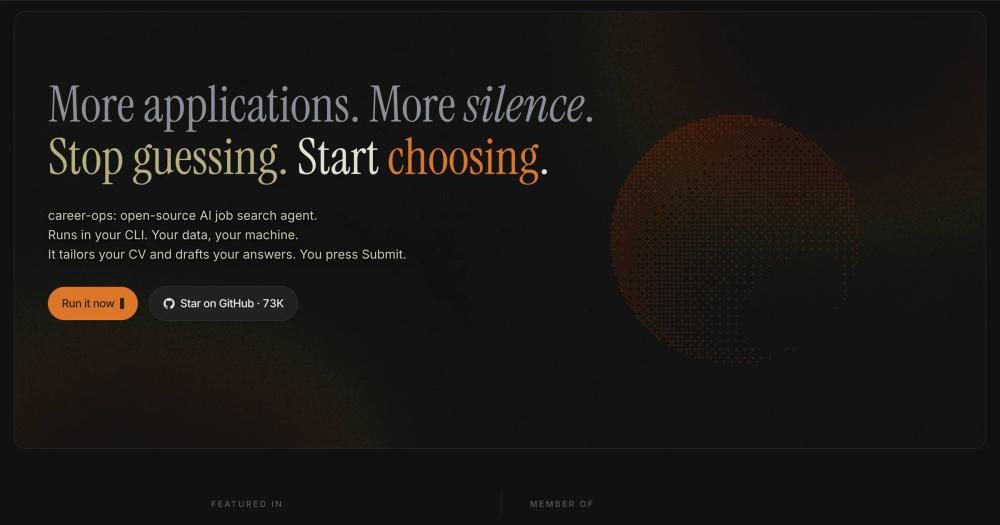
image of career-ops
TL;DR

career-ops is an open source AI job search agent that runs locally inside any AI coding CLI. It replaces commercial job search platforms like AIApply and JobCopilot with a structured, local-first approach: score each listing 1.0-5.0 across five dimensions, generate ATS-optimized PDFs per role, and track the pipeline in a terminal dashboard. MIT licensed and free forever, with no account, no telemetry, and no subscription to career-ops itself. Best for developers who already use Claude Code, Codex, or another AI coding CLI and want a deliberate, high-signal job search.

Read the full breakdownHide the full breakdownWho it is for, how it works, trade-offs, the quick start and the FAQ
who it's for

Who career-ops is for#

Developers running a deliberate, high-signal job search

career-ops fits developers who want to evaluate a targeted set of carefully selected roles using a structured rubric rather than applying broadly. The CLI environment, batch evaluation, and ATS PDF pipeline are built for people comfortable with terminal tools who already use an AI coding CLI for daily work.

Skip if:

You are not comfortable with CLI tools or do not have an AI coding CLI subscription. The setup and onboarding require technical familiarity; non-technical job seekers would need significant time to get value from the system.

Technical job seekers evaluating a high volume of listings

The batch processing mode evaluates 10+ listings in parallel using headless CLI workers, making it practical for active searchers scanning many listings per week. The portal scanner checks 150+ company career pages in one command, surfacing new roles without manual searching across each site.

Skip if:

You need a managed, no-setup tool you can hand to a less technical colleague. career-ops requires terminal comfort and an AI CLI subscription, and the local-first model means there is no shared dashboard for collaborating with a recruiter or career coach.

Privacy-conscious professionals who do not want cloud job tracking

All data (CV, applications, evaluations, reports) lives in plain files on your machine with no career-ops account, no cloud sync, and no telemetry. If you are wary of uploading job search data to a SaaS platform, the local-first data contract means nothing is transmitted to career-ops servers.

Skip if:

You want cross-device sync or access from multiple machines without setting up your own sync mechanism. career-ops does not provide a hosted dashboard; if you switch machines, you manage the file sync yourself.

Developers preparing for senior or specialized roles with complex applications

The interview suite (STAR+R story bank, time-blocked prep plans, post-interview debriefs, company red-flag detector) and offer stage tools (contract companion, salary-gap analyzer, negotiation scripts) are designed for complex, multi-stage hiring processes where preparation depth matters.

Skip if:

You are applying for entry-level or volume-hire roles where standardized applications are the norm. The structured evaluation and preparation tooling is most valuable when each application requires individualized effort and preparation.

the problem

The problem it solves#

Job searching at any scale turns into a logistics problem fast. Within days, you are tracking dozens of listings in a spreadsheet, struggling to remember which version of your CV went where, and spending hours tailoring applications manually. The signal-to-noise ratio is brutal: most listings are poorly matched, many are ghost jobs, and a small number are worth your time. Without a structured evaluation, you apply to too many and apply poorly to the ones that matter.

Paid job search tools offer auto-apply features, but mass applications damage your standing with ATS systems and burn recruiter relationships. Most also lock your data in cloud accounts with no export path, charge monthly subscription fees, and still leave you writing cover letters by hand. The real challenge is getting a clear signal on which roles are genuinely worth pursuing, then applying thoughtfully to that short list.

how career-ops solves it

How it solves it#

A-G Rubric Evaluation

Scores each listing 1.0-5.0 across five dimensions: CV match, north-star alignment, compensation, cultural signals, and red flags. Block G is a separate posting-legitimacy check that flags scams and ghost jobs without affecting the score. The system recommends against applying to anything scoring below 4.0.

ATS-Optimized PDF Resume Generation

Generates keyword-injected CVs customized per job description, formatted in Space Grotesk and DM Sans, delivered as a print-ready PDF via an HTML and Playwright pipeline. Each CV mirrors the terminology of the specific job description to pass automated resume screening.

150+ Portal Scanner

Pre-configured scrapers check 150+ company career pages across Greenhouse, Ashby, Lever, and Wellfound with zero API tokens spent. Run one command and get a ranked list of open roles back in minutes. Companies like Anthropic, OpenAI, ElevenLabs, Retool, and n8n are pre-configured out of the box.

Terminal Pipeline Dashboard

A Go-based terminal UI lets you browse, filter, and sort your application pipeline by status, score, and company. Includes automated dedup, status normalization, and health checks to keep the pipeline clean across multiple sources and evaluation batches.

Cover Letter and Application Drafting

Generates research-backed cover letters with keyword mirroring and four interactive angle prompts (why, problems, approach, tone), then delivers an A4 PDF using the same HTML and Playwright pipeline as CVs. Also drafts formal recruiter and cold-application emails from an evaluated report or pasted job description, complete with subject line and attachment checklist.

Interview and Offer Suite

Builds an Interview Story Bank of STAR+Reflection stories across evaluations, generating 5-10 master stories that answer behavioral questions. Includes time-blocked prep plans, practice sessions with feedback, post-interview debriefs, a company red-flag detector, contract reading companion, and a salary-gap analyzer.

strengths · trade-offs

Strengths and trade-offs#

Strengths

  • No account, no telemetry, data stays on your machineEvery piece of data career-ops touches (CV, profile, pipeline, evaluation reports) lives in plain Markdown and YAML files on your local machine. Nothing is uploaded to a career-ops server. System updates never touch the data layer. This is a documented data contract, not a marketing claim.
  • CLI-agnostic: works with eight AI coding CLIscareer-ops runs on Claude Code, OpenCode, Codex, Antigravity CLI, Grok Build CLI, Qwen, Kimi, and GitHub Copilot CLI through a shared skill entrypoint and identical mode files. You pick the CLI that fits your existing subscription; the system never locks you to one provider.
  • MIT licensed, permanently free, no paid tierThe MIT license means no paid tier, no waitlist, no account, and no premium features behind a paywall. Sustainability comes from voluntary GitHub Sponsors patronage. A typical job search runs on Claude Pro at $20/month (your existing CLI subscription), with no separate career-ops cost.
  • Human stays in the loop on every applicationcareer-ops never auto-submits an application. It prepares everything up to the click (scores, tailored CV, cover letter, form answers) and hands the decision back to you. This is deliberate: mass auto-apply burns ATS standing and recruiter relationships. The design keeps choice with the user.
  • Built from a real job search of 740 listingsThe creator built career-ops during his own 2026 job search, evaluating 740 listings, generating over 100 tailored CVs, and landing a Head of Applied AI role. The full scoring methodology is published at career-ops.org/methodology. The system reflects real-world job search constraints, not theoretical features.

Trade-offs

  • -Requires an AI coding CLI subscriptioncareer-ops has no AI of its own. It runs inside Claude Code, Codex, or another AI coding CLI, which means you need an active subscription to one of those services. A typical search costs approximately $20/month on Claude Pro. Running on a free tier is possible with some CLIs, but heavy batch evaluation will hit usage limits quickly.
  • -First evaluations need onboarding contextThe system does not know you on first run. You need to feed it your CV, career story, proof points, preferences, and what you want to avoid before evaluations get accurate. The README compares this to onboarding a new recruiter: the first week they need to learn about you. Expect meaningful setup time before results are calibrated to your profile.
  • -CLI-based setup is not beginner-friendlyGetting career-ops running requires Node.js, npm, and an AI coding CLI already set up. PDF generation requires Playwright and Chromium. The initialization command is simple (npx @santifer/career-ops init), but troubleshooting requires comfort with terminal tools. Non-technical job seekers will find the setup barrier high.
  • -Active issue backlog on a fast-moving projectThe project moves fast (created April 2026, 64K+ stars by August 2026) and the issue count of 336 reflects that pace. Some features may be in flux, and edge cases in portal scrapers and PDF generation are actively reported. The Discord community triages issues quickly, but expect some rough edges on newer integrations.
versus alternatives

career-ops vs alternatives#

career-ops vs JobCopilot

JobCopilot and career-ops both help job seekers find and apply to roles more efficiently, but they operate on opposite assumptions. JobCopilot is a cloud-based auto-apply service that submits applications on your behalf; career-ops is a local CLI tool that evaluates and prepares applications while keeping you in the decision loop.

Featurecareer-opsJobCopilot
LicenseMIT (open source)Proprietary
Data storageLocal files on your machineCloud account
Auto-applyNo (human-in-the-loop)Yes
SubscriptionAI CLI cost onlyPaid SaaS plan
Evaluation rubricFive-dimension, 1.0-5.0 scoreNot published

career-ops is the better choice when you want a structured, deliberate job search. It scores listings against your CV and recommends against anything below 4.0, reducing application volume and improving quality. JobCopilot suits users who want to cast a wide net without manual review and are comfortable with automated submissions.

career-ops vs AIApply

AIApply focuses on AI-assisted resume tailoring and auto-apply via a web app. career-ops runs locally with no web account and puts the apply decision in your hands. The key tradeoff is setup friction: AIApply is immediately usable from a browser; career-ops requires an AI coding CLI and a short onboarding session.

Featurecareer-opsAIApply
LicenseMIT (open source)Proprietary
Data storageLocal filesCloud account
Setup requiredNode.js + AI CLIBrowser only
CustomizationFully editable mode filesLimited to product features
PriceAI CLI cost onlyPaid subscription

career-ops wins on data privacy, long-term cost, and flexibility. You can modify the evaluation rubric, add portal scrapers, and extend the system via plugins. AIApply wins on ease of getting started, particularly for non-technical users.

career-ops vs Careerflow

Careerflow focuses on job tracking and LinkedIn profile optimization. career-ops is stronger on pre-application evaluation and document generation. They address different phases of the job search, so some users run both.

Featurecareer-opsCareerflow
LicenseMIT (open source)Proprietary
Job evaluation rubricYes (1.0-5.0, five dimensions)No
PDF CV generationYes (ATS-optimized per role)No
LinkedIn optimizationNoYes
Application trackingTerminal dashboardWeb dashboard

career-ops is the stronger fit for users who need rigorous pre-application evaluation and tailored document generation. Careerflow suits a less technical audience that wants a visual web-based pipeline tracker and LinkedIn optimization tools.

install · quick start

Quick start#

bash
Install career-ops with npx to bootstrap a project folder in your working directory.
```bash
npx @santifer/career-ops init
```
tech stack · detected from GitHub

What it's built on#

Languages
GoJavaScriptTypeScript
Frameworks
Next.jsReact
frequently asked

FAQ#

Does career-ops automatically apply to jobs for me?

No. career-ops prepares everything up to the click (scores the listing, generates a tailored CV, drafts cover letters and form answers) and then hands the decision back to you. You review and submit each application yourself. This is intentional: mass auto-apply damages ATS standing and recruiter relationships, so the system keeps you in control of every submission.

Does career-ops require an AI subscription to use?

Yes. career-ops is not an AI model itself; it runs as a skill inside an AI coding CLI like Claude Code, Codex, or OpenCode. You need an active subscription to at least one of those services. A typical job search costs approximately $20/month on Claude Pro. Some CLIs offer free tiers, but heavy batch evaluation will hit usage limits.

Where does my data go when I use career-ops?

Your CV, profile, pipeline, and evaluation reports stay on your own machine in plain Markdown and YAML files. career-ops has no server, no account, and no telemetry. The only data that leaves your computer is what your chosen AI coding CLI sends to its own provider (e.g., Anthropic for Claude Code, OpenAI for Codex).

Which AI coding CLIs does career-ops support?

career-ops supports eight CLIs: Claude Code, OpenCode, Codex, Antigravity CLI, Grok Build CLI, Qwen, Kimi, and GitHub Copilot CLI. The same mode files run on all of them through a shared skill entrypoint. You pick whichever CLI fits your existing subscription.

How does career-ops evaluate job listings?

career-ops uses a rubric-guided LLM evaluation across five dimensions: CV match, north-star alignment, compensation, cultural signals, and red flags. It produces a holistic 1.0-5.0 score with citations to specific CV lines and job description requirements. Block G is a separate check that flags scams and ghost jobs without affecting the score. The full methodology is published at career-ops.org/methodology.

also worth a look

Similar open-source tools#

REA (Reverse Engineer Anything)

Featured

Alternative toRevEng.AI

AI-powered reverse engineering for binaries, apps, and assemblies.

  • 345,900 GitHub stars
  • MITLicence MIT

Omnara

Featured

Alternative toCClaude Managed Agents

Open-source agent deployment API. Self-host or use Omnara Cloud.

  • 2,957 GitHub stars
  • Apache-2.0Licence Apache-2.0

rakazo

Featured

Alternative toGrok Bot

AI teammates you own: your keys, your model, your machine.

  • 4,904 GitHub stars
  • Apache-2.0Licence Apache-2.0

Agent Reach

Featured

Alternative toFirecrawl

Give any AI agent internet access, free and local

  • 100,165 GitHub stars
  • MITLicence MIT

Hermes Agent

Featured

Alternative toGrok Bot

Self-hosted AI agent: persistent memory, multi-channel chat, model choice.

  • 255,514 GitHub stars
  • MITLicence MIT

Openfilm

Alternative toRemotion

AI video agent for coding agents; films are local web folders.

  • 1,850 GitHub stars
  • MITLicence MIT
by category

Open source tools in these categories#

404

AI & Machine Learning

freeCodeCamp, OpenClaw, REA (Reverse Engineer Anything)
461

Developer Tools

REA (Reverse Engineer Anything), superpowers, Skills for Real Engineers

Featured

Omnara

Alternative toCClaude Managed Agents

Open-source agent deployment API. Self-host or use Omnara Cloud.

  • 2,957 GitHub stars
  • Apache-2.0Licence Apache-2.0
  • #AI Agents

rakazo

Alternative toGrok Bot

AI teammates you own: your keys, your model, your machine.

  • 4,904 GitHub stars
  • Apache-2.0Licence Apache-2.0
  • #AI Agents

Inbox Zero

Alternative toSuperhuman

AI email assistant that drafts replies and clears your inbox

  • 12,712 GitHub stars
  • AGPL-3.0Licence AGPL-3.0
  • #Email
Feature your project

New open source projects by email

The projects we add and every new guide. Free, unsubscribe any time.

Find open source alternatives to paid software

/
  • Claude Code to OpenCode
  • Jira to Windshift
  • Notion to AppFlowy
  • Slack to Mattermost
  • Linear to GitLab
  • Wispr Flow to Handy
  • CapCut to Concat
  • Grok Bot to rakazo
  • Superhuman to Inbox Zero
  • Airtable to AITable
  • Muse to OpenClaw
  • GitHub Copilot to Cline
  • Datadog to Netdata
  • Microsoft Teams to Rocket.Chat
  • Pinecone to Qdrant
  • Zapier to n8n
  • Devin AI to OpenHands
  • Firebase to Supabase
  • 1Password to KeePassXC
  • Confluence to Docmost
  • Contentful to Strapi
  • Adobe Premiere Pro to Shotcut
  • ChatGPT to AnythingLLM
  • LangSmith to Langfuse