Open Source Alternatives
  • Alternatives
  • Categories
    Categories by size882 projects
    • Developer Tools461
    • AI & Machine Learning404
    • Web Development196
    • Business & Productivity191
    • Communication & Collaboration126
    • Security & Monitoring126
    • IT Management123
    • Product & Project Management106
    • Cloud & Hosting105
    • Data & Analytics104
    Browse all 21 categoriesLLMOps & AI Tooling, Design & Creative and 9 more
  • Blog
  • Advertise
SearchNotion, Slack, password manager.../
Submit
Open Source Alternatives
  • Alternatives
    • Developer Tools461
    • AI & Machine Learning404
    • Web Development196
    • Business & Productivity191
    • Communication & Collaboration126
    • Security & Monitoring126
    • Browse all 21 categories
  • Blog
  • Advertise
Submit your project

New open source projects by email

The projects we add and every new guide. Free, unsubscribe any time.

Open Source Alternatives LogoOpen Source Alternatives

Handpicked Open Source Alternatives to Paid Softwares

Product

  • Categories
  • Tag
  • Advertise

Resources

  • Blog
  • Collection
  • Submit

Company

  • Privacy Policy
  • Terms of Service
  • Refund Policy
  • Sitemap

Alternatives

  • Claude Code
  • Jira
  • Notion
  • Slack
  • Linear
  • Wispr Flow
  • All alternatives
© 2026 Open Source Alternatives. All rights reserved.
Open SourceAlternatives
Home/Categories/AI & Machine Learning/5dive
icon of 5dive

5dive

Open source alternative to Conductor and Claude Code

  • 73 stars
  • MIT
  • Active this week
  • Last commit today

Last verified Oct 21, 2026

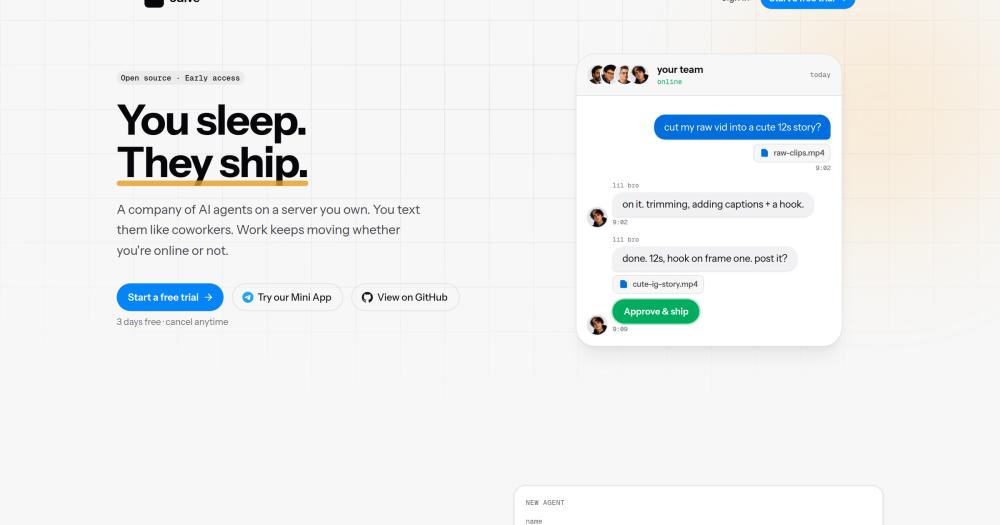
Orchestrate a team of AI coding agents on a server you own. Named agents share a task backlog, hand off work, and escalate to your phone.

Visit websiteGitHub73 starsDeploy on Hostinger
image of 5dive
TL;DR

5dive is a multi-agent orchestration layer that runs named AI coding agents as persistent systemd services on a Linux server you own. Where a single Claude Code or Codex session requires you to stay present, 5dive puts multiple agents on an org chart, gives them a shared task queue, and routes only the decisions that need a human to your phone. MIT licensed, no framework overhead; the orchestrator is Bash, SQLite, and systemd. Best for solo founders and small teams who want asynchronous, always-on AI work without giving up control of their data or their API keys.

Read the full breakdownHide the full breakdownWho it is for, how it works, trade-offs, the quick start and the FAQ
who it's for

Who 5dive is for#

Solo founders running AI development teams

One person overseeing multiple AI agents: a coder, a marketer, a researcher. 5dive gives each agent a name, a role, and a Telegram channel. Tasks flow between them via the shared backlog. The founder checks in via phone and approves the decisions that matter.

Skip if:

You need attended, interactive coding sessions with tight human-in-the-loop review at each step. 5dive is designed for asynchronous delegation, not for supervised pair programming.

Small engineering teams adding AI to existing workflows

Teams already using Claude Code or Codex can spin up 5dive to turn single sessions into a persistent team: one agent monitors the issue queue, another writes code, a third reviews PRs. Work continues between standups without manual handoffs.

Skip if:

Your team is not yet comfortable running a Linux server or managing systemd services. The install is straightforward, but ongoing maintenance requires basic Linux administration.

Developers who need agents across multiple provider CLIs

5dive supports Claude Code, Codex, Grok, Antigravity, and several community harnesses under one team. If you want a coder on Claude and a researcher on a cheaper OpenRouter model, one 5dive instance coordinates them on the same task queue.

Skip if:

You only use a single coding CLI and do not need multi-agent coordination. A single Claude Code session is simpler and lower-overhead for single-agent workflows.

Infrastructure engineers experimenting with autonomous AI workflows

5dive's architecture (Linux users, systemd, SQLite) maps directly to infrastructure patterns engineers already know. The `5dive trace` command gives full causal timelines. The isolation tiers provide explicit control over what each agent can do on the host.

Skip if:

You need Windows or macOS support, or a containerized setup without systemd. 5dive is Linux-only and assumes systemd is available.

the problem

The problem it solves#

Running AI coding agents interactively works for short tasks, but breaks down at the scale a real project requires. When you close the terminal, work stops. When you want two agents working in parallel on a sprint, there is no coordination layer. When an agent hits a decision that requires your input, it halts and waits until you happen to be watching.

Paid multi-agent platforms address this by hosting the orchestration for you, but that means your API keys transit their servers, your code runs on their infrastructure, and their pricing scales with your usage. Teams that want persistent autonomous work without that trade-off are left writing glue scripts or running attended sessions around the clock.

how 5dive solves it

How it solves it#

Named agents on an org chart

Each agent is its own Linux user running an official coding CLI as a systemd service. You give it a name, a role, and a communication channel. Multiple agents share the same host and the same 5dive CLI as their coordination bus, without any separate broker or message queue.

Shared task backlog with agent-to-agent handoffs

Agents pull work from a shared SQLite task queue and hand tasks to each other when one finishes or needs a specialist. The `5dive task` command manages the queue, and `5dive trace` shows the complete causal timeline from the original request through every handoff to the final verdict.

Human-gate escalation to your phone

Decisions you reserve (spend approvals, publishing actions, anything destructive) arrive on your phone as tap-to-answer buttons via Telegram or Discord. Agents keep working on everything else while you decide.

Support for every major coding CLI

Claude Code, Codex, Google Antigravity, xAI Grok, Devin, and several community harnesses all run as first-class agent types. Multiple agents can share a single subscription or API key through 5dive's account profiles.

Three-tier isolation model

Each agent seat operates under one of three isolation tiers: `sandboxed` (own home directory, no sudo, resource limits), `standard` (named 5dive subcommands only), or `admin` (full 5dive CLI as root, which is not root on the host box). A fourth `beyond-admin` tier is available but must be explicitly granted by an operator.

strengths · trade-offs

Strengths and trade-offs#

Strengths

  • MIT license, no open-core splitThe entire codebase ships under MIT with no paid tier or enterprise edition. Unlike commercial multi-agent platforms that restrict self-hosting or charge per seat, 5dive's full feature set is available on your own infrastructure at no additional cost.
  • Auth tokens never leave your server5dive routes credentials directly from your server to the model provider. There is no OAuth proxy or intermediary. The project documents this architecture explicitly, and there is no telemetry, error reporting, or usage data sent to 5dive's servers.
  • Runs on a 1 GB VMThe orchestration layer is Bash, SQLite, and systemd. A single-agent setup runs comfortably on a 1 GB VM. Adding agents adds Linux users and systemd units, not framework overhead. This contrasts with node-based orchestration frameworks that require several hundred megabytes of runtime before any model calls.
  • Agents keep running when you're offlineAgents run as systemd services and stay alive when you close the terminal. You can message them via Telegram any time. Work that would stall in an interactive session continues between your sessions, across time zones, or overnight.

Trade-offs

  • -Linux only, systemd required5dive's architecture relies on Linux users for agent isolation and systemd for service supervision. It does not run on macOS, Windows, or containers that lack an init system. Developers on Mac must provision a remote Linux box; the README explicitly assumes a Linux host with systemd available.
  • -Early stage, 65 GitHub starsThe project was created in May 2026 and has 65 stars and 12 open issues at the time this was written. The API surface is not yet stable and may introduce breaking changes between minor versions. Teams that need a production-hardened multi-agent runtime may find it too early.
  • -Requires your own model subscriptions5dive is the orchestration layer, not the model provider. Each agent needs its own Claude Pro/Max OAuth session or API key, OpenAI API key, or equivalent. Costs scale with how many agents you run and how much work they do; 5dive provides no model access itself.
versus alternatives

5dive vs alternatives#

5dive vs Claude Code

Claude Code is an AI-powered coding assistant from Anthropic that runs in your terminal. 5dive is a multi-agent orchestration layer that manages a team of coding agents, including Claude Code, on a server you own. These tools are not substitutes. Most 5dive deployments run Claude Code inside the agent seats. The comparison that matters is between using Claude Code alone versus using Claude Code through 5dive.

Feature5diveClaude Code (standalone)
Session modelPersistent systemd servicesInteractive terminal session
Multi-agentNamed team with shared task queueSingle session at a time
Escalation to phoneYes, via Telegram or DiscordNot built in
InfrastructureSelf-hosted Linux server requiredRuns locally; no server needed
Licensing costFree (MIT); model costs applyClaude Pro/Max subscription
Offline operationAgents run without your presenceStops when terminal closes

Claude Code alone is the right choice for interactive, attended coding sessions where you want tight control over each step and immediate feedback. It is simpler, requires no server, and runs wherever you have a terminal.

5dive is the better fit when you want a team of agents working asynchronously. Long-running tasks that span hours, multiple agents working in parallel, or autonomous work that continues while you sleep all benefit from persistent agent services. The tradeoff is operational overhead. You maintain a Linux server, manage systemd services, and provision API keys for each seat.

A common pattern is Claude Code in your local terminal for active work and 5dive on a small VPS for the background team. 5dive's own codebase is maintained by agents running on 5dive (the project tracks this with a zero-human badge in the README), so the separation-of-concerns model is one the authors use themselves.

install · quick start

Quick start#

bash
5dive installs on any Linux server running systemd.
```bash
curl -fsSL https://install.5dive.ai | sudo bash
sudo 5dive init
```
tech stack · detected from GitHub

What it's built on#

Languages
Shell
frequently asked

FAQ#

Does 5dive replace Claude Code?

No. Claude Code is the coding agent that runs inside each 5dive seat. 5dive is the orchestration layer that manages a team of agents: it assigns work, tracks the task queue, routes escalations to your phone, and keeps agents running as persistent services when you close the terminal. The two tools are complementary. Most 5dive users run Claude Code as the agent type for their coding seats.

What do I need to run 5dive?

A Linux box with systemd and your own agent CLI subscription or API key. 5dive itself requires no account and creates no external account dependency. The installer is one curl command. Each agent you add becomes a new Linux user on the same host.

Does 5dive have access to my API keys?

No. Auth tokens go from your server directly to the model provider (Anthropic, OpenAI, etc.) and never pass through 5dive's servers. The project documents this design decision explicitly and states there is no telemetry, error reporting, or usage data sent to 5dive.

Can I run 5dive on a cheap VPS?

Yes. The orchestration layer is Bash, SQLite, and systemd, which adds minimal overhead beyond the coding CLIs themselves. A single-agent setup runs comfortably on a 1 GB VM. Costs scale with how much model usage your agents generate, not with 5dive's own resource requirements.

What AI coding agents does 5dive support?

Claude Code (Anthropic), Codex (OpenAI), Google Antigravity, xAI Grok, Cognition Devin, OpenCode, and several community harnesses including hermes, openclaw, and pi. The claude agent type also supports third-party Anthropic-compatible endpoints via a custom base URL, letting you point agents at local inference servers or OpenRouter.

Looking for more

Other ways to replace Conductor and Claude Code#

paperclip

Featuredfor Conductor

Self-hosted AI agent management with org charts and budgets

105,118 GitHub starsVisit

OpenCode

#1 in the Claude Code guide

Broad provider and model choice in a terminal-first client, MIT-licensed with AGENTS.md instructions

218,637 GitHub stars

oh-my-pi

#2 in the Claude Code guide

Direct Claude configuration inheritance with Anthropic subscription support

36,029 GitHub stars

kilocode

#3 in the Claude Code guide

Documented Claude transcript import with IDE and CLI surfaces

27,673 GitHub stars
All 22 Claude Code alternatives10 open source Claude Code alternatives, ranked
by category

Open source tools in these categories#

404

AI & Machine Learning

freeCodeCamp, OpenClaw, REA (Reverse Engineer Anything)
106

Product & Project Management

agency-agents, freeCodeCamp, Gstack
126

Communication & Collaboration

iptv, freeCodeCamp, Excalidraw
Hostinger

Run 5dive on your own server

Self-host 5dive on a Hostinger VPS.

Deploy on Hostinger

Featured

Omnara

Alternative toCClaude Managed Agents

Open-source agent deployment API. Self-host or use Omnara Cloud.

  • 2,957 GitHub stars
  • Apache-2.0Licence Apache-2.0
  • #AI Agents

rakazo

Alternative toGrok Bot

AI teammates you own: your keys, your model, your machine.

  • 4,904 GitHub stars
  • Apache-2.0Licence Apache-2.0
  • #AI Agents

Inbox Zero

Alternative toSuperhuman

AI email assistant that drafts replies and clears your inbox

  • 12,712 GitHub stars
  • AGPL-3.0Licence AGPL-3.0
  • #Email
Feature your project

New open source projects by email

The projects we add and every new guide. Free, unsubscribe any time.

Find open source alternatives to paid software

/
  • Claude Code to OpenCode
  • Jira to Windshift
  • Notion to AppFlowy
  • Slack to Mattermost
  • Linear to GitLab
  • Wispr Flow to Handy
  • CapCut to Concat
  • Grok Bot to rakazo
  • Superhuman to Inbox Zero
  • Airtable to AITable
  • Muse to OpenClaw
  • GitHub Copilot to Cline
  • Datadog to Netdata
  • Microsoft Teams to Rocket.Chat
  • Pinecone to Qdrant
  • Zapier to n8n
  • Devin AI to OpenHands
  • Firebase to Supabase
  • 1Password to KeePassXC
  • Confluence to Docmost
  • Contentful to Strapi
  • Adobe Premiere Pro to Shotcut
  • ChatGPT to AnythingLLM
  • LangSmith to Langfuse