Open Source Alternatives
  • Alternatives
  • Categories
    Categories by size881 projects
    • Developer Tools460
    • AI & Machine Learning404
    • Web Development196
    • Business & Productivity191
    • Communication & Collaboration126
    • Security & Monitoring126
    • IT Management123
    • Product & Project Management106
    • Cloud & Hosting104
    • Data & Analytics104
    Browse all 21 categoriesLLMOps & AI Tooling, Design & Creative and 9 more
  • Blog
  • Advertise
SearchNotion, Slack, password manager.../
Submit
Open Source Alternatives
  • Alternatives
    • Developer Tools460
    • AI & Machine Learning404
    • Web Development196
    • Business & Productivity191
    • Communication & Collaboration126
    • Security & Monitoring126
    • Browse all 21 categories
  • Blog
  • Advertise
Submit your project

New open source projects by email

The projects we add and every new guide. Free, unsubscribe any time.

Open Source Alternatives LogoOpen Source Alternatives

Handpicked Open Source Alternatives to Paid Softwares

Product

  • Categories
  • Tag
  • Advertise

Resources

  • Blog
  • Collection
  • Submit

Company

  • Privacy Policy
  • Terms of Service
  • Refund Policy
  • Sitemap

Alternatives

  • Claude Code
  • Jira
  • Notion
  • Slack
  • Linear
  • Wispr Flow
  • All alternatives
© 2026 Open Source Alternatives. All rights reserved.
Open SourceAlternatives
Home/Categories/Developer Tools/Skills for Real Engineers
Icon for Skills for Real Engineers

Skills for Real Engineers

  • 298.1K stars
  • MIT
  • Active this week
  • Last commit 2 days ago

Last verified Oct 20, 2026

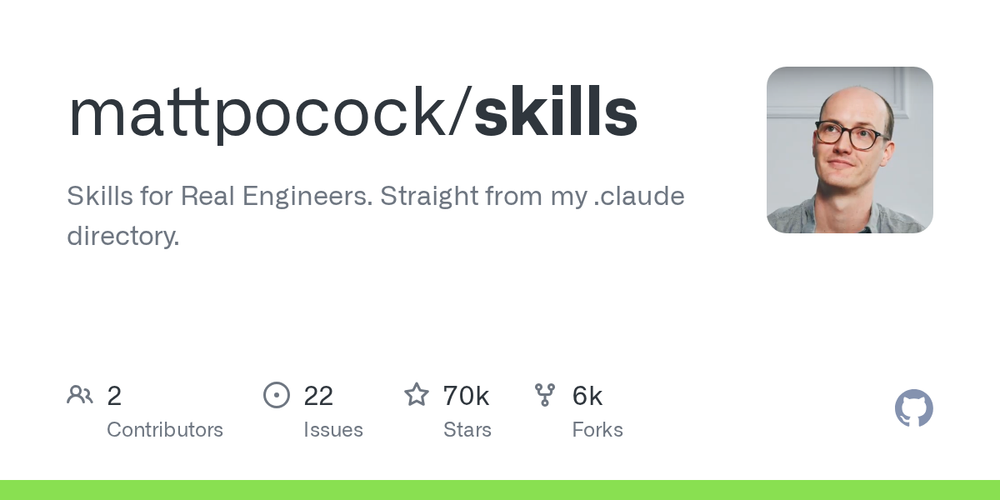
Streamline AI coding agent workflows with a composable collection of engineering skills drawn from decades of real-world software development experience.

Visit websiteGitHub298.1K stars
image of Skills for Real Engineers
TL;DR

Skills for Real Engineers applies software engineering fundamentals to AI agent workflows with composable, MIT-licensed prompt skills for alignment, TDD, and architecture review.

Read the full breakdownHide the full breakdownWho it is for, how it works, trade-offs, the quick start and the FAQ
who it's for

Who Skills for Real Engineers is for#

Solo developers building production apps with Claude Code

Skills for Real Engineers gives solo developers the structured workflow a senior engineering team would apply naturally: alignment before coding, a shared domain language, test-driven implementation, and periodic architecture review. The modular install means you can start with /grill-me and /tdd alone and add more skills as the project grows.

Skip if:

You are prototyping a throwaway proof of concept and need maximum iteration speed. The alignment and TDD overhead slows early-stage exploration. Use /prototype for the discovery phase and add the full skill set once the idea is validated.

Engineering teams managing AI-accelerated codebases

Teams using AI agents at scale face architectural entropy at an unprecedented rate. The /improve-codebase-architecture skill periodically refocuses the agent on the whole system rather than the current file, counteracting drift. Combined with /tdd, this keeps the codebase changeable as AI commit velocity increases.

Skip if:

Your team has not aligned on issue tracker tooling. The /triage and /to-issues skills require per-repo setup, and inconsistent configuration across team members reduces their coordination value.

Developers who have tried and abandoned heavier AI frameworks

If GSD, BMAD, or Spec-Kit felt too opinionated or too difficult to debug when the framework itself produced wrong output, Skills for Real Engineers offers the same workflow benefits at a fraction of the overhead. Each skill is a readable, editable prompt file you can inspect and modify without framework knowledge.

Skip if:

You prefer a fully managed AI workflow where the process layer is invisible. These skills keep you in control of every invocation, which requires intentional process adoption rather than passive installation.

TypeScript developers building domain-rich applications

The /grill-with-docs skill's domain language and ADR tooling maps directly to Domain-Driven Design practices. Developers building applications with rich domain models, bounded contexts, or complex business logic get the most value from the CONTEXT.md shared language, because the naming and conceptual consistency compound across a longer development lifecycle.

Skip if:

Your project is a simple CRUD app with minimal domain complexity. The domain language investment has the highest return on projects with 6+ months of development history and non-trivial business rules.

the problem

The problem it solves#

AI coding agents like Claude Code and Copilot routinely produce code that misses the intent of the request, skips proper test coverage, names things inconsistently, and accelerates software entropy in the codebase. Heavier workflow frameworks like GSD, BMAD, and Spec-Kit try to fix this by taking over the entire development process, but they introduce their own bugs and strip the developer out of the loop when something goes wrong.

The failure modes compound. An agent that skips clarifying questions will build the wrong thing. An agent with no feedback loop from tests will iterate blindly when something breaks. An agent that has no shared domain language for the codebase will use inconsistent naming and waste tokens re-explaining the same concepts every session. The result is a codebase that accelerates past your ability to maintain it.

how Skills for Real Engineers solves it

How it solves it#

Grilling session for intent alignment

The /grill-me and /grill-with-docs skills run a structured interview before any code is written, prompting the agent to surface every assumption and resolve every decision branch. /grill-with-docs also builds a CONTEXT.md shared domain language document and logs architectural decisions as ADRs, reducing naming inconsistencies and token costs across future sessions.

Test-driven red-green-refactor loop

The /tdd skill enforces a red-green-refactor cycle: the agent writes a failing test first, then writes the minimum implementation to pass it, then refactors. This provides a concrete feedback signal at every step rather than running blind. Works with any test framework and any supported coding agent.

Architecture improvement and context recovery

The /improve-codebase-architecture skill analyzes the codebase against its CONTEXT.md domain language and ADRs to find simplification and consolidation opportunities, counteracting the software entropy that AI agents accelerate. The /zoom-out skill reorients the agent to the whole system when it gets stuck in a specific file or function.

Disciplined debugging loop

The /diagnose skill wraps a structured diagnostic cycle: reproduce, minimise, hypothesise, instrument, fix, regression-test. It prevents the common agent pattern of making random changes until something passes, forcing a methodical path through hard bugs and performance regressions instead.

Issue management and PRD generation

/to-prd converts the current conversation into a Product Requirements Document and submits it as a GitHub or Linear issue. /to-issues breaks any PRD or spec into independently-grabbable issues using vertical slices. /triage runs issues through a configurable state machine of triage roles, with support for GitHub, Linear, or local files.

strengths · trade-offs

Strengths and trade-offs#

Strengths

  • Composable and model-agnosticEach skill is a single-purpose prompt file installed independently. They work with Claude Code, GitHub Copilot agent mode, OpenAI Codex, and any other coding agent that accepts custom instructions. Unlike GSD or BMAD, you pick the skills you need and leave the rest. The project explicitly encourages forking and modifying individual skills to fit your workflow.
  • MIT licensed with no lock-in or subscriptionThe entire collection is MIT licensed and requires no cloud service, API key, or subscription fee. Skills install into your local agent configuration and run indefinitely at no cost. Unlike Copilot at $10-19 per month per seat, there is no recurring cost for the workflow structure these skills provide.
  • Grounded in documented software engineering fundamentalsEach skill cites its source: /tdd from Kent Beck's Extreme Programming, the shared domain language from Eric Evans' Domain-Driven Design, small deliberate steps from The Pragmatic Programmer. The reasoning is auditable and the skills are defensible in code review, a notable contrast to AI process frameworks that do not document their design choices.
  • Large and active community footprintThe repo has ~78,000 GitHub stars and Matt Pocock's developer newsletter has ~60,000 subscribers who receive updates on new and updated skills. This is one of the largest community footprints of any AI coding workflow tool, with active maintenance and rapid iteration on new skills published regularly.

Trade-offs

  • -Requires consistent habit formation to deliver valueThe skills are prompt invocations, not automated enforcement. Developers must remember to run /grill-with-docs before starting features, /tdd before writing implementation, and /improve-codebase-architecture on a regular schedule. Teams without established habits around these invocations will see inconsistent results. There is no enforcement layer that runs skills automatically.
  • -Domain language setup requires upfront investmentThe /grill-with-docs skill builds a CONTEXT.md and ADRs that improve naming consistency and reduce token costs across sessions. But this investment is front-loaded and requires maintenance as the codebase evolves. On fast-moving projects or in early exploration phases, keeping CONTEXT.md current adds overhead before the benefits accumulate.
  • -Shell-based install scoped to supported agent runtimesThe npx installer writes to agent-specific config directories. Teams using multiple different coding agents across developers need to configure each agent separately. The skills are plain text files, so they do not benefit from API-level integrations that purpose-built tools can provide.
versus alternatives

Skills for Real Engineers vs alternatives#

Skills for Real Engineers vs GitHub Copilot

GitHub Copilot is a managed AI coding assistant integrated into IDEs and GitHub workflows. Skills for Real Engineers is a collection of workflow prompt files that structure how you communicate with your coding agent, including Copilot's own agent mode. They address different problems at different layers of the development process.

FeatureSkills for Real EngineersGitHub Copilot
LicenseMIT (open source)Proprietary
Self-hostingYes (local prompt files)No
PricingFree$10/mo individual, $19/mo business
Works withClaude Code, Copilot, Codex, othersGitHub ecosystem
FocusWorkflow structure and alignmentCode completion and suggestion
Setupnpx install, 30 secondsIDE extension

Skills for Real Engineers is the stronger choice when your main problem is alignment, test coverage gaps, or architectural drift in an AI-assisted codebase. The /grill-with-docs, /tdd, and /improve-codebase-architecture skills impose workflow structure that Copilot's suggestion engine does not provide. Developers who already use Copilot can run these skills on top of it without conflict.

GitHub Copilot is the better fit for developers whose primary need is inline code suggestions and tab-completion in the IDE with minimal process overhead. Copilot's chat and agentic features handle task-scoped automation well. Skills for Real Engineers handles the workflow discipline that surrounds those tasks: what to build, how to verify it, and how to keep the codebase from becoming a ball of mud over time.

install · quick start

Quick start#

bash
npx skills@latest add mattpocock/skills
tech stack · detected from GitHub

What it's built on#

Languages
JavaScript
frequently asked

FAQ#

What coding agents does Skills for Real Engineers support?

Skills for Real Engineers works with Claude Code, GitHub Copilot agent mode, and other coding agents that accept custom skills or instructions. The installer (npx skills@latest add mattpocock/skills) lets you choose which agents to install to during setup. Because each skill is a plain text prompt file, it can be manually adapted to any agent that supports custom instructions.

Is the collection free to use?

Yes. The entire collection is MIT licensed and free to install and run on your own machine. There is no cloud service, subscription, or API key required. Matt Pocock publishes new skills and updates through a free developer newsletter; the repo is publicly maintained on GitHub.

How is this different from just writing your own system prompt for Claude Code?

A hand-written system prompt sets broad agent behavior, but it does not give you purpose-built, invocable workflows for specific tasks. Each skill in this collection is a focused protocol for a specific problem: alignment before coding (/grill-with-docs), TDD enforcement (/tdd), architecture review (/improve-codebase-architecture). Maintaining a system prompt equivalent to these skills would require significant ongoing effort per repo.

Do I need to install all the skills, or can I pick just a few?

You can select individual skills during the install flow. The collection is fully modular. Productivity skills like /grill-me and /caveman have no dependencies. Engineering skills like /triage, /to-issues, and /tdd require running /setup-matt-pocock-skills once per repo to configure the issue tracker integration and domain document layout.

Why did Matt Pocock build this instead of using an existing AI framework?

The README explains that existing frameworks like GSD, BMAD, and Spec-Kit take over the entire development process, which makes their internal bugs hard to diagnose and removes the developer from the loop. Skills for Real Engineers deliberately keeps each skill small and single-purpose so that when something goes wrong, you can identify which skill failed and fix or replace it without touching the rest.

also worth a look

Similar open-source tools#

CodeBoarding

Alternative toCodeDashboard

Review code changes as architecture maps, not line diffs

  • 2,601 GitHub stars
  • MITLicence MIT

Dyad

Alternative toLovable

Local, open-source AI app builder with your own API keys

  • 22,031 GitHub stars
  • CustomLicence Apache-2.0 with separate pro-directory license

Cloudflare Os

Alternative toDust

Open source AI workspace with sandboxed apps and Gatekeeper security

  • 11,537 GitHub stars
  • Apache-2.0Licence Apache-2.0

Effect

InWeb Development

Typed errors, DI, and concurrency for TypeScript

  • 17,341 GitHub stars
  • MITLicence MIT

Firebase Ios Sdk

Alternative toAWS Amplify

Open source Apple SDK for Firebase auth, data, push and crashes

  • 6,974 GitHub stars
  • Apache-2.0Licence Apache-2.0

servers

Alternative toComposio

Open reference servers for connecting AI to external tools and data

  • 91,470 GitHub stars
  • CustomLicence Apache-2.0 and MIT (dual, transitioning)
by category

Open source tools in these categories#

460

Developer Tools

REA (Reverse Engineer Anything), superpowers, Skills for Real Engineers
404

AI & Machine Learning

freeCodeCamp, OpenClaw, REA (Reverse Engineer Anything)
196

Web Development

superpowers, freeCodeCamp, Skills for Real Engineers

Featured

rakazo

Alternative toGrok Bot

AI teammates you own: your keys, your model, your machine.

  • 4,904 GitHub stars
  • Apache-2.0Licence Apache-2.0
  • #AI Agents

Omnara

Alternative toCClaude Managed Agents

Open-source agent deployment API. Self-host or use Omnara Cloud.

  • 2,957 GitHub stars
  • Apache-2.0Licence Apache-2.0
  • #AI Agents

Inbox Zero

Alternative toSuperhuman

AI email assistant that drafts replies and clears your inbox

  • 12,712 GitHub stars
  • AGPL-3.0Licence AGPL-3.0
  • #Email
Feature your project

New open source projects by email

The projects we add and every new guide. Free, unsubscribe any time.

Find open source alternatives to paid software

/
  • Claude Code to OpenCode
  • Jira to Windshift
  • Notion to AppFlowy
  • Slack to Mattermost
  • Linear to GitLab
  • Wispr Flow to Handy
  • CapCut to Concat
  • Grok Bot to rakazo
  • Superhuman to Inbox Zero
  • Airtable to AITable
  • Muse to OpenClaw
  • GitHub Copilot to Cline
  • Datadog to Netdata
  • Microsoft Teams to Rocket.Chat
  • Pinecone to Qdrant
  • Zapier to n8n
  • Devin AI to OpenHands
  • Firebase to Supabase
  • 1Password to KeePassXC
  • Confluence to Docmost
  • Contentful to Strapi
  • Adobe Premiere Pro to Shotcut
  • ChatGPT to AnythingLLM
  • LangSmith to Langfuse