r3forth fits between a bare-bones Forth interpreter and a full game engine. Its ~40KB VM, SDL2 graphics layer, sprite and tilemap systems, 3D engine, and integrated editor give it more practical game-building capability than a minimal Forth, while staying far smaller and more direct than commercial game engines.
The MIT license is the clearest practical advantage: commercial game development tools and proprietary Forth environments charge licensing fees or restrict distribution of programs built with them. r3 has no such restriction. You can build a game with r3, sell it, modify the runtime, and share the source without paying or asking permission from anyone.
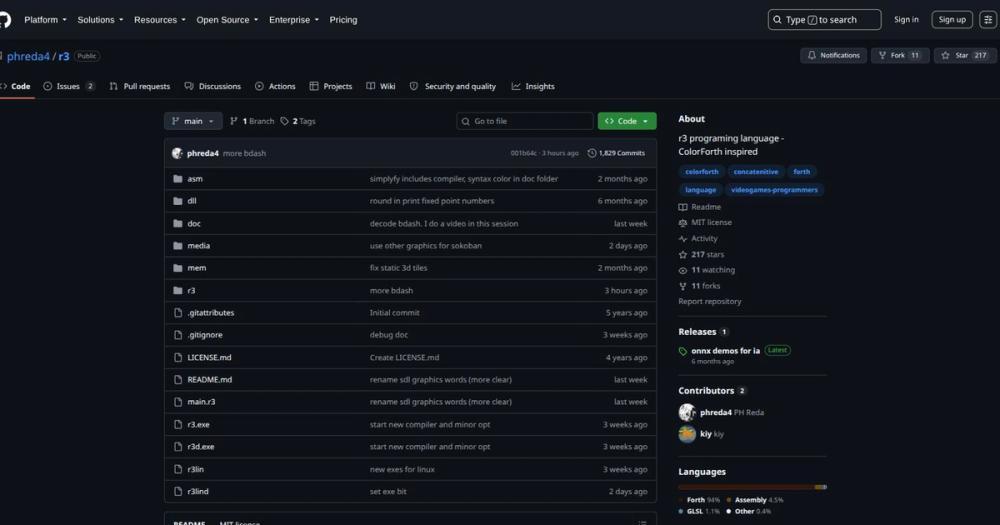
Where r3 falls short compared to paid alternatives: the community is small (217 stars, 11 forks on GitHub as of the last push in August 2026), third-party documentation is limited, and no professional support is available. The self-hosting compiler currently targets Windows only. For teams that need professional debugging tools, language-server integration, or a language familiar to contributors who do not know Forth, the tradeoff is real.
r3 is the better choice when a small, self-contained, MIT-licensed game development environment is the goal and you are willing to invest time in learning the Forth model. Paid tools and larger open source game engines are worth considering when documentation quality, team familiarity, and professional support outweigh the cost of licensing or ecosystem size.