Open Source Alternatives
  • Alternatives
  • Categories
    Categories by size882 projects
    • Developer Tools461
    • AI & Machine Learning404
    • Web Development196
    • Business & Productivity191
    • Communication & Collaboration126
    • Security & Monitoring126
    • IT Management123
    • Product & Project Management106
    • Cloud & Hosting105
    • Data & Analytics104
    Browse all 21 categoriesLLMOps & AI Tooling, Design & Creative and 9 more
  • Blog
  • Advertise
SearchNotion, Slack, password manager.../
Submit
Open Source Alternatives
  • Alternatives
    • Developer Tools461
    • AI & Machine Learning404
    • Web Development196
    • Business & Productivity191
    • Communication & Collaboration126
    • Security & Monitoring126
    • Browse all 21 categories
  • Blog
  • Advertise
Submit your project

New open source projects by email

The projects we add and every new guide. Free, unsubscribe any time.

Open Source Alternatives LogoOpen Source Alternatives

Handpicked Open Source Alternatives to Paid Softwares

Product

  • Categories
  • Tag
  • Advertise

Resources

  • Blog
  • Collection
  • Submit

Company

  • Privacy Policy
  • Terms of Service
  • Refund Policy
  • Sitemap

Alternatives

  • Claude Code
  • Jira
  • Notion
  • Slack
  • Linear
  • Wispr Flow
  • All alternatives
© 2026 Open Source Alternatives. All rights reserved.
Open SourceAlternatives
Home/Categories/AI & Machine Learning/Pstack Claude
icon of Pstack Claude

Pstack Claude

  • 3.1K stars
  • MIT
  • Active this week
  • Last commit 2 days ago

Last verified Oct 20, 2026

Orchestrate structured coding workflows on top of Claude Code, Codex, and Pi with MIT-licensed skills for every development task.

Visit websiteGitHub3.1K stars
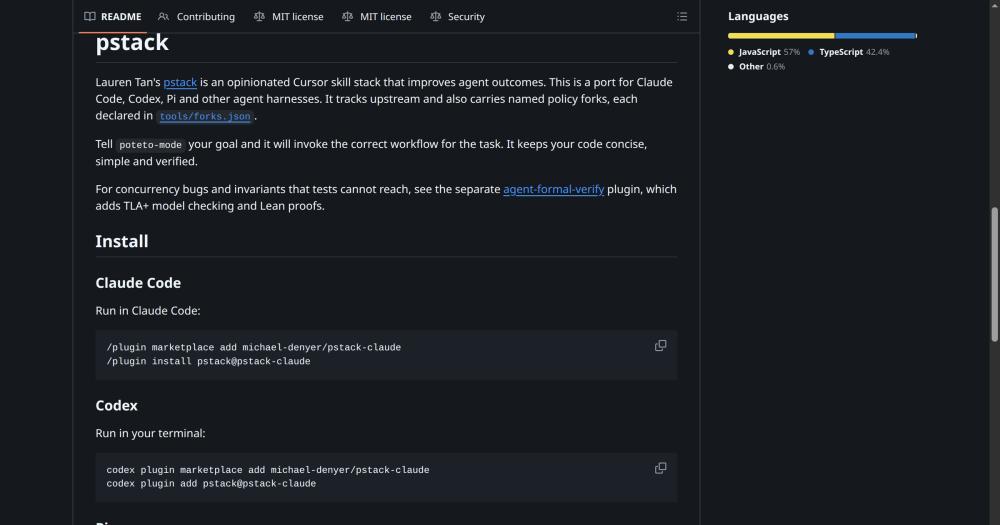
pstack-claude README — structured coding workflows
TL;DR

Pstack Claude is a port of Lauren Tan's pstack, a Cursor-native skill stack, ported to Claude Code, Codex, Pi, OpenCode, and Gemini CLI. It adds structured playbook-driven workflows on top of these agents: tell poteto-mode your goal and it reproduces failures, investigates root causes with dedicated how and why skills, delegates fixes, and verifies outcomes before landing changes. The plugin is MIT licensed, runs entirely locally with no telemetry, and tracks the upstream pstack repository with named policy forks declared in tools/forks.json.

Read the full breakdownHide the full breakdownWho it is for, how it works, trade-offs and the FAQ
who it's for

Who Pstack Claude is for#

Developers fixing bugs that need reproduction evidence

Poteto-mode's bug playbook reproduces the failure first, uses how and why to trace root cause, then delegates the fix and reruns the failing case to confirm. You receive both the fix and the failure-to-passing evidence in the same session, replacing the pattern of applying a guess and hoping it holds.

Skip if:

The bug is already fully understood and isolated. If you have a confirmed root cause and need only a one-line patch, poteto-mode's investigation steps add overhead without benefit.

Teams running PR review and maintenance on Claude Code

The PR maintenance playbook covers review, comment resolution, and pre-merge checks as a structured sequence. On Claude Code, poteto-mode routes PR work through the appropriate skills automatically, including bringing in architect if a change crosses a function boundary.

Skip if:

Your PR workflow is already fully automated by CI or a dedicated review bot. Pstack-claude adds structure to agent-driven review; it does not replace automated linting or CI gates.

Developers using multiple coding agents

The same pstack skill set works on Claude Code, Codex, Pi, OpenCode, and Gemini CLI. A developer or team that switches between coding agents gets the same poteto-mode routing and playbooks on each, without maintaining separate prompt files or configuration per tool.

Skip if:

You are committed to a single coding agent long-term. The multi-platform portability is not useful if you have no plans to work with other agents.

the problem

The problem it solves#

Coding agents answer whatever prompt they receive with no enforced workflow. Asking an agent to fix a bug typically yields a change applied directly to the code, without first reproducing the failure, verifying the root cause, or confirming that the fix holds under the original failing conditions. The same gap shows up across every task type: a feature request skips planning, a refactor skips checking for unintended side effects, and a performance investigation skips measuring before proposing changes.

Teams shipping production code need agent outputs they can verify, not outputs they have to re-check by hand on every run. Without a structured workflow plugin, sessions start from scratch each time, with no investigation steps enforced before a change reaches the repository.

how Pstack Claude solves it

How it solves it#

poteto-mode goal routing

The main entry point. Tell poteto-mode your goal and it selects the matching playbook, from bug fixes to feature planning, refactoring, PR maintenance, and longer project runs. It delegates to architect, arena, or swarm as the task requires, and uses how and why for investigation before any change is applied.

Playbooks for every development task

Named workflows cover bug fixes, feature planning, refactoring, performance investigations, prototypes, PR maintenance, and shipping. Each playbook enforces a defined sequence: plan, delegate, verify. For concurrency bugs and invariants beyond test coverage, a companion plugin (agent-formal-verify) adds TLA+ and Lean proofs.

how and why investigative skills

Before a fix is applied, poteto-mode uses the how skill to reproduce the failure and the why skill to trace root cause. This gives you failure evidence and passing evidence on the same run, not just a diff. The skills are available as standalone slash commands for use outside poteto-mode.

Sub-agent delegation with architect, arena, and swarm

Architect plans cross-boundary changes before implementation begins. Arena runs multiple sub-agents in parallel to explore solutions or perform code review. Swarm coordinates larger task decompositions. Each sub-agent type is invoked by poteto-mode's routing or called directly as a slash command.

Per-role model and reasoning effort configuration

setup-pstack sets default models and reasoning effort per agent role. For example, arena runners can be set to Opus at extra-high effort while the session default stays lower. Claude Code dispatches these through pstack:effort and pstack:poteto-agent agents declared in the plugin manifest.

strengths · trade-offs

Strengths and trade-offs#

Strengths

  • Multi-platform: one plugin set for Claude Code, Codex, Pi, and moreThe same skill set works across Claude Code, Codex, Pi, OpenCode, and Gemini CLI. On Claude Code and Codex the plugin installs a routing hook; on Pi the extension injects the same routing instruction. A team using multiple agents gets the same structured workflows without maintaining separate prompt files per platform.
  • MIT license, no infrastructureThe plugin is MIT licensed with no server, no telemetry, and no cloud dependency. Scripts run locally; PR tools use the developer's existing GitHub CLI login. Any session data goes to the model provider under the developer's own account. There are no subscription tiers or hosting fees specific to pstack-claude.
  • Tracks upstream with named policy forksPstack-claude tracks Lauren Tan's upstream Cursor pstack repository and declares any divergences as named forks in tools/forks.json. This keeps the port auditable: you can see exactly where pstack-claude differs from the original and why, rather than relying on undocumented behavioral divergences.
  • Active project with 1,100+ starsThe repo reached 1,187 GitHub stars and 135 forks since its May 2026 launch, with the last push in October 2026. 10 open issues indicates an active project without a large unaddressed backlog. Contributor guidelines and a security disclosure policy are documented in CONTRIBUTING.md and SECURITY.md.

Trade-offs

  • -Requires an existing coding agent and accountPstack-claude is a plugin, not a standalone tool. It requires an active Claude Code, Codex, or Pi account. Developers without an existing coding agent cannot use pstack-claude in isolation. The plugin also requires trusting the routing hook through the agent's /hooks interface, which Codex prompts you to approve before it runs.
  • -Install via session commands, not shell scriptsInstallation on Claude Code uses /plugin slash commands typed inside an agent session, not shell commands you can script or automate in CI. Codex offers a terminal-level codex plugin command, but Claude Code's install path has no non-interactive equivalent documented in the README.
  • -JavaScript-only implementationThe plugin is written in JavaScript with no TypeScript types exported. Teams using TypeScript-centric toolchains will not get type-checked integration with the plugin's internal APIs. The skills-and-hooks model suits JavaScript well, but it limits contribution from teams that require typed interfaces.
versus alternatives

Pstack Claude vs alternatives#

pstack-claude vs. unstructured Claude Code sessions

Claude Code without a workflow plugin responds to whatever prompt it receives. Ask it to fix a bug and it applies its best interpretation of the fix, with no enforced reproduction step, no root-cause investigation, and no verification pass before the change lands. For one-off tasks where the prompt is specific and the scope is clear, this works well.

The gap shows up on recurring work: bug investigations that need a trail of evidence, features that cross architectural boundaries, or refactors where the risk of unintended side effects is real. In these cases, an unstructured session requires the developer to manually enforce the workflow, recheck outputs, and often re-run the agent when results drift.

CapabilityClaude Code aloneClaude Code + pstack-claude
Workflow structureAd-hoc, prompt-drivenNamed playbooks per task type
Bug investigationDirect fix attemptReproduce, trace root cause, fix, verify
Sub-agent delegationManualarchitect, arena, swarm per playbook
Reasoning effort controlSession-levelPer-role via setup-pstack
Multi-platform portabilityClaude Code onlyClaude Code, Codex, Pi, OpenCode, Gemini CLI
LicensePaid subscriptionPlugin: MIT; platform: paid subscription

Pstack-claude is the better choice when you want repeatable, verifiable workflows and you already use Claude Code. The bug playbook alone gives you failure evidence and passing evidence on the same run, replacing a manual verification step that adds meaningful time to each session.

Claude Code alone remains the right call for short, well-specified tasks where the overhead of a named playbook exceeds the benefit. If you are applying a trivial one-line change with a known correct answer, running poteto-mode adds steps without value. The plugin's value scales with task complexity and the cost of an incorrect agent output reaching the repository.

tech stack · detected from GitHub

What it's built on#

Languages
JavaScriptPythonTypeScript
frequently asked

FAQ#

Does pstack-claude replace Claude Code?

No. Pstack-claude is a plugin that runs on top of Claude Code, not a replacement for it. It adds structured workflow skills to Claude Code sessions, but you still need an active Claude Code account and the agent running in your terminal. Think of it as a set of verified playbooks that improve what Claude Code already does, not a substitute for it.

Which coding agents does pstack-claude support?

Claude Code, Codex, Pi, OpenCode, and Gemini CLI are all supported, plus any coding agent that accepts a shared skills-only install (documented in docs/reference.md#shared-skills-installation). On Claude Code and Codex, the routing hook installs automatically; on Pi, the extension injects the same routing instruction. Prime Agent is also listed in the README with a reference to shared installation.

How do I configure the model and reasoning effort per role?

Run setup-pstack (or /pstack:setup-pstack inside Claude Code) to set model defaults and reasoning effort per agent role. For example, you can set arena runners to Opus at extra-high effort while keeping the session default at a lower level. Roles without an explicit setting inherit the session's current effort. Automatic routing can also be turned off from setup-pstack.

Is pstack-claude free to use?

Yes. The plugin itself is MIT licensed with no subscription or licensing fee. You do pay for whatever coding agent you run it on, such as a Claude Code subscription. The plugin adds no cost on top of that. Scripts run locally with no telemetry sent to any pstack-claude server, because there is no pstack-claude server.

What is poteto-mode and how does it work?

Poteto-mode is the main entry point for pstack-claude. You describe your goal and it selects the correct playbook automatically: bug fixes run through reproduce-investigate-fix-verify; features go through planning and delegation; refactors check for side effects before committing. For concurrency bugs and formal invariants, a companion plugin (agent-formal-verify) extends this with TLA+ model checking and Lean proofs.

also worth a look

Similar open-source tools#

rakazo

Featured

Alternative toGrok Bot

AI teammates you own: your keys, your model, your machine.

  • 4,904 GitHub stars
  • Apache-2.0Licence Apache-2.0

BMAD-METHOD

Alternative toAmazon Kiro

Spec-driven AI development workflow that keeps context across sessions

  • 54,334 GitHub stars
  • CustomLicence MIT with trademark notice

Athena-Public

Alternative toPieces for Developers

Persistent memory for your AI across IDEs

  • 619 GitHub stars
  • MITLicence MIT

Recall

Alternative toContextPool

Local project memory for Claude Code, generated entirely offline.

  • 762 GitHub stars
  • MITLicence MIT

Gstack

InAI & Machine Learning

Turn Claude Code into a virtual engineering team with 23 skills

  • 136,321 GitHub stars
  • MITLicence MIT

openrig

Alternative toConductor

Coordinate Claude Code and Codex as one persistent agent team.

  • 8,072 GitHub stars
  • Apache-2.0Licence Apache-2.0
by category

Open source tools in these categories#

404

AI & Machine Learning

freeCodeCamp, OpenClaw, REA (Reverse Engineer Anything)
462

Developer Tools

REA (Reverse Engineer Anything), superpowers, Skills for Real Engineers
106

Product & Project Management

agency-agents, freeCodeCamp, Gstack

Featured

Omnara

Alternative toCClaude Managed Agents

Open-source agent deployment API. Self-host or use Omnara Cloud.

  • 2,957 GitHub stars
  • Apache-2.0Licence Apache-2.0
  • #AI Agents

Inbox Zero

Alternative toSuperhuman

AI email assistant that drafts replies and clears your inbox

  • 12,712 GitHub stars
  • AGPL-3.0Licence AGPL-3.0
  • #Email

rakazo

Alternative toGrok Bot

AI teammates you own: your keys, your model, your machine.

  • 4,904 GitHub stars
  • Apache-2.0Licence Apache-2.0
  • #AI Agents
Feature your project

New open source projects by email

The projects we add and every new guide. Free, unsubscribe any time.

Find open source alternatives to paid software

/
  • Claude Code to OpenCode
  • Jira to Windshift
  • Notion to AppFlowy
  • Slack to Mattermost
  • Linear to GitLab
  • Wispr Flow to Handy
  • CapCut to Concat
  • Grok Bot to rakazo
  • Superhuman to Inbox Zero
  • Airtable to AITable
  • Muse to OpenClaw
  • GitHub Copilot to Cline
  • Datadog to Netdata
  • Microsoft Teams to Rocket.Chat
  • Pinecone to Qdrant
  • Zapier to n8n
  • Devin AI to OpenHands
  • Firebase to Supabase
  • 1Password to KeePassXC
  • Confluence to Docmost
  • Contentful to Strapi
  • Adobe Premiere Pro to Shotcut
  • ChatGPT to AnythingLLM
  • LangSmith to Langfuse