Recall vs Commercial AI Memory Services
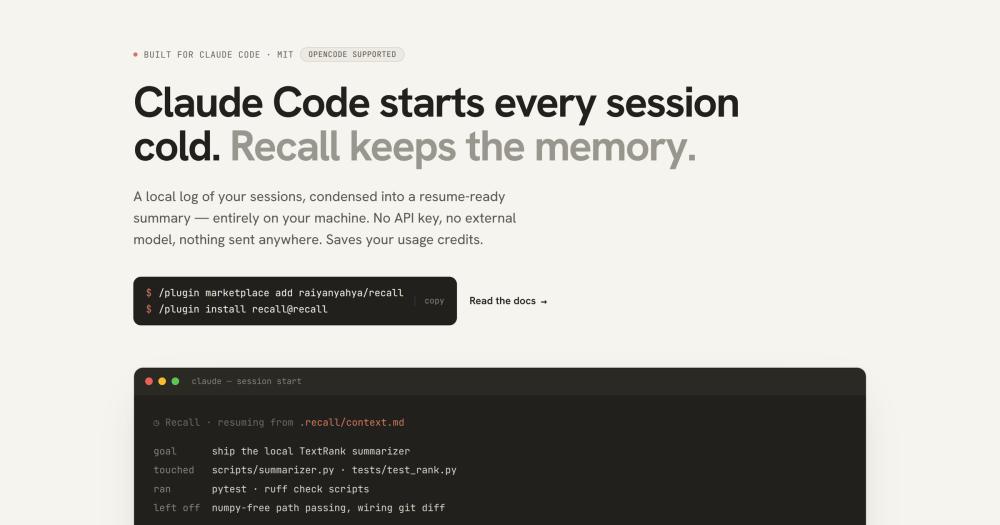
Recall and commercial AI memory tools address the same underlying need (preserving context across sessions) but split on where summarization happens and what that costs.
| Feature | Recall | Commercial AI Memory |
|---|
| License | MIT | Proprietary |
| Summarization location | Local Python | Remote LLM via API |
| Network calls | None | Required |
| Cost per summarization | None (local algorithm) | API usage fees |
| Output format | Plain markdown files | Proprietary database |
| Summary type | Extractive (sentence selection) | Generative (LLM-written) |
| Self-hosting | Runs on your own machine | Typically not available |
Recall is the better choice when privacy matters (transcripts may contain code or credentials), when you want zero marginal cost for memory operations, or when you need output that is diffable and committable to version control. Because summarization is a local Python script, it runs offline, is reproducible, and adds nothing to an API bill. The plain-markdown files in .recall/ require no special tooling to read, archive, or share with teammates.
Commercial AI memory tools have an advantage in summary quality: a remote LLM can understand intent, make inferences, and write coherent prose rather than extracting the statistically central sentences from a transcript. If summary richness is the primary concern and network access, usage billing, and data residency are not constraints, a cloud-based tool such as mem.ai will produce more natural-reading summaries. Commercial tools also typically support a broader range of input types beyond coding session transcripts.
For the specific case of Claude Code session memory, Recall's focused scope and full local execution address the cold-start problem without adding a new service dependency or billing surface. For teams needing AI-generated, semantically rich summaries and who are comfortable with cloud data handling, a commercial memory service remains the better fit.