Open Source Alternatives
  • Alternatives
  • Categories
    Categories by size882 projects
    • Developer Tools461
    • AI & Machine Learning404
    • Web Development196
    • Business & Productivity191
    • Communication & Collaboration126
    • Security & Monitoring126
    • IT Management123
    • Product & Project Management106
    • Cloud & Hosting105
    • Data & Analytics104
    Browse all 21 categoriesLLMOps & AI Tooling, Design & Creative and 9 more
  • Blog
  • Advertise
SearchNotion, Slack, password manager.../
Submit
Open Source Alternatives
  • Alternatives
    • Developer Tools461
    • AI & Machine Learning404
    • Web Development196
    • Business & Productivity191
    • Communication & Collaboration126
    • Security & Monitoring126
    • Browse all 21 categories
  • Blog
  • Advertise
Submit your project

New open source projects by email

The projects we add and every new guide. Free, unsubscribe any time.

Open Source Alternatives LogoOpen Source Alternatives

Handpicked Open Source Alternatives to Paid Softwares

Product

  • Categories
  • Tag
  • Advertise

Resources

  • Blog
  • Collection
  • Submit

Company

  • Privacy Policy
  • Terms of Service
  • Refund Policy
  • Sitemap

Alternatives

  • Claude Code
  • Jira
  • Notion
  • Slack
  • Linear
  • Wispr Flow
  • All alternatives
© 2026 Open Source Alternatives. All rights reserved.
Open SourceAlternatives
Home/Categories/DevOps & CI/CD/OneDev
icon of Onedev

OneDev

Open source alternative to GitHub, GitLab, Azure DevOps and Bitbucket

  • 15.3K stars
  • MIT
  • Active this week
  • Last commit 2 days ago

Last verified Oct 19, 2026

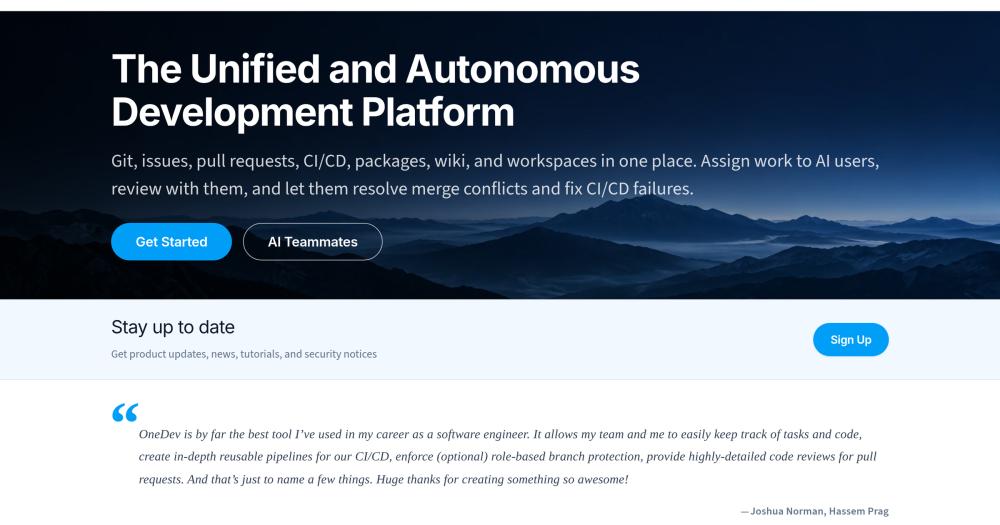
Host Git repositories, CI/CD pipelines, issue tracking, package registries, and a wiki on your server, with AI teammates that implement issues and fix builds.

Visit websiteGitHub15.3K starsDeploy on Hostinger
Image for OneDev
TL;DR

OneDev is a self-hosted Git platform that combines CI/CD, issue tracking, package registries, wiki documentation, and AI teammates in a single MIT-licensed server. It replaces GitHub, GitLab, Azure DevOps, and Bitbucket for teams that want to own their DevOps infrastructure without per-user pricing. The platform is lightweight (1 core, 2 GB RAM for medium projects) and runs on Linux, Windows, or Apple Silicon. Best for engineering teams integrating coding agents into their workflow, teams with data-residency requirements, and organizations that want traceability across code, builds, and issues without paying for a cloud-hosted suite.

Read the full breakdownHide the full breakdownWho it is for, how it works, trade-offs and the FAQ
who it's for

Who OneDev is for#

Teams building AI-assisted development workflows

OneDev's AI users plug into the native issue and PR flow: assign issues to AI for implementation, let AI review PRs, trigger AI to fix CI failures. The workspace feature runs coding agents (Claude Code, OpenCode, Codex) headlessly in browser-accessible dev containers on the OneDev server. This is the most integrated setup for teams adopting AI-pair programming at the workflow level.

Skip if:

Teams that want to use a managed AI coding product without operating their own DevOps server. OneDev's AI integration requires a self-hosted instance with a configured AI provider; there is no cloud-hosted path.

Organizations with compliance or data-residency requirements

All code, CI logs, package artifacts, issue history, and AI interaction traces stay on infrastructure you control. OneDev's MIT license permits deployment in air-gapped environments with no phone-home dependencies beyond whatever AI provider you configure. Audit trails across code, builds, and issues are all searchable within the same system.

Skip if:

Organizations without an existing server or cloud infrastructure team. If you cannot run and maintain a Linux or Windows server, the operational overhead outweighs the compliance benefit.

Mid-sized engineering teams replacing per-seat SaaS

At team sizes where GitHub Teams or GitLab Premium per-user costs become significant, OneDev's self-hosted MIT model makes the economics straightforward: pay for the server once, not per developer per month. The full feature set (CI/CD, issue tracking, packages, wikis, code review) is available on the self-hosted version without a paid tier.

Skip if:

Teams of 2-3 developers where a managed service is cheaper than the time cost of operating a server. OneDev pays off at the point where per-seat fees materially exceed infrastructure costs.

Teams integrating Renovate for dependency management

OneDev has native Renovate integration to open pull requests for dependency updates and auto-merge them when required reviewers approve and CI passes. Combined with the built-in package registry and security scanning (dependencies, binaries, container images), teams get a full dependency lifecycle inside one system.

Skip if:

Projects with simple, infrequently-changed dependency trees where Renovate automation adds configuration overhead without clear benefit.

the problem

The problem it solves#

Engineering teams running separate tools for code hosting, CI/CD, issue tracking, package management, and documentation spend significant time maintaining integrations between those systems. When a commit triggers a build that fixes a bug, tracing that chain across three different dashboards is slow and error-prone. Cloud-hosted platforms like GitHub, GitLab, and Azure DevOps solve this by bundling everything, but at the cost of per-user pricing that scales uncomfortably as teams grow, storage and runner limits tied to plan tiers, and no option to keep code and pipeline data on infrastructure you control.

For organizations with compliance requirements, air-gapped environments, or data-residency constraints, the only alternative has been assembling Gitea plus Jenkins plus Jira and keeping those integrations working over time. That maintenance burden is the real cost that per-seat SaaS pricing obscures.

how OneDev solves it

How it solves it#

AI teammates for issue and PR automation

AI users in OneDev work autonomously inside the standard issue and pull request flow. Assign an issue to an AI user and it implements the fix; add an AI reviewer to a pull request and it gives feedback; let the CI/CD failure handler assign the AI user to diagnose and fix broken builds. All AI actions happen through the platform's native workspaces, not an external service.

GUI-based CI/CD without YAML authoring

Jobs are created through an interactive editor with typed parameters, template reuse, and cache management. Framework templates cover common build patterns, and matrix jobs let you fan out tests across variable configurations. No CI YAML to commit or maintain; pipelines live inside OneDev and are version-controlled alongside the project settings.

Built-in package registries

Package registries are included and linked to CI/CD jobs, so build artifacts are published, versioned, and associated with the build that produced them. No separate registry service to operate or authenticate against; packages resolve the same identity graph as the issues and builds that reference them.

Versioned wiki documentation

Each project includes a markdown wiki that is version-controlled alongside the codebase. Pages can be edited in the browser or via Git, wiki changes can be reviewed in pull requests, and any branch or release tag has its own wiki snapshot. Documentation stays in sync with the state of the code.

Language-aware code search and navigation

Code search supports regular expressions and language-aware symbol search across any commit in the repository, not just HEAD. Click a symbol to see all occurrences in the current file. The search runs across the full history, which matters when tracing when a symbol was introduced or renamed.

Customizable issue workflows with service desk

Issue states, fields, and transition rules are configurable per project. Kanban boards can move cards manually or automatically based on commit and CI events. The service desk feature links email threads to issues, letting teams support customers without requiring them to register accounts.

strengths · trade-offs

Strengths and trade-offs#

Strengths

  • MIT license with full self-hostingOneDev is MIT-licensed and self-hosted, with no licensing fees and no restriction on commercial use or modification. You own the server, the code, the pipeline logs, and the package artifacts. Unlike GitHub (cloud-only for most features) or GitLab's paid tiers, there is no feature wall between the free and paid experience on the self-hosted path.
  • Low resource footprintThe OneDev team documents medium-sized project operation on a single core with 2 GB RAM. A published performance comparison with GitLab shows OneDev using roughly 50% less memory and pushing Git commits about 40% faster. This means smaller infrastructure spend and faster operations on shared or constrained servers.
  • Deep cross-referencing between code, builds, and issuesOneDev links issues, commits, CI/CD builds, and packages into a single traceability graph. A build shows which issues it fixed; an issue shows the builds that resolved it; package versions report the code changes they include. This is built into the data model, not a post-hoc integration between separate services.
  • Browser-based workspaces for AI and human developersWorkspaces spin up preconfigured dev containers on the OneDev server, accessible in the browser. AI users (Claude Code, OpenCode, Codex) run in task-automation workspaces headlessly; human developers open the same environment interactively. Teams can onboard contributors without local setup, which reduces environment-configuration friction on large or distributed teams.

Trade-offs

  • -Java runtime and initial setup complexityOneDev is written in Java and requires a Java runtime on the host. The server distribution handles this, but the setup process is more involved than a Docker-only install for teams unfamiliar with bare-metal service configuration. The 2026 release series replaced the old Java Service Wrapper with OneDev Wrapper, dropping Intel Mac and FreeBSD support in the process.
  • -Self-managed infrastructure responsibilityRunning OneDev means you own backups, upgrades, availability, and security patching for the server and the underlying OS. Teams that chose GitHub or GitLab specifically to offload that operational burden will find that cost returns. High-availability mode (cluster replication) is supported but requires additional server capacity and configuration work.
  • -Smaller ecosystem than GitHub or GitLabGitHub and GitLab have large ecosystems of third-party integrations, marketplace actions, and community-built templates. OneDev covers the core DevOps loop well but has fewer ready-made integrations. Teams dependent on specific GitHub Actions or GitLab CI templates may need to adapt those pipelines on import.
versus alternatives

OneDev vs alternatives#

OneDev vs GitHub

GitHub is the dominant cloud-hosted Git platform with the largest marketplace of Actions and the widest community. OneDev's self-hosted architecture targets a different set of constraints.

FeatureOneDevGitHub
LicenseMIT (self-hosted)Proprietary
Hosting modelSelf-hosted onlyCloud (GitHub.com) or Enterprise (paid)
CI/CDBuilt-in, GUI editorGitHub Actions (YAML)
Package registryBuilt-inGitHub Packages
AI integrationAI teammates in native workflowGitHub Copilot (separate subscription)
PricingFree (infrastructure cost only)Free tier + per-user plans

OneDev is the better choice when you need to keep code and CI data on your own servers, want AI-assisted workflows without a separate Copilot subscription, or have team sizes where GitHub's per-user pricing adds up. GitHub is the better choice when third-party integrations, the Actions marketplace depth, or the GitHub social graph (stars, forks, contributor discovery) matter more than data ownership.

OneDev vs GitLab

GitLab Community Edition is the most direct open source comparison: both offer self-hosted Git, CI/CD, issues, and packages. The differentiation is in footprint and philosophy.

FeatureOneDevGitLab CE
LicenseMITMIT (CE)
Resource use1 core, 2 GB RAM for medium projectsMinimum 4 GB RAM recommended
CI/CD editorGUI-based, no YAML requiredYAML only
AI integrationNative AI teammatesGitLab Duo (paid add-on)
EcosystemSmallerLarge CI template library

OneDev runs meaningfully lighter than GitLab. For teams on constrained hardware or smaller VPS instances, the resource difference is real: GitLab's documentation recommends a minimum of 4 GB RAM for even light use, while OneDev handles medium-sized projects on 2 GB. OneDev's GUI CI/CD editor reduces the YAML authoring burden that GitLab teams commonly cite as friction. GitLab is still the better choice when you need its mature ecosystem of pre-built CI templates, enterprise compliance features, or the GitLab container registry's tight integration with Kubernetes.

tech stack · detected from GitHub

What it's built on#

Languages
JavaJavaScript
frequently asked

FAQ#

Is OneDev free to use?

Yes. OneDev is MIT-licensed and self-hosted, with no paid plans or per-user fees for the self-hosted version. You pay for the server infrastructure; the software itself is free to use, modify, and deploy for any purpose, including commercial use.

How does OneDev compare to GitLab?

Both offer a similar feature set: Git hosting, CI/CD, issue tracking, and packages in one tool. OneDev uses significantly less memory (roughly 50% less) and pushes Git commits faster according to published benchmarks. GitLab has a larger ecosystem and more third-party integrations; OneDev has a lighter footprint and a GUI-based CI/CD editor that does not require YAML authoring.

Can OneDev run AI agents like Claude Code or Codex?

Yes. OneDev workspaces spin up preconfigured dev containers on the server. AI users (Claude Code, OpenCode, Codex, and others) run in task-automation workspaces headlessly, while human developers can open the same environment in the browser. OneDev also ships a CLI and skills package so coding agents can query and edit issues, pull requests, and builds.

What platforms does OneDev support?

OneDev server and agent distributions run on Linux and Windows (amd64 and arm64 architectures) and macOS on Apple Silicon. As of version 16.9.0, Intel Mac, FreeBSD, and other platforms are no longer supported.

Does OneDev support high availability?

Yes. OneDev supports a cluster setup that can replicate projects across different servers for high availability or distribute projects for horizontal scalability. The high-availability configuration requires additional server capacity; documentation is at docs.onedev.io.

also worth a look

Similar open-source tools#

Gitea

Alternative toGitHub

Self-hosted Git server with CI, issues, and pull requests

  • 58,588 GitHub stars
  • MITLicence MIT

Gogs

Alternative toGitHub

Lightweight self-hosted Git server that is painless to set up

  • 47,895 GitHub stars
  • MITLicence MIT

Forgejo

Alternative toGitHub

Self-hosted Git forge for teams that want platform independence

  • 5,688 GitHub stars
  • GPL-3.0Licence GPL-3.0

gitdeck

Alternative toGitKraken

Self-hosted Git dashboard for GitHub, GitLab, and Forgejo

  • 423 GitHub stars
  • MITLicence MIT

tuicr

Alternative toGraphite

Terminal UI for code review with vim keybindings and GitHub-style

  • 3,419 GitHub stars
  • MITLicence MIT

GitLab

Alternative toGitHub

Self-hosted Git server with CI/CD, security scans, and planning

  • 24,535 GitHub stars
  • MITLicence MIT
by category

Open source tools in these categories#

86

DevOps & CI/CD

Nvm, Uptime Kuma, Netdata
461

Developer Tools

REA (Reverse Engineer Anything), superpowers, Skills for Real Engineers
106

Product & Project Management

freeCodeCamp, agency-agents, Gstack
Hostinger

Run OneDev on your own server

Self-host OneDev on a Hostinger VPS.

Deploy on Hostinger

Featured

Omnara

Alternative toCClaude Managed Agents

Open-source agent deployment API. Self-host or use Omnara Cloud.

  • 2,957 GitHub stars
  • Apache-2.0Licence Apache-2.0
  • #AI Agents

rakazo

Alternative toGrok Bot

AI teammates you own: your keys, your model, your machine.

  • 4,904 GitHub stars
  • Apache-2.0Licence Apache-2.0
  • #AI Agents

Inbox Zero

Alternative toSuperhuman

AI email assistant that drafts replies and clears your inbox

  • 12,712 GitHub stars
  • AGPL-3.0Licence AGPL-3.0
  • #Email
Feature your project

New open source projects by email

The projects we add and every new guide. Free, unsubscribe any time.

Find open source alternatives to paid software

/
  • Claude Code to OpenCode
  • Jira to Windshift
  • Notion to AppFlowy
  • Slack to Mattermost
  • Linear to GitLab
  • Wispr Flow to Handy
  • CapCut to Concat
  • Grok Bot to rakazo
  • Superhuman to Inbox Zero
  • Airtable to AITable
  • Muse to OpenClaw
  • GitHub Copilot to Cline
  • Datadog to Netdata
  • Microsoft Teams to Rocket.Chat
  • Pinecone to Qdrant
  • Zapier to n8n
  • Devin AI to OpenHands
  • Firebase to Supabase
  • 1Password to KeePassXC
  • Confluence to Docmost
  • Contentful to Strapi
  • Adobe Premiere Pro to Shotcut
  • ChatGPT to AnythingLLM
  • LangSmith to Langfuse