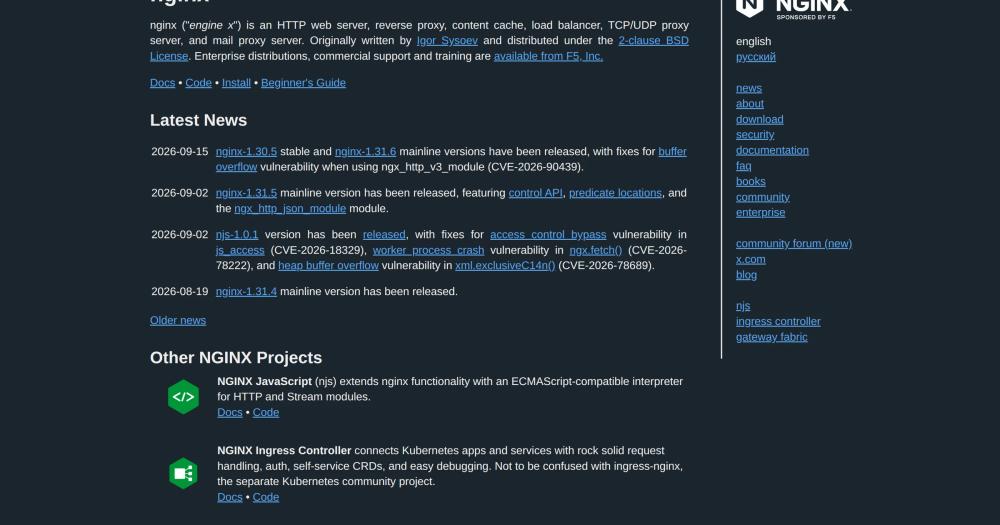
Nginx is an open-source web server, reverse proxy, and load balancer used as a self-hosted alternative to commercial solutions like Microsoft IIS, AWS Application Load Balancer, and F5 BIG-IP.
vs Microsoft IIS: IIS (Internet Information Services) is a Windows-only web server bundled with Windows Server licenses. Nginx runs on every major OS, handles higher throughput per CPU core using an event-driven asynchronous architecture, and is the dominant choice for Linux-hosted applications. IIS integrates tightly with the .NET stack; Nginx is language-agnostic and used across Python, Node.js, PHP, Go, and static-site deployments.
vs Apache HTTP Server: Apache uses a thread-per-connection or process-per-connection model that handles complex configurations well but consumes more memory under high concurrency. Nginx was designed to handle tens of thousands of simultaneous connections with minimal memory usage, making it the preferred choice for high-traffic reverse proxy and static file serving workloads. Both are open source; the choice depends on concurrency requirements and familiarity with each server's configuration model.
vs Caddy: Caddy is a modern web server that automatically provisions and renews TLS certificates via Let's Encrypt with zero configuration. Nginx requires manual TLS setup (commonly via certbot) but offers more granular control over load balancing algorithms, caching directives, upstream health checks, and proxy buffering. Caddy prioritizes zero-config convenience; Nginx is preferred when fine-grained production control is a hard requirement.