Open Source Alternatives
  • Alternatives
  • Categories
    Categories by size882 projects
    • Developer Tools461
    • AI & Machine Learning404
    • Web Development196
    • Business & Productivity191
    • Communication & Collaboration126
    • Security & Monitoring126
    • IT Management123
    • Product & Project Management106
    • Cloud & Hosting105
    • Data & Analytics104
    Browse all 21 categoriesLLMOps & AI Tooling, Design & Creative and 9 more
  • Blog
  • Advertise
SearchNotion, Slack, password manager.../
Submit
Open Source Alternatives
  • Alternatives
    • Developer Tools461
    • AI & Machine Learning404
    • Web Development196
    • Business & Productivity191
    • Communication & Collaboration126
    • Security & Monitoring126
    • Browse all 21 categories
  • Blog
  • Advertise
Submit your project

New open source projects by email

The projects we add and every new guide. Free, unsubscribe any time.

Open Source Alternatives LogoOpen Source Alternatives

Handpicked Open Source Alternatives to Paid Softwares

Product

  • Categories
  • Tag
  • Advertise

Resources

  • Blog
  • Collection
  • Submit

Company

  • Privacy Policy
  • Terms of Service
  • Refund Policy
  • Sitemap

Alternatives

  • Claude Code
  • Jira
  • Notion
  • Slack
  • Linear
  • Wispr Flow
  • All alternatives
© 2026 Open Source Alternatives. All rights reserved.
Open SourceAlternatives
Home/Categories/Developer Tools/googletest
icon of googletest

googletest

Open source alternative to Parasoft C/C++test, VectorCAST and QA Systems Cantata

  • 39.7K stars
  • BSD-3-Clause
  • Active this month
  • Last commit 8 days ago

Last verified Oct 20, 2026

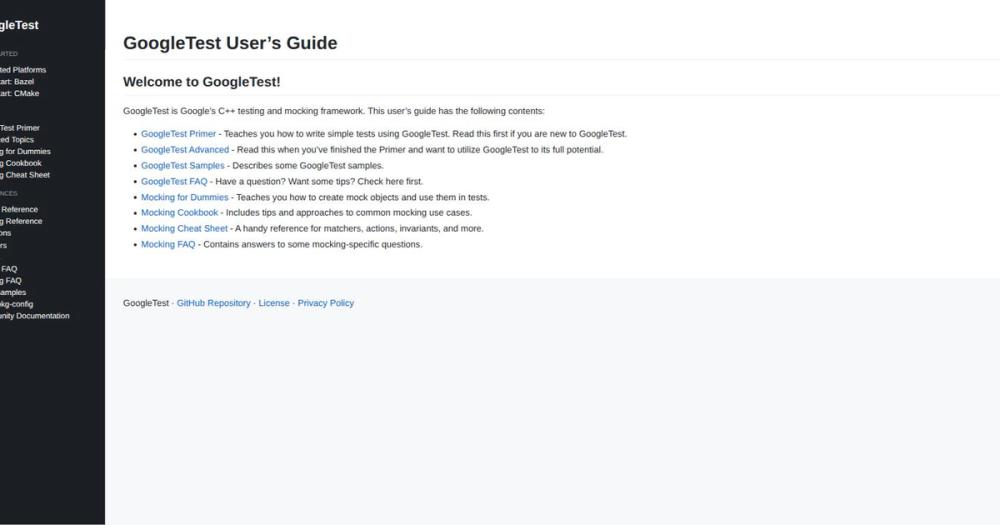
Build C++ unit tests with Google's xUnit framework: automatic test discovery, rich assertions, mocking, and parameterized runs. BSD-3-Clause licensed.

Visit websiteGitHub39.7K stars
Image for googletest
TL;DR

googletest is Google's C++ unit testing and mocking framework, built on the xUnit architecture. It replaces paid tools like Parasoft C/C++test and VectorCAST for teams that do not need compliance-specific reporting: no per-seat license, no vendor contract, BSD-3-Clause licensed. Best for C++ engineers writing unit tests, death tests, and parameterized test suites across compilers and platforms.

Read the full breakdownHide the full breakdownWho it is for, how it works, trade-offs and the FAQ
who it's for

Who googletest is for#

C++ teams building unit test suites from scratch

GoogleTest provides everything needed to start: test macros, an assertion library, test discovery, and mock object support. Teams can adopt it incrementally, adding TEST() definitions alongside existing code with no invasive refactoring of the production codebase.

Skip if:

If your team is in a safety-critical domain requiring DO-178C, ISO 26262, or similar compliance artifacts, GoogleTest alone will not produce the required documentation. Consider VectorCAST or Parasoft C/C++test for certified workflows.

Teams migrating from paid C++ testing tools

GoogleTest covers the core feature set of commercial C++ testing tools: assertions, test discovery, parameterized runs, and mocking. Teams moving off Parasoft C/C++test or VectorCAST can port most test logic without significant rewriting, since both use the xUnit model.

Skip if:

If your current tool's compliance reports are required by a regulator, migrating to GoogleTest requires adding a separate compliance layer. Do not migrate if certification artifacts are non-negotiable for your project.

Open source C++ projects needing CI coverage

Chromium, LLVM, Protocol Buffers, and OpenCV all use GoogleTest, meaning it integrates well with GitHub Actions, Jenkins, and other CI systems via the XML output flag. BSD-3-Clause licensing means it can be included in any open source project without license conflicts.

Skip if:

If your project is primarily C rather than C++, verify that the C++ compilation requirement fits your toolchain. For C-only codebases, the C++ dependency may add unwanted complexity.

the problem

The problem it solves#

Testing C++ code without a framework means writing assertion macros by hand, manually registering test cases, and running executables with no discovery, filtering, or parallelism. These ad-hoc setups work on small codebases but break under scale: a growing test suite needs consistent failure reporting, the ability to run only affected tests, and mocking for dependency isolation. Verifying that error-handling code causes the process to exit in a specific way (death tests) is especially hard to implement cleanly without dedicated framework support.

The commercial testing market in C++ targets safety-critical and regulated industries. Tools like Parasoft C/C++test, VectorCAST, and QA Systems Cantata carry enterprise pricing and certification overhead that general-purpose C++ projects do not need. Teams outside regulated verticals end up either paying for features they will not use or stitching together ad-hoc test harnesses that do not scale.

how googletest solves it

How it solves it#

Automatic test discovery

GoogleTest discovers and runs all test functions automatically at binary startup, eliminating the need to manually register each test. You define tests with TEST() or TEST_F() macros; the framework finds and executes them in order, with filtering and per-test result tracking.

Value-parameterized and type-parameterized tests

Run the same test logic across multiple input values with value-parameterized tests, or across multiple data types with type-parameterized tests. Both modes reduce duplicated test code when verifying functions that accept varied inputs or template arguments.

Death test support

Death tests verify that a specific code path causes the program to exit in an expected way, useful for testing error-handling and assertion logic. GoogleTest runs death tests in a child process to prevent them from terminating the full test suite on failure.

Fatal and non-fatal failure modes

ASSERT_* macros stop the current test on failure (fatal); EXPECT_* macros record the failure and continue running (non-fatal). This lets a single test run report multiple failures rather than stopping at the first, which speeds up diagnosis of broad regressions.

Google Mock integration

The formerly separate GoogleMock project is now part of this repository. It provides a C++ framework for creating mock objects and verifying interactions, with a matcher and action vocabulary documented in a dedicated cheat sheet and cookbook in the project documentation.

Rich built-in assertion library

Built-in assertions cover equality, inequality, ordering, string matching, exception throwing, and floating-point comparisons. User-defined matchers can extend the assertion vocabulary for domain-specific checks without modifying the framework itself.

strengths · trade-offs

Strengths and trade-offs#

Strengths

  • Production-proven at Google scaleChromium, LLVM, Protocol Buffers, and OpenCV all run their tests with GoogleTest, meaning the framework handles real-world C++ codebases with demanding requirements. Google also uses it for internal projects at scale, giving confidence that edge cases in test infrastructure have been exercised.
  • BSD-3-Clause license for commercial useThe BSD-3-Clause license allows use in closed-source commercial products without any source-disclosure requirement. Unlike AGPL or GPL frameworks, there is no obligation to publish your test code or application code when distributing binaries.
  • Actively maintained with recent releasesThe repository received its latest push on 2026-08-27, with Release 1.18.0 as the current stable version. Google's internal CI drives continuous integration, and active development continues with a planned dependency on the Abseil library in a future release.
  • Zero licensing cost vs commercial alternativesGoogleTest is free to use without per-seat fees, enterprise contracts, or tiered feature gating. Compared to commercial C++ testing tools that charge enterprise pricing per seat, the total cost is build infrastructure only.

Trade-offs

  • -C++17 required for the 1.18.x branchThe 1.18.x release requires at least C++17. Projects targeting older compiler standards (C++11 or C++14) must pin to an earlier GoogleTest release, which means missing recent framework improvements and falling behind on maintained updates.
  • -No built-in compliance reportingGoogleTest does not generate the DO-178C, ISO 26262, or IEC 61508 compliance reports that tools like VectorCAST and Parasoft C/C++test target. Teams in regulated industries will need separate tooling for certification artifacts in addition to GoogleTest.
  • -Requires C++ build system integrationGoogleTest is a library, not a standalone tool with an installer or GUI. Adding it to an existing project requires integrating it into CMake, Bazel, or another build system. Teams new to C++ build tooling may find the initial setup takes meaningful time.
versus alternatives

googletest vs alternatives#

GoogleTest vs Parasoft C/C++test

Parasoft C/C++test is a commercial static analysis and unit testing tool targeting safety-critical development. Its core value is compliance reporting: it generates traceability matrices and coverage reports satisfying DO-178C, ISO 26262, and similar standards. GoogleTest does not generate these artifacts natively.

For teams building general-purpose C++ applications where compliance certification is not required, GoogleTest covers the unit testing functionality Parasoft provides at zero licensing cost. The xUnit model, assertion library, and parameterized test support match Parasoft's core testing workflow. Teams that need compliance traceability will still need Parasoft or a supplemental reporting layer on top of GoogleTest.

GoogleTest vs VectorCAST

VectorCAST is a commercial automated testing tool from Vector Informatik, commonly used in automotive and avionics software development. Its differentiation is automated test case generation, requirements-based traceability, and certification-ready reporting for IEC 61508 and DO-178C environments.

GoogleTest does not automate test generation or produce certification artifacts. For standard C++ unit testing, it removes per-seat fees and vendor lock-in compared to VectorCAST. The test discovery, mock support, and assertion library cover the same fundamental testing workflow. Teams moving from VectorCAST to GoogleTest in non-regulated projects typically find the migration straightforward because both use function-level test cases.

GoogleTest vs QA Systems Cantata

QA Systems Cantata targets embedded and safety-critical C and C++ testing with static analysis, code coverage measurement, and compliance documentation. Like Parasoft and VectorCAST, its primary value for regulated teams is certification support.

For embedded C++ teams outside regulated verticals, GoogleTest provides the xUnit testing model at no licensing cost. Cantata's code coverage instrumentation is more specialized; GoogleTest works alongside standard coverage tools (gcov, llvm-cov) without being tied to a proprietary analysis environment. Teams that do not need certification reports will find GoogleTest the more practical choice.

tech stack · detected from GitHub

What it's built on#

Languages
CC++Python
frequently asked

FAQ#

Is GoogleTest free to use for commercial projects?

Yes. GoogleTest is BSD-3-Clause licensed, which permits use in closed-source commercial applications without any requirement to publish your source code. There are no per-seat fees, enterprise licenses, or paid tiers.

What C++ standard does GoogleTest require?

The 1.18.x branch requires at least C++17. If your project targets an older standard, you can pin to an earlier GoogleTest release, though you will not receive the improvements added in recent versions.

Does GoogleTest replace commercial tools like Parasoft C/C++test or VectorCAST?

For teams outside regulated industries, yes. GoogleTest covers unit testing, mocking, and parameterized runs without licensing fees. Parasoft C/C++test and VectorCAST add compliance reporting (DO-178C, ISO 26262) that GoogleTest does not generate natively. If compliance certification is not a requirement, GoogleTest meets the core testing needs at no cost.

Can GoogleTest run tests in parallel?

Yes. GoogleTest supports running tests in parallel via gtest-parallel (a separate Google-maintained runner) or by splitting test binaries and running them concurrently in CI. Individual test binaries run test cases sequentially by default.

What mocking support does GoogleTest include?

Google Mock, formerly a separate project, is now part of the GoogleTest repository. It provides a C++ framework for creating mock objects and verifying expectations, with a matcher vocabulary and action library documented in the mocking cheat sheet and cookbook on the project documentation site.

also worth a look

Similar open-source tools#

WebCheck-OSINT

Alternative toShodan

44-check OSINT scanner for DNS, SSL, ports, CVEs, and TLS audits

  • 343 GitHub stars
  • MITLicence MIT

Void Cloud

Alternative toVercel

Full-stack Vite toolkit with one-command Cloudflare deployment

  • 507 GitHub stars
  • MITLicence MIT

Rust

InWeb Development

Systems language with memory safety and no garbage collector.

  • 120,618 GitHub stars
  • Apache-2.0Licence Apache-2.0

Markdown Preview Editor

Alternative toTypora

Browser-only Markdown editor with live preview and strict privacy.

  • 30 GitHub stars
  • MITLicence MIT

CodeBoarding

Alternative toCodeDashboard

Review code changes as architecture maps, not line diffs

  • 2,601 GitHub stars
  • MITLicence MIT

Dyad

Alternative toLovable

Local, open-source AI app builder with your own API keys

  • 22,031 GitHub stars
  • CustomLicence Apache-2.0 with separate pro-directory license
by category

Open source tools in these categories#

462

Developer Tools

REA (Reverse Engineer Anything), superpowers, Skills for Real Engineers
196

Web Development

freeCodeCamp, superpowers, Skills for Real Engineers

Featured

Omnara

Alternative toCClaude Managed Agents

Open-source agent deployment API. Self-host or use Omnara Cloud.

  • 2,957 GitHub stars
  • Apache-2.0Licence Apache-2.0
  • #AI Agents

rakazo

Alternative toGrok Bot

AI teammates you own: your keys, your model, your machine.

  • 4,904 GitHub stars
  • Apache-2.0Licence Apache-2.0
  • #AI Agents

Inbox Zero

Alternative toSuperhuman

AI email assistant that drafts replies and clears your inbox

  • 12,712 GitHub stars
  • AGPL-3.0Licence AGPL-3.0
  • #Email
Feature your project

New open source projects by email

The projects we add and every new guide. Free, unsubscribe any time.

Find open source alternatives to paid software

/
  • Claude Code to OpenCode
  • Jira to Windshift
  • Notion to AppFlowy
  • Slack to Mattermost
  • Linear to GitLab
  • Wispr Flow to Handy
  • CapCut to Concat
  • Grok Bot to rakazo
  • Superhuman to Inbox Zero
  • Airtable to AITable
  • Muse to OpenClaw
  • GitHub Copilot to Cline
  • Datadog to Netdata
  • Microsoft Teams to Rocket.Chat
  • Pinecone to Qdrant
  • Zapier to n8n
  • Devin AI to OpenHands
  • Firebase to Supabase
  • 1Password to KeePassXC
  • Confluence to Docmost
  • Contentful to Strapi
  • Adobe Premiere Pro to Shotcut
  • ChatGPT to AnythingLLM
  • LangSmith to Langfuse