
Open Source Alternatives
  • Alternatives
  • Categories
    Categories by size881 projects
    • Developer Tools460
    • AI & Machine Learning404
    • Web Development196
    • Business & Productivity191
    • Communication & Collaboration126
    • Security & Monitoring126
    • IT Management123
    • Product & Project Management106
    • Cloud & Hosting104
    • Data & Analytics104
    Browse all 21 categoriesLLMOps & AI Tooling, Design & Creative and 9 more
  • Blog
  • Advertise
SearchNotion, Slack, password manager.../
Submit
Open Source Alternatives
  • Alternatives
    • Developer Tools460
    • AI & Machine Learning404
    • Web Development196
    • Business & Productivity191
    • Communication & Collaboration126
    • Security & Monitoring126
    • Browse all 21 categories
  • Blog
  • Advertise
Submit your project

New open source projects by email

The projects we add and every new guide. Free, unsubscribe any time.

Open Source Alternatives LogoOpen Source Alternatives

Handpicked Open Source Alternatives to Paid Softwares

Product

  • Categories
  • Tag
  • Advertise

Resources

  • Blog
  • Collection
  • Submit

Company

  • Privacy Policy
  • Terms of Service
  • Refund Policy
  • Sitemap

Alternatives

  • Claude Code
  • Jira
  • Notion
  • Slack
  • Linear
  • Wispr Flow
  • All alternatives
© 2026 Open Source Alternatives. All rights reserved.
Open SourceAlternatives
Home/Categories/Developer Tools/Godot Engine
icon of Godot Engine

Godot Engine

Open source alternative to Unity, Unreal Engine and GameMaker Studio

  • 118.8K stars
  • MIT
  • Active this week
  • Last commit 1 day ago

Last verified Oct 21, 2026

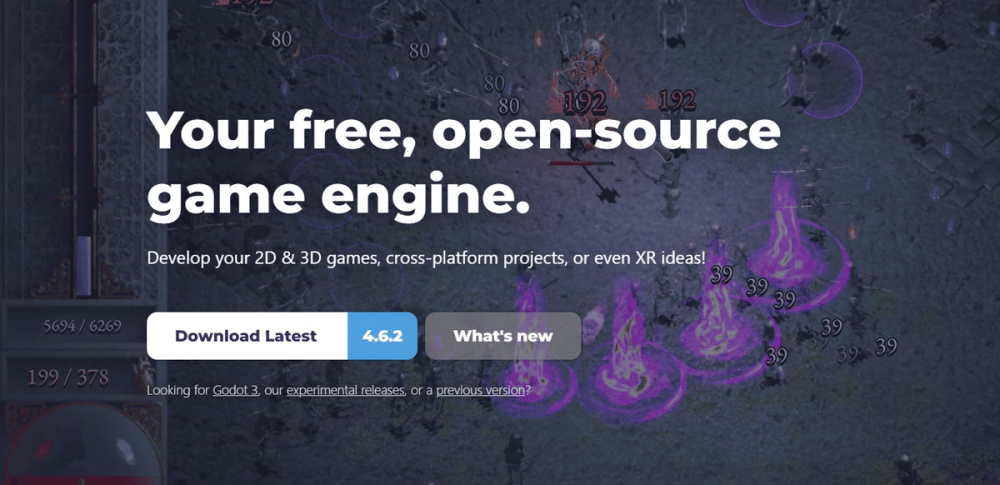
Godot is a free and open-source game engine for 2D and 3D game development.

Visit websiteGitHub118.8K stars
image of Godot Engine
TL;DR

Godot Engine helps indie and professional teams build 2D, 3D, and XR games without Unity or Unreal licensing pressure or vendor lock-in.

Read the full breakdownHide the full breakdownWho it is for, how it works, trade-offs, the quick start and the FAQ
who it's for

Who Godot Engine is for#

Ship indie 2D games

Use Godot's dedicated 2D engine, tile maps, animation tools, and desktop, mobile, or web exports to build commercial games without engine royalties or per-seat costs.

Skip if:

Your project depends on a proprietary console workflow or a Unity-only asset package that would take longer to replace than the game itself.

Prototype small 3D games

Build playable 3D scenes with Godot's editor, renderer options, physics, animation, and GDScript iteration loop before deciding whether the project needs a heavier engine.

Skip if:

You need a mature AAA-grade 3D content pipeline, a large proprietary marketplace, or an existing Unreal team with no time to retrain.

Teach game development

Use a free MIT licensed editor, readable GDScript, and built-in 2D and 3D tutorials so students can install the same tool at home without license management.

Skip if:

The course is specifically about Unity, Unreal, or C# web deployment in Godot 4.

Build interactive tools

Godot can build non-game applications and complex UI tools with its GUI system, resource model, and cross-platform exports. It fits apps that behave more like interactive scenes than CRUD dashboards.

Skip if:

You mostly need web forms, server-rendered pages, or conventional business software where a web framework is simpler.

the problem

The problem it solves#

Game teams often choose between expensive proprietary engines and lighter tools that do not cover the full production pipeline. Indie studios, educators, and small professional teams need an editor that handles scenes, scripting, animation, physics, UI, asset import, and export without per-seat costs or royalty anxiety.

The pain gets sharper when a project needs both 2D and 3D, or when a studio wants to customize the engine itself. A closed engine can leave teams dependent on a vendor roadmap, plugin marketplace, or license change, while Godot gives them source access and a community-driven path.

how Godot Engine solves it

How it solves it#

Compose scenes from nodes

Build games from nodes and reusable scenes, then attach scripts to customize behavior. This keeps menus, characters, enemies, levels, and UI screens as editable building blocks instead of one-off code paths.

Build in 2D or 3D

Create pixel-based 2D games with real 2D coordinates, tile maps, and canvas tools, or switch to 3D nodes with OpenGL plus Vulkan, Direct3D 12, and Metal renderers for modern projects.

Pick GDScript, C#, or C++

Write gameplay in GDScript, use C# with the dedicated .NET executable on desktop and mobile, or add performance-critical code through C++ GDExtension without recompiling the engine.

Export to desktop, mobile, and web

Export one project to Linux, macOS, Windows, Android, iOS, and web targets. Console releases are possible through third-party publishers, which matches Godot's official console support model.

Extend the editor and asset pipeline

Import Blender scenes directly, use glTF or FBX assets, build editor plugins, and share reusable addons or templates through the Godot ecosystem.

strengths · trade-offs

Strengths and trade-offs#

Strengths

  • Avoid royalties and license lock-inGodot's MIT license lets teams use, modify, and distribute the engine for commercial projects. Game content stays under the creator's chosen license, which removes the revenue-share and license-change risk common with proprietary engines.
  • Modify and redistribute the engineTeams can inspect the engine, change it, ship modified versions, and keep proprietary game code private as long as they include the Godot license notice. That matters for studios that need custom engine modules or third-party library integration.
  • Start with a real 2D pipelineGodot has a separate 2D pipeline with pixel coordinates, 2D nodes, tile map editing, and UI tools. Teams making 2D-first games avoid forcing sprites and menus through a 3D-centered workflow.
  • Shape the project in publicThe project is developed in the open and supported by the not-for-profit Godot Foundation. Contributors can influence engine direction rather than waiting for a proprietary vendor to prioritize their use case.

Trade-offs

  • -Validate C# targets earlyGodot 4's C# support is available for desktop and mobile targets, while web support still points users to Godot 3. Teams planning browser releases should validate language choice before committing.
  • -Plan console releases separatelyGodot can target consoles, but the public engine workflow depends on third-party publishers or developers with porting experience. Small teams should plan for that gap early if console release is required.
  • -Bring proprietary SDKs yourselfThe project avoids adding closed-source SDKs to the core engine. Teams that depend on FMOD, GameWorks, or other proprietary middleware may need plugins, custom modules, or a different engine path.
  • -Budget for workflow migrationGodot's scene, node, resource, and scripting model is its own workflow, not a Unity or Unreal clone. Existing projects may need redesign rather than a direct import path.
versus alternatives

Godot Engine vs alternatives#

Godot Engine vs Unity and Unreal Engine

Godot overlaps most directly with Unity for indie and cross-platform game development, while Unreal remains the proprietary benchmark for high-end 3D production. Godot wins when source access, licensing stability, 2D workflow, and lightweight iteration matter more than a proprietary asset marketplace or studio services.

CriterionGodot EngineUnity / Unreal Engine
LicenseMITProprietary
Source accessFull engine sourceVendor-controlled source access and terms
RoyaltiesNone from GodotCommercial terms, not MIT
2D workflowDedicated 2D engineUsually part of a broader 3D-first toolchain
Console pathThird-party publishersMature commercial console programs

Choose Godot for indie 2D games, student projects, modifiable engine work, and teams that want to own the full toolchain. Unity or Unreal can still be the better fit when a studio already relies on their proprietary services, marketplace assets, console relationships, or specialized high-end 3D production workflows.

install · quick start

Quick start#

bash
# macOS desktop integration
brew install --cask godot

# Linux desktop integration
flatpak install flathub org.godotengine.Godot

# Source build for Linux/BSD
git clone https://github.com/godotengine/godot.git -b 4.6
cd godot
scons platform=linuxbsd
tech stack · detected from GitHub

What it's built on#

Languages
CC#C++JavaKotlinObjective-C++Python
frequently asked

FAQ#

Is Godot free for commercial games?

Yes. Godot is MIT licensed, free to download, and usable for personal, nonprofit, and commercial projects. The official license page says your game content remains yours, while redistributed Godot binaries need the copyright and license notice.

Can Godot make both 2D and 3D games?

Yes. Godot supports both 2D and 3D projects from one editor, with a dedicated 2D engine and 3D nodes and renderers. It is often strongest for teams that want a first-class 2D workflow plus enough 3D for prototypes, stylized games, and smaller productions.

What languages can I use in Godot?

Godot supports GDScript, C#, and C++ through GDExtension, with community bindings for languages such as Rust, Nim, Python, and JavaScript. C# support in Godot 4 is for desktop and mobile targets, so browser projects should verify the current web support path first.

Can Godot export to consoles?

Yes, but console support is handled through third-party publishers rather than a fully public export path. Teams targeting PlayStation, Xbox, or Nintendo should plan for porting support and console vendor requirements early.

How do I install Godot?

Most users download the official editor binary and run it without a system install. For desktop integration, Godot's FAQ points users to Steam, Scoop, Homebrew, or Flathub, and Linux users can also place the binary in their PATH as godot.

also worth a look

Similar open-source tools#

Openfilm

Alternative toRemotion

AI video agent for coding agents; films are local web folders.

  • 1,850 GitHub stars
  • MITLicence MIT

SOMA

Alternative toZoo.dev

Parametric 3D modeling via CLI agent: describe, generate, iterate.

  • 162 GitHub stars
  • GPL-3.0Licence GPL-3.0

OpenCreator

Alternative toHeyGen

Local AI workspace for video, image, voice, and translation

  • 13,637 GitHub stars
  • Apache-2.0Licence Apache-2.0

Drift

Alternative toCapCut

Desktop CapCut alternative. GPL-3.0, no subscription, no watermark.

  • 2,024 GitHub stars
  • GPL-3.0Licence GPL-3.0

Artcraft

Alternative toRunway

Open source AI studio for artists who want real control

  • 33,842 GitHub stars
  • Apache-2.0Licence Apache-2.0

Caret

Alternative toPlasmic

Your design canvas is backed by real files in git

  • 38 GitHub stars
  • Apache-2.0Licence Apache-2.0
by category

Open source tools in these categories#

460

Developer Tools

REA (Reverse Engineer Anything), superpowers, Skills for Real Engineers
97

Design & Creative

ComfyUI, Excalidraw, Godot Engine

Featured

rakazo

Alternative toGrok Bot

AI teammates you own: your keys, your model, your machine.

  • 4,904 GitHub stars
  • Apache-2.0Licence Apache-2.0
  • #AI Agents

Omnara

Alternative toCClaude Managed Agents

Open-source agent deployment API. Self-host or use Omnara Cloud.

  • 2,957 GitHub stars
  • Apache-2.0Licence Apache-2.0
  • #AI Agents

Inbox Zero

Alternative toSuperhuman

AI email assistant that drafts replies and clears your inbox

  • 12,712 GitHub stars
  • AGPL-3.0Licence AGPL-3.0
  • #Email
Feature your project

New open source projects by email

The projects we add and every new guide. Free, unsubscribe any time.

Find open source alternatives to paid software

/
  • Claude Code to OpenCode
  • Jira to Windshift
  • Notion to AppFlowy
  • Slack to Mattermost
  • Linear to GitLab
  • Wispr Flow to Handy
  • CapCut to Concat
  • Grok Bot to rakazo
  • Superhuman to Inbox Zero
  • Airtable to AITable
  • Muse to OpenClaw
  • GitHub Copilot to Cline
  • Datadog to Netdata
  • Microsoft Teams to Rocket.Chat
  • Pinecone to Qdrant
  • Zapier to n8n
  • Devin AI to OpenHands
  • Firebase to Supabase
  • 1Password to KeePassXC
  • Confluence to Docmost
  • Contentful to Strapi
  • Adobe Premiere Pro to Shotcut
  • ChatGPT to AnythingLLM
  • LangSmith to Langfuse