Open Source Alternatives
  • Alternatives
  • Categories
    Categories by size882 projects
    • Developer Tools461
    • AI & Machine Learning404
    • Web Development196
    • Business & Productivity191
    • Communication & Collaboration126
    • Security & Monitoring126
    • IT Management123
    • Product & Project Management106
    • Cloud & Hosting105
    • Data & Analytics104
    Browse all 21 categoriesLLMOps & AI Tooling, Design & Creative and 9 more
  • Blog
  • Advertise
SearchNotion, Slack, password manager.../
Submit
Open Source Alternatives
  • Alternatives
    • Developer Tools461
    • AI & Machine Learning404
    • Web Development196
    • Business & Productivity191
    • Communication & Collaboration126
    • Security & Monitoring126
    • Browse all 21 categories
  • Blog
  • Advertise
Submit your project

New open source projects by email

The projects we add and every new guide. Free, unsubscribe any time.

Open Source Alternatives LogoOpen Source Alternatives

Handpicked Open Source Alternatives to Paid Softwares

Product

  • Categories
  • Tag
  • Advertise

Resources

  • Blog
  • Collection
  • Submit

Company

  • Privacy Policy
  • Terms of Service
  • Refund Policy
  • Sitemap

Alternatives

  • Claude Code
  • Jira
  • Notion
  • Slack
  • Linear
  • Wispr Flow
  • All alternatives
© 2026 Open Source Alternatives. All rights reserved.
Open SourceAlternatives
Home/Categories/AI & Machine Learning/UniMate
icon of UniMate

UniMate

Open source alternative to DeepMotion SayMotion

  • 2K stars
  • MIT
  • Active this month
  • Last commit 14 days ago

Last verified Oct 20, 2026

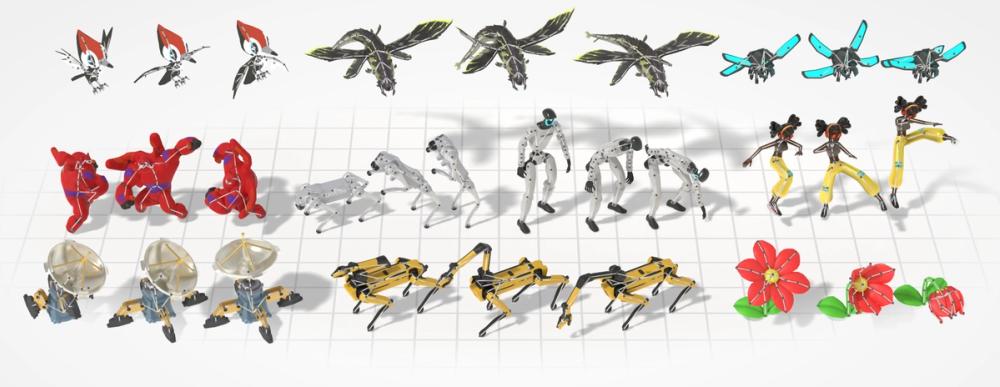
Generate articulated motion for any rigged 3D skeleton from a text prompt, with no per-skeleton retraining. A SIGGRAPH Asia 2026 research model.

Visit websiteGitHub2K stars
image of UniMate
TL;DR

UniMate is an MIT-licensed research model that generates animation for arbitrary rigged 3D skeletons from a text prompt. One model covers bipeds, quadrupeds, birds, fish, insects and snakes without per-skeleton retraining. It also supports motion editing, in-betweening and expansion. It is an early release that needs a GPU and Python setup, and the authors say many motions and skeletons still fail.

Read the full breakdownHide the full breakdownWho it is for, how it works, trade-offs, the quick start and the FAQ
who it's for

Who UniMate is for#

Prototyping creature animation

Generate rough walk, fly or swim motion for a non-human rig from a short prompt, to block out a scene before committing to hand animation.

Skip if:

You need production-ready, hand-polished animation with guaranteed quality on a specific rig.

Animation research and benchmarking

Use the code, checkpoints and UniML3D dataset as a baseline for work on cross-topology motion generation.

Skip if:

You do not have a GPU environment or the time to set up a research codebase.

the problem

The problem it solves#

Rigging has become fast, but animating the result has not. Learned animators usually depend on category-specific templates, per-skeleton fine-tuning, or reference motions at inference. Teams working with varied characters, creatures and rigid objects either buy fixed motion packs or hand-animate each rig. UniMate targets that gap: given any rigged asset and a text prompt, it synthesizes motion for that exact skeleton, with no test-time optimization.

how UniMate solves it

How it solves it#

One model for diverse skeletons

A topology-aware diffusion transformer adapts to each rig's structure, covering bipedal, quadrupedal, avian, marine, insectoid, serpentine and articulated rigid objects without retraining per skeleton.

Text-prompted motion generation

Provide a rigged 3D asset and a prompt such as a dog walking or a dragon taking off. The model generates motion for that skeleton and exports sample renders and motion files.

Zero-shot editing, in-betweening and expansion

The same trained model keeps chosen joints or keyframes fixed and regenerates the rest, or chains several prompts into a longer motion, with no fine-tuning or auxiliary networks.

UniML3D dataset and training code

The repo includes training configs, inference scripts and a data-processing pipeline. UniML3D holds 13,006 text-paired motion sequences, released on Hugging Face.

Animated mesh export

A helper script turns generated motion files into an animated GLB and FBX for the original rigged mesh, so results can move into a standard 3D workflow.

strengths · trade-offs

Strengths and trade-offs#

Strengths

  • Topology generalizationOne set of weights handles very different skeletons, so you do not need a separate model or fine-tuning run for each creature or object rig.
  • Open code, weights and dataTraining and inference code is MIT licensed, preview checkpoints are on Hugging Face, and the processed dataset and its pipeline are published.
  • Several tasks from one modelEditing, in-betweening and motion expansion reuse the pretrained model by holding parts of the motion fixed during sampling.

Trade-offs

  • -Early research releaseThe README calls UniMate an early step toward text-to-animation for any skeleton and says many motions and skeletons still fail. Expect rough results on unusual rigs.
  • -Setup and hardware demandsYou install a conda environment and run Python scripts, and sampling expects the training dataset features for the target skeleton to be present. A GPU is practical for any serious use.
  • -Data licensing gapsThe Truebones ZOO motions are a commercial asset pack that cannot be redistributed, so you must buy that pack yourself to rebuild the full dataset. An official preprocessing pipeline for new rigs was still listed as a TODO.
versus alternatives

UniMate vs alternatives#

UniMate vs Truebones ZOO motion packs

Truebones ZOO is a commercial pack of animal motion clips. The UniMate authors consume it as part of their training data and note that its license does not permit redistribution. A pack gives you fixed, authored clips for a fixed set of creatures. UniMate generates new motion from a prompt for the rig you supply, including rigs outside any pack, but quality varies and the project says many motions still fail.

UniMate vs Mixamo

Mixamo is a proprietary service with a library of human animations, and the UniMate dataset draws on Mixamo clips. Its strength is a large catalog of human motion. UniMate targets the case Mixamo's human focus does not cover: arbitrary skeletons such as quadrupeds, birds, insects and snakes, driven by text. You trade a polished hosted service for a self-run research codebase.

Where the open model fits

UniMate suits teams that want to prototype motion for varied rigs, or researchers who need open weights, code and data. It is not a drop-in replacement for a polished commercial animation suite. Expect to run Python, manage a GPU environment and review generated clips before they reach a project.

install · quick start

Quick start#

bash
Setup uses a conda environment with Python 3.10 and the repository's requirements file.

```bash
git clone https://github.com/Friedrich-M/UniMate.git
cd UniMate
conda create -n unimate python=3.10 -y
conda activate unimate
pip install "setuptools<81"
pip install -r requirements.txt --no-build-isolation
```
tech stack · detected from GitHub

What it's built on#

Languages
Python
frequently asked

FAQ#

What does UniMate do?

It generates articulated motion for a rigged 3D asset from a text prompt. A single unified model handles many skeleton types, with no per-skeleton retraining and no test-time optimization.

What license is UniMate under?

The repository is MIT licensed. The Truebones ZOO motions used to build part of the dataset are a separate commercial pack that is not redistributed, so you must purchase it directly to reproduce that portion.

Can I use it for editing or in-betweening existing motion?

Yes. The same pretrained model supports motion editing, in-betweening and expansion by pinning chosen joints or keyframes during sampling, with no fine-tuning.

Is it production ready?

Not yet. The authors describe it as an early step and note that many motions and skeletons still fail. Preview checkpoints are on Hugging Face and new ones will be synced there.

also worth a look

Similar open-source tools#

God's Eye View

Featured

Alternative toFFlightradar24

Real-time global intelligence on a 3D globe

  • 58,501 GitHub stars
  • CustomLicence MIT with third-party data restrictions

CodeBoarding

Alternative toCodeDashboard

Review code changes as architecture maps, not line diffs

  • 2,601 GitHub stars
  • MITLicence MIT

Vela

Alternative toGoogle Maps

OpenStreetMap and Google data, no account, no Play Services

  • 2,060 GitHub stars
  • GPL-3.0Licence GPL-3.0

Lingbot Map

Alternative toPix4D

Self-hosted streaming 3D reconstruction from long video

  • 18,171 GitHub stars
  • Apache-2.0Licence Apache-2.0

Vane

Alternative toPerplexity AI

AI-powered answering engine for private, cited web searches

  • 37,553 GitHub stars
  • MITLicence MIT

Dyad

Alternative toLovable

Local, open-source AI app builder with your own API keys

  • 22,031 GitHub stars
  • CustomLicence Apache-2.0 with separate pro-directory license
by category

Open source tools in these categories#

404

AI & Machine Learning

freeCodeCamp, OpenClaw, REA (Reverse Engineer Anything)
196

Web Development

superpowers, freeCodeCamp, Skills for Real Engineers

Featured

rakazo

Alternative toGrok Bot

AI teammates you own: your keys, your model, your machine.

  • 4,904 GitHub stars
  • Apache-2.0Licence Apache-2.0
  • #AI Agents

Omnara

Alternative toCClaude Managed Agents

Open-source agent deployment API. Self-host or use Omnara Cloud.

  • 2,957 GitHub stars
  • Apache-2.0Licence Apache-2.0
  • #AI Agents

Inbox Zero

Alternative toSuperhuman

AI email assistant that drafts replies and clears your inbox

  • 12,712 GitHub stars
  • AGPL-3.0Licence AGPL-3.0
  • #Email
Feature your project

New open source projects by email

The projects we add and every new guide. Free, unsubscribe any time.

Find open source alternatives to paid software

/
  • Claude Code to OpenCode
  • Jira to Windshift
  • Notion to AppFlowy
  • Slack to Mattermost
  • Linear to GitLab
  • Wispr Flow to Handy
  • CapCut to Concat
  • Grok Bot to rakazo
  • Superhuman to Inbox Zero
  • Airtable to AITable
  • Muse to OpenClaw
  • GitHub Copilot to Cline
  • Datadog to Netdata
  • Microsoft Teams to Rocket.Chat
  • Pinecone to Qdrant
  • Zapier to n8n
  • Devin AI to OpenHands
  • Firebase to Supabase
  • 1Password to KeePassXC
  • Confluence to Docmost
  • Contentful to Strapi
  • Adobe Premiere Pro to Shotcut
  • ChatGPT to AnythingLLM
  • LangSmith to Langfuse