Open Source Alternatives
  • Alternatives
  • Categories
    Categories by size882 projects
    • Developer Tools461
    • AI & Machine Learning404
    • Web Development196
    • Business & Productivity191
    • Communication & Collaboration126
    • Security & Monitoring126
    • IT Management123
    • Product & Project Management106
    • Cloud & Hosting105
    • Data & Analytics104
    Browse all 21 categoriesLLMOps & AI Tooling, Design & Creative and 9 more
  • Blog
  • Advertise
SearchNotion, Slack, password manager.../
Submit
Open Source Alternatives
  • Alternatives
    • Developer Tools461
    • AI & Machine Learning404
    • Web Development196
    • Business & Productivity191
    • Communication & Collaboration126
    • Security & Monitoring126
    • Browse all 21 categories
  • Blog
  • Advertise
Submit your project

New open source projects by email

The projects we add and every new guide. Free, unsubscribe any time.

Open Source Alternatives LogoOpen Source Alternatives

Handpicked Open Source Alternatives to Paid Softwares

Product

  • Categories
  • Tag
  • Advertise

Resources

  • Blog
  • Collection
  • Submit

Company

  • Privacy Policy
  • Terms of Service
  • Refund Policy
  • Sitemap

Alternatives

  • Claude Code
  • Jira
  • Notion
  • Slack
  • Linear
  • Wispr Flow
  • All alternatives
© 2026 Open Source Alternatives. All rights reserved.
Open SourceAlternatives
Home/Categories/Communication & Collaboration/Quiet
icon of Quiet

Quiet

Open source alternative to Slack, Threema Work and Wire

  • 2.7K stars
  • GPL-3.0
  • Active this week
  • Last commit 3 days ago

Last verified Oct 20, 2026

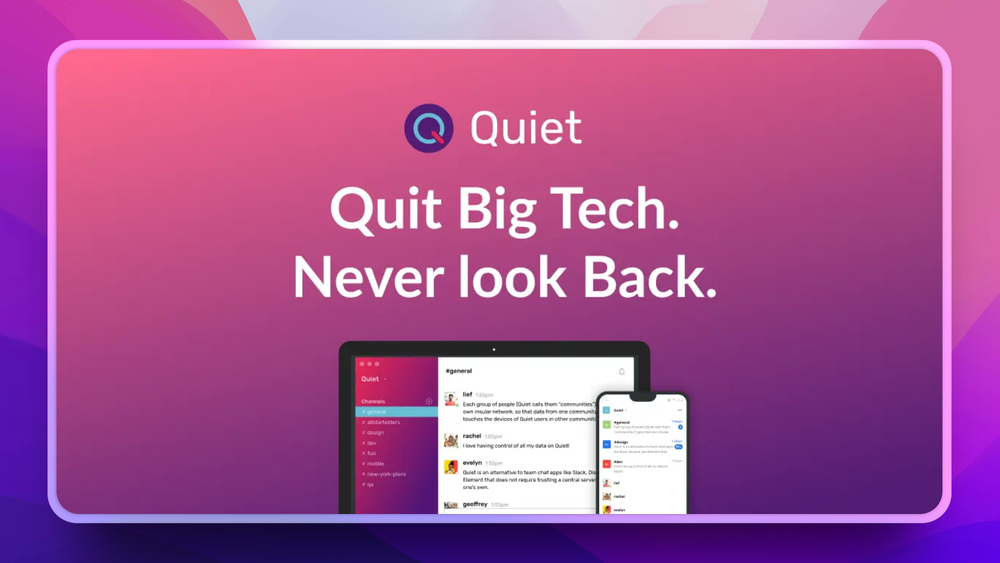
Secure private group messaging through Tor with a peer-to-peer chat app that avoids central servers.

Visit websiteGitHub2.7K starsDeploy on Hostinger
image of Quiet
TL;DR

Quiet is a peer-to-peer team messaging app that uses Tor and local-first architecture for private group communication. It replaces centralized chat workspaces for groups that want serverless, privacy-focused messaging. GPL-3.0 licensed.

Read the full breakdownHide the full breakdownWho it is for, how it works, trade-offs and the FAQ
who it's for

Who Quiet is for#

Small privacy-sensitive groups

Use Quiet when a group needs private chat without depending on a central workspace provider.

Skip if:

You need enterprise administration, app integrations, and formal compliance reporting.

Communities avoiding central servers

Use Quiet for community spaces where server ownership and metadata exposure are major concerns.

Skip if:

Your members need the simplest possible mainstream onboarding experience.

the problem

The problem it solves#

Private groups often use hosted team chat even when they do not want a central provider controlling servers, metadata, or access. That creates a trust gap for activist groups, sensitive communities, and teams working under privacy constraints.

Serverless messaging can reduce provider dependence, but it changes expectations around availability, moderation, and administration. Teams need to choose it for the right reason: privacy and ownership, not maximum workplace features.

how Quiet solves it

How it solves it#

Peer-to-peer team chat

Quiet is built around group messaging without a traditional central workspace server.

Tor-based privacy layer

The project uses Tor as part of its privacy model, reducing exposure of network metadata compared with ordinary hosted chat.

Local-first community data

Quiet emphasizes local-first communication patterns, which helps groups retain more control over their messages and spaces.

strengths · trade-offs

Strengths and trade-offs#

Strengths

  • No central chat providerQuiet is useful for groups that do not want their communication tied to a company-owned workspace server.
  • Designed for sensitive communitiesThe Tor and peer-to-peer architecture makes privacy a core product decision rather than an add-on setting.

Trade-offs

  • -Not a Slack cloneQuiet should not be evaluated as a feature-for-feature Slack replacement. It prioritizes privacy architecture over broad workplace integrations.
tech stack · detected from GitHub

What it's built on#

Languages
CC++JavaScriptKotlinPythonSwiftTypeScript
Frameworks
ExpressNestJS
Tooling
Webpack
frequently asked

FAQ#

Is Quiet self-hosted?

Quiet is better described as peer-to-peer and serverless rather than a traditional self-hosted chat server.

Does Quiet use Tor?

Yes. Quiet uses Tor as part of its privacy-focused communication model.

Can Quiet replace Slack?

Quiet can replace Slack for small groups prioritizing privacy, but it is not meant to match Slack's full business workspace ecosystem.

Looking for more

Other ways to replace Slack, Threema Work and Wire#

Buzz

Featuredfor Slack

Self-hosted team chat where people and AI agents work together

36,174 GitHub starsVisit

Mattermost

#1 in the Slack guide

Closest drop-in Slack replacement for self-hosted teams

39,388 GitHub stars

Rocket.Chat

#2 in the Slack guide

Teams needing internal chat and customer omnichannel in one tool

46,298 GitHub stars

Zulip

#3 in the Slack guide

Async-first teams that need organized, low-noise conversations

26,085 GitHub stars
All 17 Slack alternatives8 open source Slack alternatives, ranked
by category

Open source tools in these categories#

126

Communication & Collaboration

freeCodeCamp, iptv, Excalidraw
126

Security & Monitoring

REA (Reverse Engineer Anything), RustDesk, Uptime Kuma
Hostinger

Run Quiet on your own server

Self-host Quiet on a Hostinger VPS.

Deploy on Hostinger

Featured

rakazo

Alternative toGrok Bot

AI teammates you own: your keys, your model, your machine.

  • 4,904 GitHub stars
  • Apache-2.0Licence Apache-2.0
  • #AI Agents

Inbox Zero

Alternative toSuperhuman

AI email assistant that drafts replies and clears your inbox

  • 12,712 GitHub stars
  • AGPL-3.0Licence AGPL-3.0
  • #Email

Omnara

Alternative toCClaude Managed Agents

Open-source agent deployment API. Self-host or use Omnara Cloud.

  • 2,957 GitHub stars
  • Apache-2.0Licence Apache-2.0
  • #AI Agents
Feature your project

New open source projects by email

The projects we add and every new guide. Free, unsubscribe any time.

Find open source alternatives to paid software

/
  • Claude Code to OpenCode
  • Jira to Windshift
  • Notion to AppFlowy
  • Slack to Mattermost
  • Linear to GitLab
  • Wispr Flow to Handy
  • CapCut to Concat
  • Grok Bot to rakazo
  • Superhuman to Inbox Zero
  • Airtable to AITable
  • Muse to OpenClaw
  • GitHub Copilot to Cline
  • Datadog to Netdata
  • Microsoft Teams to Rocket.Chat
  • Pinecone to Qdrant
  • Zapier to n8n
  • Devin AI to OpenHands
  • Firebase to Supabase
  • 1Password to KeePassXC
  • Confluence to Docmost
  • Contentful to Strapi
  • Adobe Premiere Pro to Shotcut
  • ChatGPT to AnythingLLM
  • LangSmith to Langfuse