
Open Source Alternatives
  • Alternatives
  • Categories
    Categories by size882 projects
    • Developer Tools461
    • AI & Machine Learning404
    • Web Development196
    • Business & Productivity191
    • Communication & Collaboration126
    • Security & Monitoring126
    • IT Management123
    • Product & Project Management106
    • Cloud & Hosting105
    • Data & Analytics104
    Browse all 21 categoriesLLMOps & AI Tooling, Design & Creative and 9 more
  • Blog
  • Advertise
SearchNotion, Slack, password manager.../
Submit
Open Source Alternatives
  • Alternatives
    • Developer Tools461
    • AI & Machine Learning404
    • Web Development196
    • Business & Productivity191
    • Communication & Collaboration126
    • Security & Monitoring126
    • Browse all 21 categories
  • Blog
  • Advertise
Submit your project

New open source projects by email

The projects we add and every new guide. Free, unsubscribe any time.

Open Source Alternatives LogoOpen Source Alternatives

Handpicked Open Source Alternatives to Paid Softwares

Product

  • Categories
  • Tag
  • Advertise

Resources

  • Blog
  • Collection
  • Submit

Company

  • Privacy Policy
  • Terms of Service
  • Refund Policy
  • Sitemap

Alternatives

  • Claude Code
  • Jira
  • Notion
  • Slack
  • Linear
  • Wispr Flow
  • All alternatives
© 2026 Open Source Alternatives. All rights reserved.
Open SourceAlternatives
Home/Categories/APIs & Integration/Open Wearables
icon of Open Wearables

Open Wearables

Open source alternative to Human API and Validic

  • 2.7K stars
  • MIT
  • Active this week
  • Last commit 2 days ago

Last verified Oct 20, 2026

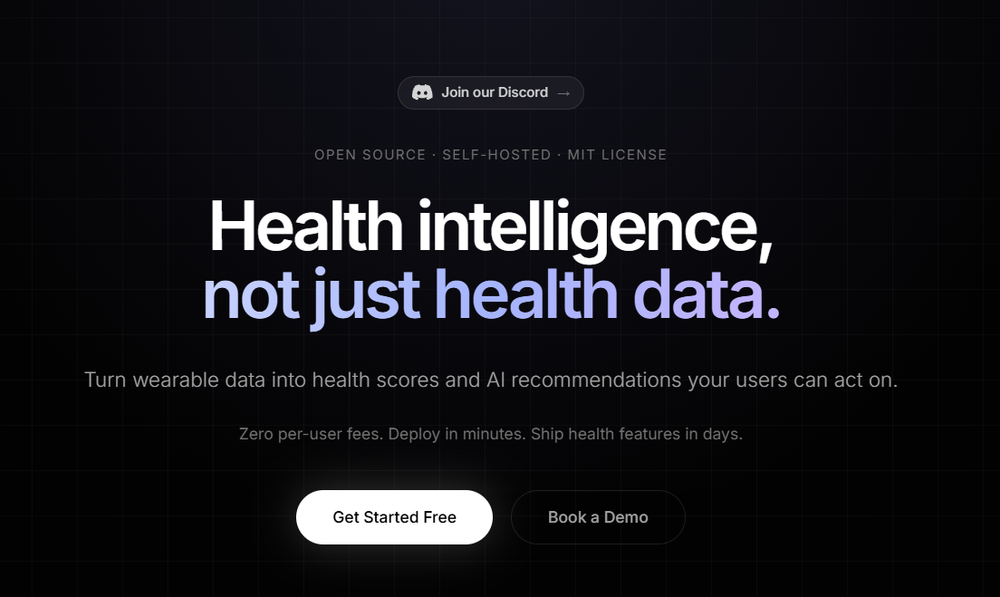
Open-source wearable API and health intelligence platform for developers.
Visit websiteGitHub2.7K starsDeploy on Hostinger
image of Open Wearables
TL;DR

Open Wearables is a self-hosted wearable health data API that unifies fitness and health data from providers like Garmin, Whoop, Apple Health, and Suunto. It replaces separate wearable integrations for developers building health apps or AI workflows. MIT licensed.

Read the full breakdownHide the full breakdownWho it is for, how it works, trade-offs and the FAQ
who it's for

Who Open Wearables is for#

Health app developers unifying devices

Use Open Wearables when your app needs a single API over wearable data from multiple providers.

Skip if:

Your product only supports one wearable provider with a mature first-party API.

Teams building AI health insights

Use Open Wearables to normalize sleep, activity, and fitness data before building natural-language or automation features.

Skip if:

You cannot meet the privacy, consent, and compliance requirements around health data.

the problem

The problem it solves#

Wearable data is fragmented across device vendors, mobile ecosystems, and provider APIs. Developers building health, fitness, or quantified-self apps have to implement each integration separately before they can even start working on product logic.

That fragmentation gets worse when AI features need normalized data. Sleep, activity, heart rate, and workout fields need consistent structure before they are useful for insights, notifications, or user-facing automation.

how Open Wearables solves it

How it solves it#

Unified wearable data API

Provides one API over multiple wearable and fitness data sources, reducing the need to build separate Garmin, Whoop, Apple Health, or Suunto integrations.

Developer portal and widgets

Includes developer-facing surfaces and embeddable widgets so health apps can connect users and display synced data more quickly.

AI-ready health data

Positions normalized wearable data for natural-language automations and health insights, which helps teams building AI features on top of fitness streams.

strengths · trade-offs

Strengths and trade-offs#

Strengths

  • Reduces integration sprawlOpen Wearables gives developers one self-hosted layer for multiple wearable providers instead of a separate connector per device ecosystem.
  • Self-hosted health data controlHealth data is sensitive. A self-hosted path helps teams reason about data handling and retention before adding AI or analytics features.

Trade-offs

  • -Provider coverage must match your usersOpen Wearables is useful only if its supported device and provider integrations cover the wearables your audience actually uses.
tech stack · detected from GitHub

What it's built on#

Languages
PythonTypeScript
Frameworks
FastAPISvelte
Infrastructure
AWS
Cache
Redis
frequently asked

FAQ#

What is Open Wearables?

Open Wearables is a self-hosted tool that unifies wearable health data through one API for health and fitness applications.

Which wearable providers does Open Wearables target?

The official source references providers such as Garmin, Whoop, Apple Health, and Suunto as examples of the integrations it aims to unify.

Who should use Open Wearables?

Open Wearables fits developers building health apps, quantified-self tools, or AI health workflows that need normalized data from multiple wearable sources.

also worth a look

Similar open-source tools#

Marker

Alternative toUnstructured.io

Convert documents to clean markdown and JSON with open source AI.

  • 40,566 GitHub stars
  • Apache-2.0Licence Apache-2.0

MinerU

Alternative toLlamaParse

Document parsing for LLM workflows, OCR, and agent reading.

  • 82,142 GitHub stars
  • CustomLicence Apache-2.0 with commercial threshold and attribution terms

Simdjson

InDeveloper Tools

Parse gigabytes of JSON per second with SIMD instructions

  • 24,438 GitHub stars
  • Apache-2.0Licence Apache-2.0

Renart

Alternative todbt Cloud

SQL and Python pipelines, notebooks, and dashboards in Git

  • 93 GitHub stars
  • Apache-2.0Licence Apache-2.0

jsreport

Alternative toStimulsoft Reports.JS

JavaScript report server with PDF, Excel, DOCX, and HTML output

  • 1,322 GitHub stars
  • LGPL-3.0Licence LGPL-3.0

FckSignups

InCustomer Support

Open-source tools that work instantly, no signup required

  • 4,511 GitHub stars
  • GPL-3.0Licence GPL-3.0
by category

Open source tools in these categories#

78

APIs & Integration

n8n, Firecrawl, iptv
104

Data & Analytics

Firecrawl, ragflow, Worldmonitor
461

Developer Tools

REA (Reverse Engineer Anything), superpowers, Skills for Real Engineers
Hostinger

Run Open Wearables on your own server

Self-host Open Wearables on a Hostinger VPS.

Deploy on Hostinger

Featured

rakazo

Alternative toGrok Bot

AI teammates you own: your keys, your model, your machine.

  • 4,904 GitHub stars
  • Apache-2.0Licence Apache-2.0
  • #AI Agents

Omnara

Alternative toCClaude Managed Agents

Open-source agent deployment API. Self-host or use Omnara Cloud.

  • 2,957 GitHub stars
  • Apache-2.0Licence Apache-2.0
  • #AI Agents

Inbox Zero

Alternative toSuperhuman

AI email assistant that drafts replies and clears your inbox

  • 12,712 GitHub stars
  • AGPL-3.0Licence AGPL-3.0
  • #Email
Feature your project

New open source projects by email

The projects we add and every new guide. Free, unsubscribe any time.

Find open source alternatives to paid software

/
  • Claude Code to OpenCode
  • Jira to Windshift
  • Notion to AppFlowy
  • Slack to Mattermost
  • Linear to GitLab
  • Wispr Flow to Handy
  • CapCut to Concat
  • Grok Bot to rakazo
  • Superhuman to Inbox Zero
  • Airtable to AITable
  • Muse to OpenClaw
  • GitHub Copilot to Cline
  • Datadog to Netdata
  • Microsoft Teams to Rocket.Chat
  • Pinecone to Qdrant
  • Zapier to n8n
  • Devin AI to OpenHands
  • Firebase to Supabase
  • 1Password to KeePassXC
  • Confluence to Docmost
  • Contentful to Strapi
  • Adobe Premiere Pro to Shotcut
  • ChatGPT to AnythingLLM
  • LangSmith to Langfuse