Open Source Alternatives
  • Alternatives
  • Categories
    Categories by size882 projects
    • Developer Tools461
    • AI & Machine Learning404
    • Web Development196
    • Business & Productivity191
    • Communication & Collaboration126
    • Security & Monitoring126
    • IT Management123
    • Product & Project Management106
    • Cloud & Hosting105
    • Data & Analytics104
    Browse all 21 categoriesLLMOps & AI Tooling, Design & Creative and 9 more
  • Blog
  • Advertise
SearchNotion, Slack, password manager.../
Submit
Open Source Alternatives
  • Alternatives
    • Developer Tools461
    • AI & Machine Learning404
    • Web Development196
    • Business & Productivity191
    • Communication & Collaboration126
    • Security & Monitoring126
    • Browse all 21 categories
  • Blog
  • Advertise
Submit your project

New open source projects by email

The projects we add and every new guide. Free, unsubscribe any time.

Open Source Alternatives LogoOpen Source Alternatives

Handpicked Open Source Alternatives to Paid Softwares

Product

  • Categories
  • Tag
  • Advertise

Resources

  • Blog
  • Collection
  • Submit

Company

  • Privacy Policy
  • Terms of Service
  • Refund Policy
  • Sitemap

Alternatives

  • Claude Code
  • Jira
  • Notion
  • Slack
  • Linear
  • Wispr Flow
  • All alternatives
© 2026 Open Source Alternatives. All rights reserved.
Open SourceAlternatives
Home/Categories/AI & Machine Learning/LibreChat
icon of LibreChat

LibreChat

Open source alternative to ChatGPT and Anthropic (Claude)

  • 46.1K stars
  • MIT
  • Active this week
  • Last commit today

Last verified Oct 22, 2026

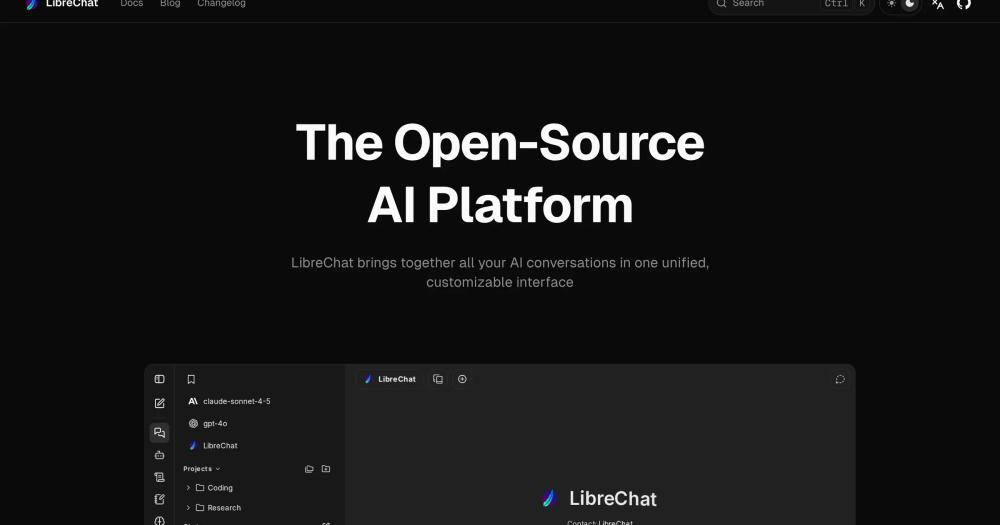
Connect all your AI providers in one self-hosted chat interface, with agents, MCP, code execution, and enterprise authentication built in.

Visit websiteGitHub46.1K starsDeploy on Hostinger
image of LibreChat
TL;DR

LibreChat is a self-hosted AI chat tool that connects Anthropic Claude, OpenAI, Google Gemini, DeepSeek, AWS Bedrock, and 30+ other providers through a single MIT-licensed interface. It replaces paid AI chat services like ChatGPT and Claude.ai with a deployment you control, using your own API keys and no per-seat fees. Agents, MCP tool connections, a sandboxed code interpreter, web search, and enterprise authentication (SSO, SAML, LDAP) are all included. Best for privacy-focused teams, multi-model power users, and organizations that need fine-grained user access controls.

Read the full breakdownHide the full breakdownWho it is for, how it works, trade-offs, the quick start and the FAQ
who it's for

Who LibreChat is for#

Privacy-focused teams handling sensitive data

Organizations under regulatory constraints or NDA-heavy workflows get full conversation ownership: all history stays on your infrastructure under your data policies, with no vendor retention. You choose which providers to connect and can restrict users to private-endpoint models only.

Skip if:

Your team is comfortable with vendor data storage terms and prefers a managed service with no self-hosting overhead.

Developers evaluating multiple AI models for a project

LibreChat lets you run the same prompt against Claude, GPT, Gemini, and DeepSeek in parallel sessions and compare outputs in a unified interface. Conversation forking lets you branch a thread to test different follow-ups without rebuilding your context.

Skip if:

You only use one model provider and have no need to compare outputs across vendors.

Enterprises deploying AI access to internal teams

The admin panel controls which users and groups can access which models, sets token spend limits, and manages SSO through SAML or LDAP. Agents and presets share org-wide, giving everyone a consistent starting point without per-user manual configuration.

Skip if:

Your team is fewer than five people. The setup complexity pays off once you have multiple users with different access needs.

AI power users building agent workflows

MCP support connects agents to external tools, file systems, and APIs. Skills bundle reusable instruction sets that agents invoke on demand. The attached code workspace lets agents inspect, edit, and run code in a managed environment without leaving the chat session.

Skip if:

You need a simple one-model chat interface. The agent and MCP features add configuration overhead that straightforward chat use does not require.

the problem

The problem it solves#

Most teams working with multiple AI models end up managing a separate tab for each provider. ChatGPT in one window, Claude in another, Gemini in a third. Conversation history stays siloed per service, files have to be re-uploaded for each provider, and there is no way to compare model responses or share a conversation across a team. Per-seat subscriptions stack quickly once a team needs access to more than one frontier model.

The deeper pain is data control. Commercial AI chat services store conversation history on vendor infrastructure under vendor data policies, with limited export options. Teams handling confidential client work, internal knowledge, or regulated data cannot simply accept those terms, but building a custom multi-provider chat interface from scratch is weeks of engineering.

how LibreChat solves it

How it solves it#

Multi-Provider Model Routing

Connects Anthropic, OpenAI, Google, AWS Bedrock, Azure, Groq, Mistral, DeepSeek, Ollama, and any OpenAI-compatible endpoint. API keys configure per provider; model access assigns per user or group. Switching between models happens mid-conversation without losing context.

Sandboxed Code Interpreter

Executes code in Python, Node.js, Go, C/C++, Java, PHP, Rust, and Fortran inside an isolated environment. File uploads process directly in the sandbox, so you can run data analysis, generate plots, or process documents without leaving the chat. No external service required when self-hosting.

AI Agents with MCP Support

Custom agents combine model instructions, tool access, file search, and code execution into reusable workflows. Model Context Protocol support lets agents connect to any external tool or service. Agents are shareable across users and discoverable through a deployment marketplace.

Web Search with Reranking

Gives any connected model live internet access by combining search providers, content scrapers, and configurable Jina rerankers. Results inject into the model context without leaving the LibreChat interface, and the feature works across all configured AI providers.

Code Artifacts and Generative UI

Renders React components, HTML pages, and Mermaid diagrams directly in the chat window. Mermaid diagrams export as SVG or PNG. Full-screen preview lets you interact with rendered output without opening a separate tool.

Enterprise Authentication

Ships with OAuth2, SAML, LDAP, OpenID, and two-factor authentication. The bundled admin panel manages users, groups, roles, and permission overrides from a browser UI without redeploying the server. Token spend limits and built-in moderation tools are included.

strengths · trade-offs

Strengths and trade-offs#

Strengths

  • MIT license with no usage restrictionsThe MIT license means you can deploy LibreChat commercially, modify the codebase, and run it for unlimited users with no licensing fees. You pay only for API calls to the model providers you connect, with no markup or subscription overhead.
  • Unified conversation history across all providersEvery conversation, regardless of which model generated it, lives in your own database. Full-text search spans all providers at once, and export works in multiple formats including JSON, markdown, and plain text.
  • Active codebase with 43,000+ GitHub starsThe repository received a push on 2026-09-15 and has shipped major features including MCP support, a code interpreter, and agent workspaces in recent releases. 411 contributors and 52.7 million Docker pulls indicate a production-grade install base.
  • Bring-your-own-API-key modelNo markup on API calls. You connect directly to Anthropic, OpenAI, Google, or any compatible endpoint using your own credentials, paying provider pricing without an intermediary. Local models via Ollama run at zero API cost.

Trade-offs

  • -You manage API keys and billing for each providerLibreChat does not bundle model access. You need an API account with each provider you want to use and must manage billing, rate limits, and key rotation yourself. Teams expecting a turnkey subscription service will need to set up provider accounts before the first conversation.
  • -Self-hosting carries operational overheadRunning LibreChat in production means maintaining a server, a MongoDB or PostgreSQL database, and optionally Redis for horizontal scaling. Version upgrades occasionally include breaking changes that require reviewing the changelog before updating.
  • -741 open GitHub issues at last checkThe active issue count reflects a fast-moving codebase. Some edge cases in less common provider configurations or authentication setups take time to resolve. Checking GitHub Issues before deploying an uncommon integration is worthwhile.
versus alternatives

LibreChat vs alternatives#

LibreChat vs ChatGPT

ChatGPT and LibreChat both offer a chat interface to frontier AI models. The key difference is control, provider selection, and deployment model.

FeatureLibreChatChatGPT
LicenseMITProprietary
Self-hostingYesNo
Model selection30+ providersOpenAI models only
PricingInfrastructure + API costs$20/month per user
Data ownershipYour infrastructureOpenAI servers
Enterprise authOAuth, SAML, LDAP, 2FASSO on Teams/Enterprise tiers

LibreChat is the better choice when you need multiple model providers in one interface, want conversation history on your own infrastructure, or need to avoid per-seat pricing for a larger team. ChatGPT is the better fit when you want a fully managed experience with no setup, need first-party OpenAI features on day one, or prefer not to maintain a server.

LibreChat vs Claude.ai

Claude.ai is Anthropic's managed chat interface for Claude models. LibreChat connects to Anthropic's API and gives you Claude access alongside every other provider.

FeatureLibreChatClaude.ai
LicenseMITProprietary
Self-hostingYesNo
Models availableAnthropic + 30 othersClaude only
Data storageYour databaseAnthropic servers
Agent supportYes (MCP, Skills, Subagents)Yes (Projects)
PricingAPI cost only$20/month per user

LibreChat is worth choosing when you need Claude access alongside GPT, Gemini, or DeepSeek in one conversation history, or when your organization requires data to stay on-premises. Claude.ai makes more sense when you want the managed Claude experience, first-party Projects and Artifacts support, or do not want to maintain your own infrastructure.

install · quick start

Quick start#

bash
Self-hosting uses Docker Compose with the official repository.

```bash
git clone https://github.com/danny-avila/LibreChat
cd LibreChat
docker compose up -d
```
tech stack · detected from GitHub

What it's built on#

Languages
JavaScriptTypeScript
Frameworks
ExpressReact
Databases
MongoDB
Infrastructure
AWSAzure
Search
Meilisearch
Cache
Redis
frequently asked

FAQ#

Does LibreChat cost anything to use?

LibreChat is MIT licensed and free to self-host. You pay for the infrastructure you run it on and for API calls to whichever model providers you connect. There is no per-seat fee or platform subscription. Your costs are server and API usage only.

Can I use LibreChat with local AI models?

Yes. LibreChat connects to Ollama and other local model servers through its custom endpoints configuration. You can run entirely offline with no external API calls, or mix local and cloud providers in the same installation. Local models via Ollama run at zero API cost.

How do I install LibreChat?

The primary path is Docker Compose. The official repository includes a Docker Compose file that starts the app, database, and optional services together. Railway, Zeabur, and Sealos offer one-click deployment templates if you prefer managed infrastructure. The quickstart guide at docs.librechat.ai covers both paths.

Is LibreChat suitable for teams, or only single-user installs?

LibreChat supports multi-user deployments with role-based access, group permissions, and enterprise authentication (OAuth, SAML, LDAP, 2FA). The admin panel manages users and model access without redeploying. The project is designed for team and organizational use, not just individual installs.

What databases does LibreChat require?

LibreChat uses MongoDB by default for conversation and user storage. PostgreSQL is also supported. Redis is optional but recommended for horizontally scaled deployments, and it enables resumable stream support across multiple server instances.

also worth a look

Similar open-source tools#

ODS

Alternative toChatGPT

Turn any computer into a private AI server

  • 7,601 GitHub stars
  • Apache-2.0Licence Apache-2.0

scientific-agent-skills

Alternative toClaude Science

AI-driven research automation for complex tasks

  • 53,235 GitHub stars
  • MITLicence MIT

Local Deep Research

Alternative toPerplexity AI

Your AI research assistant, fully local and encrypted.

  • 9,372 GitHub stars
  • MITLicence MIT

GenericAgent

Alternative toSai by Simular

Autonomous agent that evolves skills over time

  • 14,331 GitHub stars
  • MITLicence MIT

Thunderbolt

Alternative toChatGPT

Control your AI infrastructure with Thunderbolt

  • 4,799 GitHub stars
  • MPL-2.0Licence MPL-2.0

Jan

Alternative toChatGPT

Run open source LLMs on your own hardware with no cloud required

  • 45,019 GitHub stars
  • Apache-2.0Licence Apache-2.0
by category

Open source tools in these categories#

404

AI & Machine Learning

freeCodeCamp, OpenClaw, REA (Reverse Engineer Anything)
462

Developer Tools

REA (Reverse Engineer Anything), superpowers, Skills for Real Engineers
126

Communication & Collaboration

iptv, freeCodeCamp, Excalidraw
Hostinger

Run LibreChat on your own server

Self-host LibreChat on a Hostinger VPS.

Deploy on Hostinger

Featured

rakazo

Alternative toGrok Bot

AI teammates you own: your keys, your model, your machine.

  • 4,904 GitHub stars
  • Apache-2.0Licence Apache-2.0
  • #AI Agents

Omnara

Alternative toCClaude Managed Agents

Open-source agent deployment API. Self-host or use Omnara Cloud.

  • 2,957 GitHub stars
  • Apache-2.0Licence Apache-2.0
  • #AI Agents

Inbox Zero

Alternative toSuperhuman

AI email assistant that drafts replies and clears your inbox

  • 12,712 GitHub stars
  • AGPL-3.0Licence AGPL-3.0
  • #Email
Feature your project

New open source projects by email

The projects we add and every new guide. Free, unsubscribe any time.

Find open source alternatives to paid software

/
  • Claude Code to OpenCode
  • Jira to Windshift
  • Notion to AppFlowy
  • Slack to Mattermost
  • Linear to GitLab
  • Wispr Flow to Handy
  • CapCut to Concat
  • Grok Bot to rakazo
  • Superhuman to Inbox Zero
  • Airtable to AITable
  • Muse to OpenClaw
  • GitHub Copilot to Cline
  • Datadog to Netdata
  • Microsoft Teams to Rocket.Chat
  • Pinecone to Qdrant
  • Zapier to n8n
  • Devin AI to OpenHands
  • Firebase to Supabase
  • 1Password to KeePassXC
  • Confluence to Docmost
  • Contentful to Strapi
  • Adobe Premiere Pro to Shotcut
  • ChatGPT to AnythingLLM
  • LangSmith to Langfuse