Open Source Alternatives
  • Alternatives
  • Categories
    Categories by size882 projects
    • Developer Tools461
    • AI & Machine Learning404
    • Web Development196
    • Business & Productivity191
    • Communication & Collaboration126
    • Security & Monitoring126
    • IT Management123
    • Product & Project Management106
    • Cloud & Hosting105
    • Data & Analytics104
    Browse all 21 categoriesLLMOps & AI Tooling, Design & Creative and 9 more
  • Blog
  • Advertise
SearchNotion, Slack, password manager.../
Submit
Open Source Alternatives
  • Alternatives
    • Developer Tools461
    • AI & Machine Learning404
    • Web Development196
    • Business & Productivity191
    • Communication & Collaboration126
    • Security & Monitoring126
    • Browse all 21 categories
  • Blog
  • Advertise
Submit your project

New open source projects by email

The projects we add and every new guide. Free, unsubscribe any time.

Open Source Alternatives LogoOpen Source Alternatives

Handpicked Open Source Alternatives to Paid Softwares

Product

  • Categories
  • Tag
  • Advertise

Resources

  • Blog
  • Collection
  • Submit

Company

  • Privacy Policy
  • Terms of Service
  • Refund Policy
  • Sitemap

Alternatives

  • Claude Code
  • Jira
  • Notion
  • Slack
  • Linear
  • Wispr Flow
  • All alternatives
© 2026 Open Source Alternatives. All rights reserved.
Open SourceAlternatives
Home/Categories/APIs & Integration/Hoppscotch
icon of Hoppscotch

Hoppscotch

Open source alternative to Postman and Insomnia

  • 80.7K stars
  • MIT
  • Active this week
  • Last commit 2 days ago

Last verified Oct 20, 2026

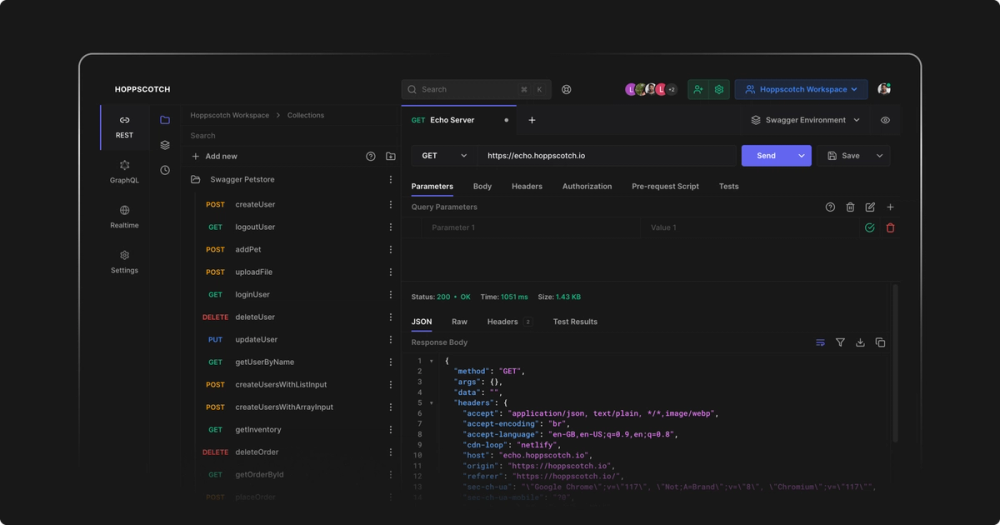
Manage API testing across REST, GraphQL, WebSocket, and MQTT with a self-hosted MIT-licensed Postman alternative that keeps requests on your infrastructure.

Visit websiteGitHub80.7K stars1-click deploy on Hostinger
image of Hoppscotch
TL;DR

Hoppscotch is an open source Postman alternative for API testing across REST, GraphQL, WebSocket, and MQTT, replacing paid clients with a MIT-licensed Docker-based self-hosted workflow on your own infrastructure.

Read the full breakdownHide the full breakdownWho it is for, how it works, trade-offs, the quick start and the FAQ
who it's for

Who Hoppscotch is for#

API QA engineer

Use Hoppscotch for fast regression calls across REST and GraphQL endpoints when validating feature changes before deployment.

Skip if:

Skip if your team already requires built-in SSO and deep governance templates from a hosted platform.

Backend team for real-time APIs

Use the WebSocket and MQTT clients to test live channels and event payload formats during integration work.

Skip if:

Skip if your stack only uses request-response HTTP and has no event streams.

Independent contractor building microservices

Use Hoppscotch as a lightweight, browser-accessible toolkit for testing client and service APIs while moving between projects.

Skip if:

Skip if you need native desktop-only integrations that are outside browser-based workflows.

Small dev team lead

Use self-hosted workspaces to keep API collections, auth settings, and request history in one repository-sized workflow for your whole team.

Skip if:

Skip if your team already uses another enterprise API portal as the single source of truth for API contracts.

the problem

The problem it solves#

API teams using Postman or similar paid clients often pay for the full package, not just core request testing, once they add collection sharing, workspace history, and team sync. The result is recurring cost, hidden portability risk, and workflow lock-in. Hoppscotch targets teams that need fast request debugging and reusable API collections without giving up control of test data and history. It also helps solo developers who want an API client that can keep pace across REST and WebSocket-style tools in one place without adding new subscriptions.

how Hoppscotch solves it

How it solves it#

Protocol coverage

Supports HTTP/REST, GraphQL, WebSocket, MQTT, Socket.IO, and Server-Sent Events from one request composer. This avoids context switching when debugging mixed backends or event-driven APIs.

Workspace and history model

Stores collections, environments, and response history in self-hosted project state with role-aware workspace sharing. That gives teams the same starting point for collaboration, plus local control over team data.

Code and import flexibility

Exports request examples as curl and language snippets, and imports files or GitHub gists. This helps teams keep API examples close to implementation workflows and documentation pipelines.

Cross-device access

Offers desktop and browser entry points plus browser-based testing that works quickly on lightweight laptops. Teams can use the web app during incident work without installing a native client on every machine.

Self-hosting path

Uses a Docker deployment option with a preset compose profile and migration step, including backend services and a database option. That lets operations teams run it on managed cloud or private infrastructure.

strengths · trade-offs

Strengths and trade-offs#

Strengths

  • Open source with MIT termsThe core web and desktop tools are MIT, so teams can run the code in their own stack, review behavior, and adjust deployment if needed. This lowers operational risk when compliance requires vendor control.
  • Protocol-first API testingFew API clients bundle REST, GraphQL, WebSocket, and event-stream tools together with a single interface. Hoppscotch works where API stacks mix sync and real-time traffic, reducing tool fatigue.
  • Browser-first speedFast startup and a lightweight interface helps engineers run ad-hoc tests during incidents. You get immediate request execution and response inspection without waiting on heavyweight startup flows.

Trade-offs

  • -Feature tradeoff in enterprise controlsAudit logs, advanced access controls, and some governance controls are in the enterprise self-hosted path. If your team needs strict role policies and advanced compliance reporting, those capabilities may require paid extensions.
  • -Operational dependency for full stackA production self-hosted setup is easiest with Docker, Postgres, and basic ops routines for upgrades. Teams wanting zero-maintenance SaaS behavior need to account for patching and service uptime.
  • -Team management maturityBasic sharing is available, but organizations needing enterprise-grade identity federation may need extra provisioning work. In these cases, dedicated enterprise support can reduce setup friction.
versus alternatives

Hoppscotch vs alternatives#

Hoppscotch vs Postman and Insomnia

Postman, Insomnia, and Hoppscotch target the same API testing workflows, so the main decision is deployment control versus managed convenience. Postman delivers a large managed ecosystem with polished enterprise admin features, but much of team collaboration and sync sits in Postman's cloud domain. Insomnia is strong for desktop API development with a clean local client flow, yet many teams still use it in parallel for WebSocket or streaming cases.

ToolHosting modelCollaboration modelBest fit
PostmanManaged SaaS + paid plans for most advanced team controlsStrong managed workspace and governance defaultsTeams that want zero infra operations
InsomniaMixed client focus with commercial tiersDesktop-first workflows with local and cloud blendDevelopers preferring a native app-centric flow
HoppscotchMIT self-hosted option with Docker profileBrowser-first collaboration with self-hosted workspace scopeTeams needing local control and protocol breadth

Choose Hoppscotch when your priority is self-hosted data ownership, faster protocol coverage in one tool, and lower lock-in for request and collection data. Choose Postman or Insomnia if you need managed account orchestration and polished enterprise controls with minimal infrastructure overhead.

install · quick start

Quick start#

bash
# Clone the repository

git clone https://github.com/hoppscotch/hoppscotch.git
cd hoppscotch

# Prepare local environment
cp .env.example .env

# Start Hoppscotch with Docker Compose
docker compose --profile default up
tech stack · detected from GitHub

What it's built on#

Languages
JavaScriptRustTypeScript
Frameworks
ExpressNestJSVue
Databases
PostgreSQL
Messaging
WebSocket
Tooling
GraphQLRollup
frequently asked

FAQ#

Can I self-host Hoppscotch?

Yes. Use the official Docker compose profiles from the repository. The default profile starts the all-in-one service plus database and migration handling, while the default-no-db profile supports external database setups.

How does Hoppscotch compare to Postman?

Postman has a broad ecosystem, but it can route your work through its own collaboration and account flows. Hoppscotch gives you self-hosted ownership for collections and history while covering the same core testing protocols in most workflows.

Can I test event and streaming APIs with Hoppscotch?

Yes. Hoppscotch includes WebSocket, MQTT, Socket.IO, and Server-Sent Events support in the same request panel so you can validate both sync and streaming APIs without opening a second tool.

Which paid option is closest to Hoppscotch?

Postman remains the most common paid replacement for teams moving from familiar workspace workflows, while Insomnia offers a different desktop-first developer experience. If you want browser-first testing with strict self-hosted control, Hoppscotch is the clearer fit for many teams.

also worth a look

Similar open-source tools#

Echolon

Alternative toPostman

Local-first API client for HTTP, REST, and GraphQL

  • 58 GitHub stars
  • MITLicence MIT

Yaak

Alternative toPostman

Local-first API client for HTTP, GraphQL, and WebSocket

  • 19,338 GitHub stars
  • MITLicence MIT

Octrafic

Alternative toPostman

AI-powered CLI for automated API testing with natural language

  • 35 GitHub stars
  • MITLicence MIT

Keploy

Alternative toPostman

AI-powered tool that converts API traffic into test cases

  • 18,658 GitHub stars
  • Apache-2.0Licence Apache-2.0

servers

Alternative toComposio

Open reference servers for connecting AI to external tools and data

  • 91,470 GitHub stars
  • CustomLicence Apache-2.0 and MIT (dual, transitioning)

jsreport

Alternative toStimulsoft Reports.JS

JavaScript report server with PDF, Excel, DOCX, and HTML output

  • 1,322 GitHub stars
  • LGPL-3.0Licence LGPL-3.0
by category

Open source tools in these categories#

78

APIs & Integration

n8n, Firecrawl, iptv
462

Developer Tools

REA (Reverse Engineer Anything), superpowers, Skills for Real Engineers
196

Web Development

freeCodeCamp, superpowers, Skills for Real Engineers
Hostinger

Run Hoppscotch on your own server

Hostinger sets Hoppscotch up as a one-click app on a VPS.

Deploy on Hostinger

Featured

Inbox Zero

Alternative toSuperhuman

AI email assistant that drafts replies and clears your inbox

  • 12,712 GitHub stars
  • AGPL-3.0Licence AGPL-3.0
  • #Email

rakazo

Alternative toGrok Bot

AI teammates you own: your keys, your model, your machine.

  • 4,904 GitHub stars
  • Apache-2.0Licence Apache-2.0
  • #AI Agents

Omnara

Alternative toCClaude Managed Agents

Open-source agent deployment API. Self-host or use Omnara Cloud.

  • 2,957 GitHub stars
  • Apache-2.0Licence Apache-2.0
  • #AI Agents
Feature your project

New open source projects by email

The projects we add and every new guide. Free, unsubscribe any time.

Find open source alternatives to paid software

/
  • Claude Code to OpenCode
  • Jira to Windshift
  • Notion to AppFlowy
  • Slack to Mattermost
  • Linear to GitLab
  • Wispr Flow to Handy
  • CapCut to Concat
  • Grok Bot to rakazo
  • Superhuman to Inbox Zero
  • Airtable to AITable
  • Muse to OpenClaw
  • GitHub Copilot to Cline
  • Datadog to Netdata
  • Microsoft Teams to Rocket.Chat
  • Pinecone to Qdrant
  • Zapier to n8n
  • Devin AI to OpenHands
  • Firebase to Supabase
  • 1Password to KeePassXC
  • Confluence to Docmost
  • Contentful to Strapi
  • Adobe Premiere Pro to Shotcut
  • ChatGPT to AnythingLLM
  • LangSmith to Langfuse